


If you have ever paused mid sentence wondering whether to write trek or treck, you are not alone. This tiny spelling question trips up a lot of writers, travelers, and students because the words sound almost identical when spoken out loud. The good news is that the answer is simple once you know the rule, and this guide will walk you through everything so you never second guess it again.
Quick Answer: Trek or Treck?
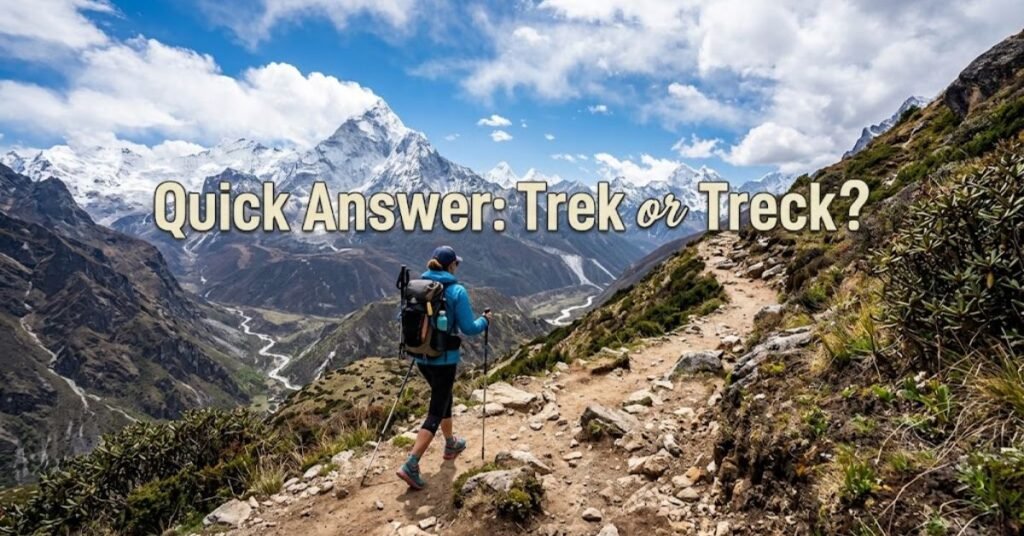
The correct spelling is trek. It is the only version recognized in standard English dictionaries, and it is the one you will find in books, articles, travel blogs, and everyday conversation. Treck is simply a misspelling, even though it looks like it could be right.
People often add that extra “c” because it feels natural in English, similar to words like “check” or “deck.” But trek does not follow that pattern, and adding the letter creates a spelling mistake rather than an alternate accepted form. So whenever you are describing a long journey or a challenging hike, stick with trek.
Why People Confuse Trek And Treck
The confusion mostly comes down to sound. Since trek and treck are pronounced the exact same way, our brains sometimes assume there must be two acceptable spellings, especially when we see the word typed differently by different people online. This kind of pronunciation based spelling confusion happens with a lot of English words.
Another reason is pattern matching. English has plenty of words ending in “-eck,” so it feels instinctive to tack on that extra letter. Add in the fact that treck shows up in casual texts, social media captions, and even some low quality articles, and it starts to look more legitimate than it actually is.
Finally, autocorrect does not always catch it, especially on mobile keyboards, which lets the typing error slip through unnoticed. Once you spot the pattern though, it becomes much easier to catch yourself before hitting send.
What Does Trek Mean?
Trek refers to a long, often difficult journey, usually made on foot. It carries a sense of effort and distance, which is why it is so commonly used for hiking trips, mountain expeditions, and other physically demanding travel. The word works well in both casual chats and more professional writing.
Trek As A Noun
As a noun, trek describes the journey itself. You might say someone completed a “three-day trek” through the mountains or a “five-mile trek” across rough terrain. It usually implies the trip required real effort, not just a quick stroll down the street.
Trek As A Verb
As a verb, trek describes the act of making that journey. For example, “they trekked across the desert” or “we plan to trek through the forest next spring.” The verb form works smoothly in both past and present tense, and it fits naturally into travel writing and adventure stories.
What Does Treck Mean?
Here is the straightforward truth: treck has no meaning in standard English. It is not listed in any major dictionary, and it does not have an accepted dictionary definition. It is simply an incorrect variation of trek that has spread through casual typing habits.
You might occasionally see it used as a name, a username, or a stylized brand spelling, but as an everyday English word, it does not exist. If you come across it in an article or caption, it is almost always a spelling mistake rather than an intentional or valid alternative.
Meaning And Usage Difference
Since treck is not a real word, there technically is not a meaning difference to compare, only a usage difference in the sense that one is correct and one is not. Trek carries all the weight of describing a long or challenging journey, while treck carries no accepted meaning at all.
This matters more than it might seem, especially in written content. Using the wrong spelling can quietly hurt your credibility, whether you are writing a travel blog, a school essay, or a professional report. Readers may not always consciously notice, but small spelling mistakes like this can affect how trustworthy your writing feels.
Tone, Context, And Formality
Trek is considered a neutral word, which means it fits comfortably into both casual context and formal context writing. You can use it in a relaxed text message to a friend, and it will also sound perfectly natural in edited writing like a magazine feature or a company travel guide.
Because it works everywhere, trek is a safe and reliable choice no matter who you are writing for. Treck, on the other hand, has no place in formal writing at all, since it is not a recognized word. Even in casual writing, using it can come across as a simple typo rather than a stylistic choice.
Which One Should You Use?
This one is easy. Always use trek. There is no situation, whether formal, casual, academic, or conversational, where treck is the appropriate choice. If you are ever unsure while writing quickly, a good memory trick is to think of “trek” like “trip,” since both start with “tr” and both describe travel.
If your keyboard or autocorrect suggests treck, or if you type it out of habit, take a second to fix it before publishing or sending. It is a small fix, but it keeps your writing accurate and polished.
When One Choice Sounds Wrong
There really is not a scenario where treck sounds “right” once you know it is not an actual word. However, people sometimes hesitate because they have seen it used somewhere online, like in a comment section or an unofficial blog post. If a source is not a trusted dictionary or major publication, it is best to assume the spelling is unreliable.
If you ever see trek and treck used interchangeably in the same article, that is usually a red flag that the content was not carefully edited. Reliable, well researched writing will always default to the standard spelling, trek, without exception.
Common Mistakes And Quick Fixes
Even though the rule is simple, a few patterns keep showing up again and again. Knowing these common slip ups can help you catch them faster in your own writing.
Mistake 1: Adding Extra Letters
The most frequent issue is simply adding that extra “c,” turning trek into treck. This usually happens out of habit or a rushed typing moment. The fix is easy: whenever you type the word, do a quick mental check and make sure it only has one syllable’s worth of letters, “t-r-e-k.”
Mistake 2: Misspelling The Verb Form
Some writers also stumble on the verb form, especially when adding “-ed” or “-ing.” The correct forms are “trekked” and “trekking,” with the consonant doubled. Writing “treked” or “treking” is another common spelling mistake that can slip past a quick read.
Mistake 3: Confusing Trek With Similar Travel Words
Trek sometimes gets mixed up with other similar travel words like “track” or “trek’s” close cousin, “trip.” While these words relate to travel and movement, they are not interchangeable. A trek specifically implies a long or difficult journey, while a trip can be short and easy, and a track refers to a path or route rather than the act of traveling itself.
Everyday Examples
Seeing the word in action can make the correct usage stick much better than just reading the rule.
Travel Examples
“Our trek through Southeast Asia lasted almost a month.” “She trekked across three countries before settling down for the winter.” These examples show trek used naturally in a travel writing context, describing longer, more involved journeys.
Outdoor Examples
“The group finished their mountain trek just before sunset.” “Hikers often trek through the valley to reach the base camp.” These sentences highlight how trek fits perfectly into outdoor adventure and hiking trail descriptions, especially when the terrain is rough or the distance is significant.
Conversation Examples
“That trek to the grocery store in this heat felt endless.” “Getting to the office today was a total trek with all that traffic.” Notice how trek can even be used humorously in everyday conversation to describe something that simply felt like a long, tiring journey, even if it technically was not one.
Dictionary-Style Word Details
For readers who want a more structured breakdown, here is a closer look at trek from a dictionary style angle.
Verb
To trek means to travel or move slowly and with difficulty, often over a long distance. It is commonly used for foot travel across challenging terrain, though it can be stretched informally to describe any tiring journey, even a short one through heavy traffic or a crowded city.
Noun
As a noun, a trek is the long or arduous journey itself. It can refer to a physical hiking expedition, a historical migration, or even a weekend trek with friends. The noun form is widely used in adventure vocabulary and outdoor writing.
Synonyms
Trek
Common synonyms for trek include journey, expedition, hike, trip, and trudge. Depending on context, words like “voyage” or “odyssey” can also work, especially when describing something particularly long or memorable.
Treck
Since treck is not a real word, it has no official synonyms. Any list claiming otherwise is simply treating the misspelling as if it were valid, which it is not.
Example Sentences
Trek
“They trekked through the jungle for five days straight.” “Our next trek will take us across the Sahara desert.” “Trekking through the Himalayas remains one of the most unforgettable treks for many travelers.”
Treck
There are no correct example sentences for treck, since it is not an accepted English word. Any sentence using it should simply be corrected to trek instead.
Word History
Trek comes from Afrikaans, borrowed originally from Dutch, where it referred to pulling or hauling, often connected to wagon travel across long distances. Over time, English adopted the word to describe any long, difficult overland journey, and it eventually expanded into more casual, everyday usage as well.
This origin explains why trek carries such a strong sense of effort and distance. It was never meant to describe a quick or easy outing, and that meaning has largely stuck around even as the word became more common in modern English vocabulary.
Phrases Containing
Trek
Phrases like “long trek,” “desert trek,” “cross country trek,” and “trek across” all show up frequently in travel and outdoor writing. These combinations naturally reinforce the sense of distance and challenge tied to the word.
Treck
Because treck is not standard English, it does not appear in legitimate phrases or established expressions. Any phrase using it should be treated as an error rather than a stylistic variation.
FAQs
Is trek or treck correct?
Trek is the correct spelling. Treck is a common misspelling and is not recognized in any standard dictionary.
Is trek a real word?
Yes, trek is a real, widely used English word functioning as both a noun and a verb, most often describing a long or difficult journey.
Can trek be used as a verb?
Absolutely. You can say someone “trekked” somewhere, and the present tense form is “trekking,” with both forms doubling the final consonant.
What is the difference between trek and hike?
A hike usually refers to a walk on trails, often for recreation, while a trek tends to imply a longer, more demanding journey that may span multiple days. All hikes are not treks, but many treks do involve hiking.
How do you spell trekked?
The correct spelling is “trekked,” with two k’s, following the standard rule of doubling the final consonant before adding “-ed.”
Conclusion
At the end of the day, this comparison is not really much of a debate. Trek is the correct, dictionary approved spelling, while treck is simply a spelling mistake that slipped into casual use. Whether you are writing about a mountain expedition, a desert crossing, or just a long day of errands that felt like an adventure, trek is always the word you want.
Keeping your spelling accurate might seem like a small detail, but it adds up when it comes to clear, credible, and polished writing. Now that you know the difference, you can write with confidence every time this word comes up.

Arthur Whitmore is a passionate grammar enthusiast and language writer at Hexobrust.com. He creates clear, helpful content on grammar, spelling, and everyday English to make learning simple and enjoyable.
