

Steer is the correct word. Stear is not a real word in modern English, no matter how often people type it that way.
If you’re texting a friend or writing a report, stick with steer. It works as both a verb and a noun, and every major dictionary backs it up.
Has Anyone Heard of “Steer,” “Stere,” or “Stear”?
Type “stear” into a search bar and you’ll notice something odd. Google quietly nudges you toward steer, almost like it’s correcting a typo before you even ask.
That’s because stear isn’t sitting in any respected dictionary. You might also stumble across stere, a rare unit used to measure a cubic meter of wood, but that’s a completely different word with nothing to do with vehicle control.
So why does this confusion even exist? Blame it partly on how our ears process sound and partly on old, forgotten spelling habits that never made it into standard English.
Steer vs. Stear: Which Is Correct?
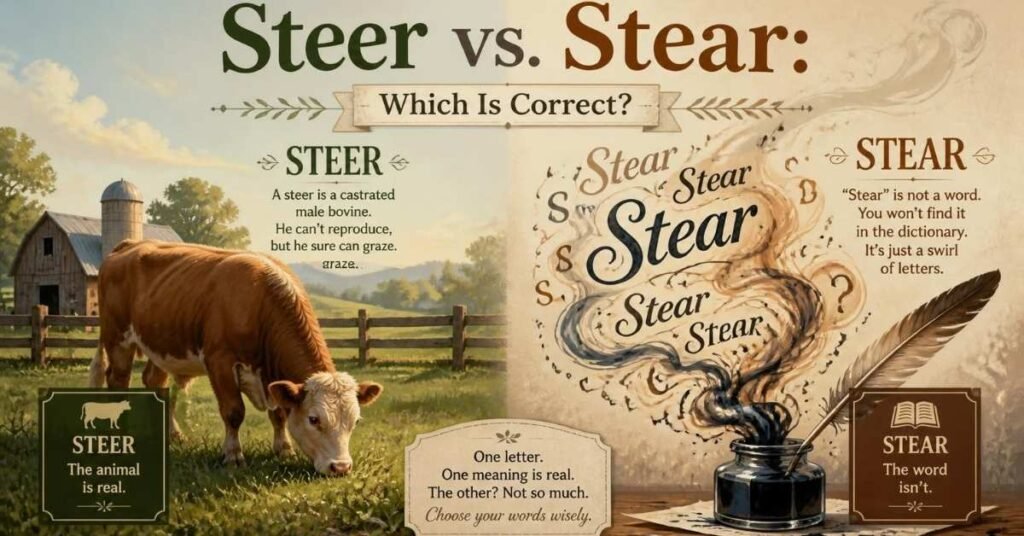
Here’s the short version: steer wins, every single time. Stear shows up now and then in old manuscripts or as a surname, but it has no place in your grammar toolkit today.
Writers, students, and professionals should treat stear as a spelling mistake, not a stylistic choice. Autocorrect agrees, and so does every credible style guide out there.
Think of it like the difference between “definately” and “definitely.” One looks close enough to trick your brain, but only one survives a spell check.
What Does “Steer” Mean?

Steer carries more weight than people realize. It’s not just about turning a wheel. It touches driving, boating, business talk, and even farming.
Depending on the sentence, it can act as a verb describing an action or a noun naming a specific animal. Let’s break both down so there’s zero confusion left.
As a Verb
As a verb, steer means to guide or direct the movement of something. You steer a car around a pothole. You steer a conversation away from an awkward topic.
- She steered the truck carefully through the storm.
- He steered the discussion back to the budget.
- The captain steered the ship into the harbor.
Notice how steer works just as well for a physical object as it does for something abstract, like a meeting or a plan.
As a Noun
As a noun, steer refers to a castrated male cow raised specifically for beef production. Farmers and ranchers use this term constantly, especially around livestock auctions.
- The farmer sold three steers at the auction last week.
- Steers graze in that field every morning.
So yes, one small word covers both a driving maneuver and a farm animal. English loves doing that.
What Does “Stear” Mean?
Honestly? Nothing, at least not in contemporary writing. Stear doesn’t appear as an entry in the Oxford English Dictionary (OED) or Merriam-Webster.
You might spot it as a last name, like the actress Jessica Stear, or buried in some historical texts where spelling wasn’t standardized yet. Centuries ago, English spelling was a bit of a free-for-all before dictionaries locked things down.
But for anyone writing today, whether it’s an email, a blog post, or a school essay, stear simply isn’t an option. Treat it as an obsolete spelling at best.
Steer vs. Stear: The Main Difference
The gap between these two words isn’t about meaning. It’s about legitimacy. Steer is real, useful, and everywhere. Stear is a misspelling dressed up to look convincing.
One key difference comes down to a classic letter combination mix-up: the “ee” spelling pattern versus the “ea” spelling pattern. English is full of words where these two combos sound nearly identical but mean totally different things.
Compare hear and here, or fear and fair. The sound tricks your ear, but only careful reading catches the trap.
Why Do People Confuse Steer and Stear?
Blame pronunciation similarity. Both words sound almost the same out loud, which makes them feel like homophones even though only one is technically real.
Add in similar sounding words like clear, wear, and hear, and your brain starts guessing at patterns instead of checking facts. It’s a shortcut that usually works, until it doesn’t.
There’s also the influence of regional dialects. Some accents blur vowel sounds together, making steer and stear feel interchangeable even though only one belongs in academic writing or business writing.
Common Mistakes
Let’s get specific, because vague warnings don’t help anyone fix their writing. Here are the exact spots where people slip up most often.
Incorrect
- “Can you stear the boat toward the dock?”
- “He stears his team through tough decisions.”
- “I need to stear this car into the garage.”
Correct
- “Can you steer the boat toward the dock?”
- “He steers his team through tough decisions.”
- “I need to steer this car into the garage.”
Notice the pattern? Swap that “ea” for “ee” and suddenly the sentence looks professional instead of shaky.
How to Remember the Correct Spelling
Here’s a memory trick that actually sticks. Picture a steering wheel. Both words start with “st” and end similarly, but “steer” has that double “ee,” just like “wheel” has a double “ee.”
Another trick: think of hear, fear, and clear. Wait, those use “ea,” and they’re all real words too. So instead, anchor your memory to cheer, deer, and peer. Those all follow the “ee” pattern, just like steer.
- Steer rhymes with cheer, deer, and peer.
- All of them use the double “ee” pattern.
- If you can spell “cheer,” you can spell “steer.”
Simple visual cues like this beat memorizing grammar rules any day.
Steer in Everyday English
Steer doesn’t stay in one lane. It shows up across totally different corners of daily life, from wet roads to heavy traffic to boardroom meetings.
Understanding these contexts helps you use the word naturally, without sounding like you memorized it from a textbook.
Driving
Behind the wheel, steer describes controlling your vehicle steering through traffic, curves, or tricky weather. Every driver deals with this daily, whether it’s a car, a truck, or even a bicycle.
- She steered carefully around the fallen branch.
- He steered the truck through the narrow alley.
Boating
Out on the water, a captain steers the ship using a wheel or a rudder, guiding it safely into a harbor. Navigation depends entirely on smooth, controlled steering.
- The crew steered the boat away from the rocks.
- Sailing requires constant small adjustments to steer straight.
Leadership
In offices and boardrooms, people steer conversations, projects, or entire companies. This figurative use shows up constantly in management and company direction discussions.
- The CEO steered the company through a rough quarter.
- She steered the meeting back on track after the interruption.
Is Stear Ever Correct?
Rarely, and only in narrow situations. As a surname, Stear is completely valid. Plenty of real people carry that last name proudly.
It also pops up occasionally in dialectal language or old regional writing, tied to language history rather than current usage. But none of that gives it a pass in modern writing.
If you’re writing anything meant for online publishing, school, or work, treat stear as off-limits. Save it for names only.
Steer vs. Stear Examples
Seeing both words side by side in full sentences makes the difference crystal clear. Here’s a quick grammar comparison to lock it in.
- Correct: The driver steered smoothly despite the rain.
- Incorrect: The driver steared smoothly despite the rain.
- Correct: Investors want leadership that can steer through uncertainty.
- Incorrect: Investors want leadership that can stear through uncertainty.
- Correct: The rancher raised the steer for nearly two years.
- Incorrect: The rancher raised the stear for nearly two years.
Every single incorrect version fails a basic spell check, which tells you everything you need to know.
Steer vs. Stear in American and British English
Here’s something that surprises people. This isn’t a case of American English versus British usage, like “color” versus “colour.” Steer stays identical on both sides of the Atlantic.
English dictionaries in the US and UK agree completely here. There’s no regional variant, no accepted spelling difference, and no exception carved out for British writers.
So unlike words that shift depending on where you live, steer remains one of those rare constants across international English usage.
Steer and Its Word Family
Beyond the base word, steer branches into a few related forms worth knowing. Getting these right rounds out your grip on the whole word group.
Steered works as the past tense, describing something that already happened. Steering functions as the present participle, often paired with “wheel” or “committee.” Meanwhile, steers can either mean multiple cattle or describe what someone does right now, as in “he steers the ship.”
- Steered: “She steered the car into the driveway.”
- Steering: “He’s steering the project toward success.”
- Steers: “The company steers its strategy based on customer feedback.”
Getting comfortable with these variations makes your writing feel natural instead of stiff.
Why Correct Spelling Still Matters in 2026
Some people brush off small spelling errors as no big deal. But in business writing especially, a mistake like stears or steared can quietly chip away at your credibility.
Readers form snap judgments fast. A single spelling correction away from looking sloppy, one typo can shift how trustworthy your entire message feels, even if the content itself is solid.
That’s especially true for anyone publishing online. Search engines and readers both reward communication accuracy, and small details like steer versus stear add up over time.
Final Thoughts
At the end of the day, this comes down to one simple rule. Steer is correct, useful, and flexible enough to describe driving, sailing, leading, or raising cattle.Stear just isn’t part of standard language anymore, outside of names or rare historical mentions.
Once you lock in that “ee” pattern in your head, this mistake becomes easy to avoid for good.Language keeps shifting, but some rules hold steady. This is one of them.
FAQs
What’s the difference between steer and stear?
Steer is the only correct spelling in modern English. Stear is a misspelling, though it does exist as a surname.
Is stear a real word?
No, not as a standalone word in current dictionaries. It survives mainly as a last name or in old, regional spelling variations.
Is it steer or stear?
It’s always steer. Whether you’re driving, sailing, or talking about leadership, steer is the word you want.
How do you use steer in a sentence?
Use it as a verb to describe guiding something, like “She steered the car safely,” or as a noun for a young male cow raised for beef.
Is stear used in modern English?
Practically never, except as a surname. Contemporary writing and every respected style guide point exclusively to steer.

Arthur Whitmore is a passionate grammar enthusiast and language writer at Hexobrust.com. He creates clear, helpful content on grammar, spelling, and everyday English to make learning simple and enjoyable.
