


Both spellings are correct. Authorization is the standard in American English, while authorisation is the preferred form in British English. Neither one is a typo. They’re the same word, just dressed differently depending on which side of the Atlantic you’re writing for.
If you’ve ever stared at a form, a contract, or a login screen and wondered which version to use, you’re not alone. This guide breaks it all down so you never second guess yourself again.
Quick Answer
Here’s the short version before we get into the weeds. Authorization with a Z is used in the US, Canada (mostly), and a handful of other regions that follow American spelling conventions. Authorisation with an S is the go to for the UK, Australia, and most Commonwealth countries.
They mean exactly the same thing. There’s no legal meaning difference, no usage difference, and no hidden nuance between the two. It’s purely a matter of regional spelling and which style your audience expects.
So if someone tells you one spelling is “more correct,” they’re wrong. Pick based on your reader, not on some imaginary rulebook.
Which Spelling Is Correct, Authorisation or Authorization?
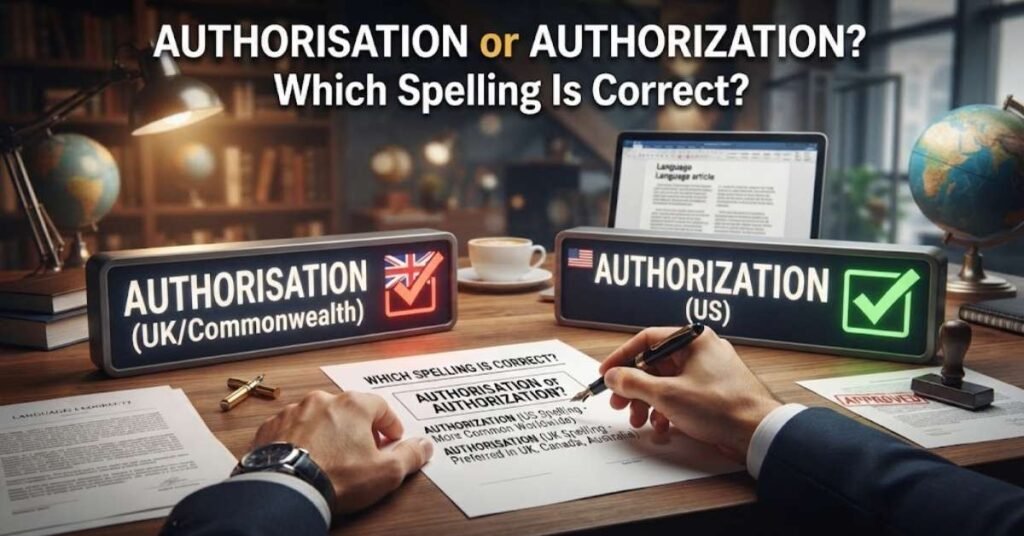
This question comes up constantly, and the honest answer is: both are correct spellings, just in different places. Think of it like “color” versus “colour.” Nobody’s failing an exam by choosing one over the other, as long as it fits their audience.
Authorization dominates in American English. Authorisation is the standard in British English. If you’re writing for a US based company, a Z spelling looks professional and expected. If your readers are in London or Sydney, the S version will feel more natural to them.
The real mistake isn’t picking the “wrong” one. It’s mixing them. Switching between authorization and authorisation in the same document looks sloppy, and readers notice even if they can’t explain why.
What Does Authorisation Mean?

At its core, authorisation means official permission to do something. It’s the act of granting authority to a person, system, or process to take a specific action. Someone with the right to make decisions gives the green light, and that green light is the authorisation.
You’ll see this word pop up everywhere. A manager signs off on an expenditure. A bank clears a payment. A hospital releases patient records after getting the proper sign off. Each of those is an example of authorisation in action.
It’s not just a formal, legal-sounding term either. You give your kid authorisation to stay out late. You give your assistant authorisation to book meetings on your behalf. The word scales from casual to highly official without changing meaning.
Is Authorisation with an S or Z?
Both. It depends entirely on which English variety you’re writing in. If you’re targeting a US audience, use the Z. If you’re targeting a UK, Australian, or most other Commonwealth audience, use the S.
Here’s a simple trick worth remembering: American English tends to favor Z in words that end in -ization, like organization, realization, and yes, authorization. British English often swaps that Z for an S, giving you organisation, realisation, and authorisation.
That said, British English isn’t 100% consistent here. Some UK style guides, including the Oxford spelling convention, actually prefer the Z ending even for British audiences. It’s a smaller detail, but worth knowing if you’re editing for a publisher that follows Oxford rules specifically.
What’s the Difference Between Authentication and Authorisation?
This one trips up a lot of people, especially in tech circles. Authentication answers the question “who are you?” Authorization answers a completely different question: “what are you allowed to do?”
Picture logging into your email. Typing your password and confirming your identity, maybe with a code sent to your phone, that’s authentication. Once you’re in, the system decides what you can actually see or change. That’s authorization.
In plain terms: authentication checks your ID at the door. Authorization decides which rooms you’re allowed to walk into once you’re inside. They work together, but they’re two separate steps doing two separate jobs.
Why People Confuse Them
Part of the confusion comes from how similar the words sound and look. Both start with “author,” both end in a long word full of syllables, and both show up in the same sentences constantly, especially in technology and security contexts.
Another reason? Software platforms often blur the line in casual language. You’ll hear developers say “auth” as shorthand for both authentication and authorization, which muddies the waters even more for people outside that world.
The fix is simple once you know it. Authentication is about proving identity. Authorization is about granting access permission. Keep that distinction in your head and the confusion mostly disappears.
Key Differences At A Glance
- Spelling region: Authorization (US), Authorisation (UK)
- Meaning: Identical in both cases, no difference in legal force
- Pronunciation: Same in both spellings
- Common contexts: Banking, medicine, legal documents, computer security
- Confused with: Authentication (a separate concept entirely)
- Verb form: Authorize (US) or Authorise (UK)
Meaning And Usage Difference
What Does Authorization Mean?
Authorization is the American spelling for granting official approval or permission. It shows up in business writing, legal documents, and everyday conversation across the US, whenever someone needs the authority to perform an action.
What Does Authorisation Mean?
Authorisation carries the exact same definition, just with British spelling conventions. Whether it’s a workplace approval, a financial approval, or a medical approval, the underlying concept never changes. Only the letters shift.
Do The Spellings Have Different Legal Meanings?
No, and this is worth repeating because people genuinely worry about it. Courts, contracts, and governing law don’t treat the two spellings differently. A written authorization in New York carries the same weight as a written authorisation in London, assuming the underlying agreement is equivalent.
American And British English Preferences
American English
US English leans heavily on the Z spelling across the board. This includes authorization, organization, and dozens of similar words. If you’re writing for a US audience, sticking with Z keeps your content looking native and polished.
British English
British English traditionally favors the S ending, giving you authorisation, organisation, and so on. This is the expected form for most UK publications, though as mentioned earlier, some British institutions still lean toward the Z.
Other English Varieties
Canadian English is a mixed bag, often blending American and British habits depending on the publisher. Australian English and New Zealand English typically follow the British S pattern, though exceptions exist depending on house style.
Pronunciation
Here’s something that surprises people: both spellings sound identical when spoken aloud. Whether you write authorization or authorisation, you’ll pronounce it the same way, roughly “aw-thuh-ruh-ZAY-shun,” with the stress landing on that fourth syllable.
There’s no regional pronunciation quirk tied to the spelling difference. This is purely a written spelling convention, not a spoken one. So don’t worry about sounding “wrong” in conversation. Just get the spelling right on the page.
Tone, Context, And Formality
Authorization and authorisation both work comfortably in formal and semi formal writing. You’ll rarely see either word in super casual conversation, since “permission” or “the okay” tend to replace it when people are speaking loosely.
In legal writing, medical writing, and government writing, the full formal word is almost always expected. In everyday business emails, it still works fine, but simpler alternatives like “approval” or “sign off” often read more naturally.
Match your tone to your audience. A legal contract calls for the formal term. A quick internal Slack message probably doesn’t need it.
Authorization In Technology
In computer security and software, authorization plays a starring role. Every time you open an app and it checks what features you’re allowed to use, that’s authorization quietly working behind the scenes.
Think about administrator access versus a regular user access level. An admin might edit system settings, while a standard user can only view them. That difference in user permissions is authorization doing its job.
This concept extends to login systems, passkey setups, file sharing, and account management. Whenever a software platform decides what you’re permitted to touch, it’s running an authorization check under the hood.
Which One Should You Use?
Base your choice on your audience, not personal preference. Writing for American readers? Use authorization. Writing for a British, Australian, or broadly international readership that expects UK conventions? Use authorisation.
If you genuinely don’t know your audience, check your company’s style guide or editorial style sheet first. Most established brands have already made this decision, and consistency matters more than which specific spelling you land on.
When One Choice Sounds Wrong
There are a few situations where the “wrong” spelling genuinely stands out. Government forms, for instance, often specify a required spelling, and deviating from it can look careless or even get your form rejected in strict bureaucratic settings.
Legal documents are another spot where consistency really counts. If a legal contract uses authorization throughout, switching to authorisation halfway through looks like an editing mistake, not a stylistic choice.
Common Mistakes And Quick Fixes
Mixing Z And S Forms
The most common slip up is using authorization in one paragraph and authorisation in the next. Pick one spelling at the start of your document and stick with it from top to bottom.
Writing Authoriztion
This is a simple missing letter error, dropping the “a” before the “tion.” The correct spelling always includes that extra “a,” giving you authoriz-a-tion, not authoriztion.
Writing Authorazation
Swapping that middle vowel changes the word incorrectly. It’s authorization or authorisation, never authoraZation. Double check that middle syllable when proofreading.
Confusing Authorization With Authority
Authority is the power itself. Authorization is the act of granting that power to someone for a specific task. A manager has authority. Giving an employee permission to spend company money is authorization.
Confusing Authorization With Authentication
As covered earlier, these are different concepts entirely. Authentication proves identity. Authorization grants access. Mixing them up in technical documentation can genuinely confuse readers trying to troubleshoot a system.
Changing Spelling Inside A Quotation
Never alter the spelling inside a direct quotation, even if it clashes with your document’s house style. If the original spelling uses “authorisation” and your article uses “authorization,” leave the quote exactly as it was written and adjust your surrounding text instead.
Everyday Examples
Examples With Authorization
- “The bank flagged the transaction because it needed additional authorization.”
- “She didn’t have authorization to access those files.”
- “His manager gave final authorization for the new hire.”
Examples With Authorisation
- “The clinic required authorisation before releasing the medical records.”
- “Staff need proper authorisation to enter the secure area.”
- “The refund needed authorisation from a senior team member.”
Examples With Related Verbs
- “Please authorize the payment before Friday.” (American)
- “Please authorise the payment before Friday.” (British)
- “The director authorized the budget increase last week.”
Dictionary-Style Word Details
Verb
The verb forms are authorize (American) and authorise (British). Both mean to give official permission or approval for something to happen.
Noun
As a noun, authorization or authorisation refers to the actual permission granted, or the document that proves it. It functions as a noncount noun in most contexts, though it can be used as a count noun when referring to specific instances, like “two separate authorizations.”
Synonyms
Common synonyms include permission, approval, consent, clearance, sanction, license, and the informal “go ahead.”
Example Sentences
“You’ll need written authorization from HR before accessing payroll data.” “Her authorisation expired after thirty days, so she had to reapply.”
Word History
The word traces back to the Latin “auctor,” meaning “author” or “originator,” which also gave us authority. Over centuries, the meaning shifted from simply “creating” something to “having the power to permit” something, which is where our modern usage comes from.
Phrases Containing
Common phrases include written authorization, prior authorization, payment authorization, security authorization, and simply without authorization.
How To Remember Authorization vs Authorisation
Here’s a memory trick that actually sticks: Z is for the USA, S is for the UK. Both letters happen to appear in their respective country names, sort of. USA has that harsh Z sound feel, while the UK’s softer S matches British pronunciation habits in other words too.
Another trick: think “organize” versus “organise.” If you already know which spelling your audience expects for that word, authorization and authorisation will follow the exact same pattern every time.
FAQs
Is authorization or authorisation correct?
Both are correct. Authorization is American English, authorisation is British English. Choose based on your audience.
Which spelling should I use in the United States?
Use authorization. American publications, businesses, and government forms almost universally use the Z spelling.
Is authorization accepted in British English?
It’s understood everywhere, but authorisation is the traditionally preferred spelling in the UK, aside from some Oxford style exceptions.
Do authorization and authorisation mean the same thing?
Yes, completely. There’s no difference in definition, legal meaning, or level of formality between the two.
Is it authorize or authorise?
Authorize is American English. Authorise is British English. Same rule applies as the noun forms.
What is the plural of authorization?
Authorizations or authorisations, used when referring to multiple separate instances of permission granted.
What is the difference between authorization and authentication?
Authentication verifies who you are. Authorization determines what you’re allowed to do once your identity is confirmed.
Should I Change Authorisation To Authorization In A Quotation?
No. Always preserve the original spelling inside quoted material, even when it doesn’t match your document’s overall style.
Conclusion
At the end of the day, authorization and authorisation are the same word wearing two different regional outfits. Pick the one your audience expects, stay consistent throughout your writing, and you’ll never trip over this again.
Whether you’re drafting a contract, writing app documentation, or just wondering which spelling looks right in an email, the answer really is this simple: know your reader, and let that decide.

Arthur Whitmore is a passionate grammar enthusiast and language writer at Hexobrust.com. He creates clear, helpful content on grammar, spelling, and everyday English to make learning simple and enjoyable.
