


Ever typed “speciality” into an email, then stared at it wondering if you just made a typo?You’re not alone. This one trips up writers, marketers, even doctors filling out paperwork.Here’s the short version before we dig in:
if you’re writing for a US audience, use specialty. If you’re writing for a UK audience, speciality is the standard call. Same word, same meaning, different side of the pond.
Quick Answer
Specialty is the correct spelling in American English. That’s the version you’ll see in US newspapers, business websites, and medical journals.
Speciality is the British English version. It shows up across the UK, Ireland, Australia, and most Commonwealth countries.
Neither spelling is wrong on its own. It just depends on your intended audience and which style guide you’re following.
What Is Correct, Specialty or Speciality?
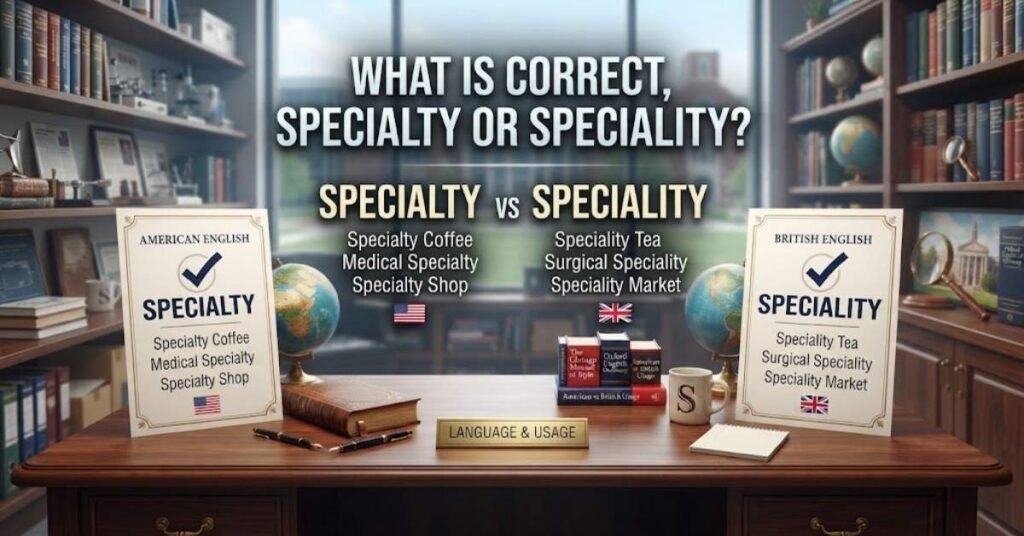
Both spellings are technically correct English, just tied to different regions. Think of it like “color” versus “colour.” Same idea, different regional spelling conventions.
If you’re writing a resume for a US company, a blog for American readers, or a product page for a specialty retailer based in the States, go with specialty. It’s the standard American spelling hands down.
Switch your setting to UK, and speciality becomes the natural fit. British newspapers, UK job listings, and academic papers from London universities lean on it consistently.
Is It Speciality Coffee or Specialty Coffee?

This one confuses a lot of coffee lovers, and honestly, it’s a fair question. The industry itself uses both, depending on geography.
In the US, you’ll see specialty coffee everywhere, on menus, bags of beans, café signage. The Specialty Coffee Association, a major name in the coffee industry, actually uses the American spelling in its official name, even though it has members worldwide.
Across the UK, baristas and coffee shops often write speciality coffee instead. Both refer to the same thing: high-quality, carefully sourced beans with distinct flavor profiles. So if you’re brewing a cold-brew coffee blend for your American café menu, “specialty” is your word.
How Do You Spell “Specialty” in the UK?

In the UK, the word is spelled speciality, with that extra “i” tucked in the middle. It’s not a typo or an old-fashioned version. It’s just how British usage has settled over time.
You’ll spot it in UK job ads for a doctor’s “area of speciality,” in restaurant menus advertising the house speciality, and in British dictionaries as the primary listed form.
If you’re writing content for a UK audience or following a British house style, stick with speciality throughout. Mixing the two spellings in one piece looks sloppy, even if both are individually correct.
Why People Confuse Them
Honestly? It’s an easy mix-up. The words look almost identical, sound almost identical, and mean exactly the same thing. There’s no logic gap to catch, just a regional spelling variation.
A lot of confusion also comes from native speakers consuming both British and American media constantly. Watch a UK show, then read a US news article, and your brain starts blending the two without you noticing.
Autocorrect doesn’t help either. Depending on your device’s language settings, it might flag one spelling as wrong even when it’s perfectly correct for your target region. That’s a spelling difference worth double checking before you publish anything.
Key Differences At A Glance
Here’s a simple breakdown so you can settle this fast:
- Specialty → US English, American usage, shorter form
- Speciality → UK English, British usage, includes the extra “i”
- Both mean the same thing: a special skill, product, or area of focus
- Neither is a misspelling, context decides which is right
- Plurals follow the same regional split (more on that below)
Once you know your audience, this decision basically makes itself.
Meaning And Usage Difference
Beyond spelling, both words carry a handful of overlapping meanings. They describe a field of expertise, a signature product, or something a person or business is especially good at.
Let’s break these meanings down individually, because the word does more heavy lifting than people realize.
A Field Of Expertise
This is the most common use. Someone’s specialty is their professional field, the thing they’ve built deep expertise in over years of work.
A cardiologist’s specialty is the heart. A tax lawyer’s specialty is, well, tax law. It’s their focus, their discipline, the corner of their profession they know better than most.
You’ll see this usage constantly in professional biographies, resumes, and job applications where someone lists their area of expertise front and center.
A Distinctive Skill
Sometimes specialty describes a distinctive skill, a talent or forte someone’s known for. It’s less about a formal profession and more about a personal strength.
Maybe your friend’s specialty is fixing bikes. Maybe yours is making people laugh at the worst possible moments. Either way, it’s an expert skill tied to identity, not necessarily a job title.
A Distinctive Food Or Product
This meaning shows up constantly in restaurants and kitchens. A chef’s signature dish, a bakery’s famous loaf, a café’s featured product, all of these get called a specialty.
Think grilled salmon at a seafood spot, peach pie at a diner, or sourdough bread at your neighborhood bakery. These items become the local delicacy or house favorite that keeps people coming back.
A Specialized Type Of Product Or Business
A specialty business or specialty store focuses on one narrow category instead of trying to sell everything. Think a specialty grocery store stocking imported cheeses, or a specialty pharmacy handling complex prescriptions.
Other examples include specialty insurance, specialty chemicals, and specialty equipment built for niche industrial uses. These businesses succeed precisely because they don’t try to be everything to everyone.
Pronunciation
Specialty pronunciation is fairly straightforward: SPESH-uhl-tee, three syllables, stress on the first.
Speciality pronunciation adds a syllable: SPESH-ee-AL-ih-tee, four syllables total, with the stress shifting slightly. That extra “i” isn’t silent, it actually changes how the word sounds out loud.
Plural Forms
Specialty plural is specialties. Drop the “y,” add “ies,” standard English pluralization.
Speciality plural is specialities, following the same pattern but keeping that extra syllable throughout. So British writers might discuss “medical specialities” while American writers write “medical specialties,” same concept, different regional spelling.
Tone, Context, And Formality
Neither spelling is more formal or casual than the other. This isn’t a tone issue, it’s purely a regional preference thing.
That said, context absolutely matters. A formal writing piece, like an academic assignment or legal document, needs consistent spelling throughout based on the expected reader. Flip-flopping between spellings mid-document signals carelessness.
Informal writing, like a casual blog post or social caption, has a bit more wiggle room, but consistency still reads better. Pick your regional convention and commit to it.
Which One Should You Use?
Ask yourself one question: who’s reading this?
Writing for US audience? Use specialty. Writing for a British, Australian, or Irish reader base? Use speciality. Writing for an international audience with no clear regional lean? Pick one and stay consistent, most style guides recommend defaulting to American spelling for global business content since it’s more widely recognized online.
If your company has an established house style, that trumps everything else. Follow it.
When One Choice Sounds Wrong
Certain phrases just sound off if you swap the spelling. “Medical specialty” reads naturally in American healthcare writing, while “medical speciality” feels foreign to US ears, even though it’s technically correct British usage.
Same goes the other way. A British reader seeing “specialty” repeated throughout a UK-based article might assume the writer isn’t a native speaker, or that the content was translated from American sources without localizing it.
Do Not Confuse Specialty With Specialization
Here’s a mistake worth flagging separately. Specialty is a noun describing the thing itself, the skill or product. Specialization describes the process of narrowing your focus toward that thing.
A doctor specializes (verb) in cardiology, and cardiology becomes their specialty (noun). The two words work together but aren’t interchangeable. Mixing them up is one of the more common grammar rules slip-ups even experienced writers make.
Common Mistakes (And Quick Fixes)
Let’s run through the errors people actually make with this word:
- Mixing spellings in one document → Fix: Pick American or British spelling and stick with it start to finish
- Confusing specialty with specialization → Fix: Use specialty for the noun, specialize/specialization for the process
- Wrong plural form → Fix: Specialties for US writing, specialities for UK writing
- Assuming one spelling is universally “more correct” → Fix: Correctness depends entirely on region, not preference
- Ignoring official organization names → Fix: If quoting a brand like the Specialty Coffee Association, keep their official spelling even in British content
Everyday Examples
Seeing the word in action helps it stick. Here are a few natural, real-world uses:
- “Our restaurant’s local specialty is smoked brisket, and people drive an hour for it.”
- “She’s building a career in international finance, with a growing specialty in emerging markets.”
- “The bakery’s house specialty sells out by 10am most Saturdays.”
- “He runs a specialty cleaning products business focused entirely on commercial kitchens.”
- “Her area of speciality at university was environmental law, back when she studied in London.”
Notice how naturally the word slides into everyday conversation, work talk, and casual storytelling alike.
Dictionary-Style Word Details
Let’s get into the nuts and bolts, the kind of breakdown you’d find flipping through Merriam-Webster or the Cambridge Dictionary.
Verb
Specialty itself isn’t a verb. The related verb form is “specialize,” meaning to focus your work or study on one particular area.
Noun
As a noun, specialty/speciality refers to a special skill, product, subject, or area someone or something is known for. It can also function as an attributive noun, describing another noun directly, like “specialty store” or “specialty pharmacy.”
Synonyms
Common synonyms include forte, strength, expertise, focus, niche, and signature. Each carries a slightly different flavor depending on context, but they all circle back to the same core idea of a defining strength.
Example Sentences
“Neurology became her specialty after a decade in general medicine.” “This shop’s speciality is handmade furniture built from reclaimed wood.” “Digital illustration is his creative specialty, and it shows in every project.”
Word History
The word history traces back to Latin “specialis,” meaning particular or individual, filtered through Old French before landing in English. The British form kept more of that French-influenced spelling pattern, while American English simplified it over time, part of a broader push toward simpler spellings championed by Noah Webster centuries ago.
Phrases Containing
Common phrases include area of specialty, regional specialty, local specialty, house specialty, and medical specialty. Swap in the British spelling for any UK-facing content, and you’re covered.
Fresh Angle: Which Industries Use This Word Most?
Beyond coffee and medicine, this word shows up constantly across event planning, commercial photography, small-business accounting, and even customer service roles where someone’s known for handling tricky situations well.
Job listings in these fields often ask candidates to list their specialty upfront, since it helps hiring managers quickly match people to the right team or project.
Fresh Angle: How Search Engines Treat Both Spellings
Search engines like Google generally recognize both spellings as related terms, showing results for either one regardless of which you typed. That said, matching your spelling to your intended audience still helps with relevance and audience expectations, especially for local businesses targeting UK or US shoppers specifically.
Conclusion
At the end of the day, this isn’t really a grammar trap, it’s a geography question. Specialty belongs to American writing. Speciality belongs to British writing. Both describe the same idea: something special, distinctive, and worth pointing out.
Pick based on your reader, stay consistent, and you’ll never trip over this one again.Got a specialty of your own worth bragging about? Drop it in the comments, I’d genuinely love to hear it.
FAQs
Is specialty or speciality correct?
Both are correct. Specialty is standard in the US, speciality is standard in the UK.
Which spelling should Americans use?
Americans should use specialty. It’s the accepted standard American spelling across US publications and businesses.
Is speciality a misspelling?
No, it’s not a misspelling. It’s the correct British English form, just different from the American version.
What is the plural of specialty?
The plural is specialties, following standard American pluralization rules.
What is the plural of speciality?
The plural is specialities, the British equivalent following the same pattern.
Is it medical specialty or medical speciality?
In the US, it’s medical specialty. In the UK, it’s medical speciality. Both refer to a doctor’s focused area of practice.
Is it specialty food or speciality food?
American writing uses specialty food, while British writing uses speciality food. Same category of product, different regional spelling.

Arthur Whitmore is a passionate grammar enthusiast and language writer at Hexobrust.com. He creates clear, helpful content on grammar, spelling, and everyday English to make learning simple and enjoyable.
