


You’re halfway through an email, and one word suddenly looks wrong. Is it sentence or sentance?Here’s the answer, straight up. Sentence is the correct spelling, and sentance is a misspelling in every form of standard English.
Stay with me, and you’ll see why the mix-up happens.You’ll also get a memory trick, real examples, and quick fixes for related spelling mistakes.
Quick Answer
Write sentence, with three e’s and no a.
That holds true in American English, British English, and every other English spelling you’ll run into.
Sentance doesn’t show up in dictionaries, style guides, or court records.
If you’ve typed it, you made a spelling mistake, and that’s nothing to lose sleep over.
The fix takes two seconds.
Swap the a for an e, and you’re done.
Why People Confuse Them
Blame your ears first.
We say SEN-tuhns, and that last syllable carries a lazy “uh” vowel sound that could be spelled a dozen ways.
Then your brain jumps in with a shortcut.
It spots words like importance, distance, and assistance, so it assumes the same spelling pattern applies here.
Speed makes it worse.
When you’re typing fast, word confusion creeps in, and your fingers grab the familiar ending.
Key Differences At A Glance
Here’s the whole story in one small table.
Skim it before you write anything that matters.
| Feature | Sentence | Sentance |
| Status | Correct spelling | Incorrect spelling |
| Meaning | A group of words or a court punishment | None |
| Where you’ll see it | Grammar, law, news | Typos only |
| Verb forms | Sentences, sentenced, sentencing | None that are valid |
Meaning And Usage Difference
The word sentence does two big jobs.
One belongs to grammar, and the other belongs to law.
Context tells you which job you’re looking at.
“Write a sentence” is about words, while “the judge handed down a sentence” is about punishment.
Sentance does neither job, because it isn’t a word.
So there’s no usage difference to weigh, only a typo to fix.
What Does Sentence Mean In Grammar?
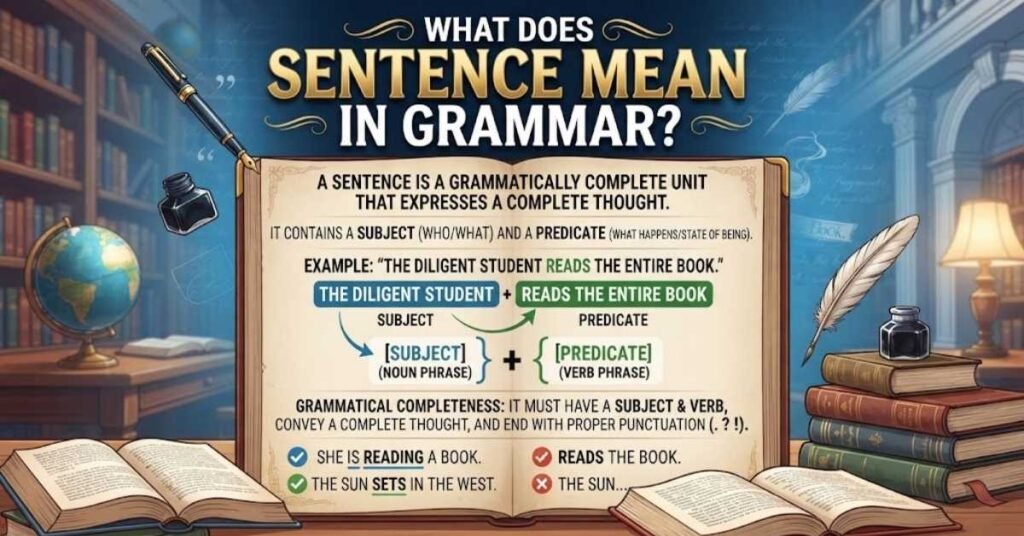
In grammar, a sentence is a group of words that expresses a complete thought.
It needs a subject and a verb, like “Birds sing.”
It starts with a capital letter and ends with a period, a question mark, or an exclamation point.
Think of it as the basic unit of language in all writing.
Good sentence structure keeps readers moving.
Tangled ones make people reread, and most readers won’t bother twice.
What Does Sentence Mean In Law?
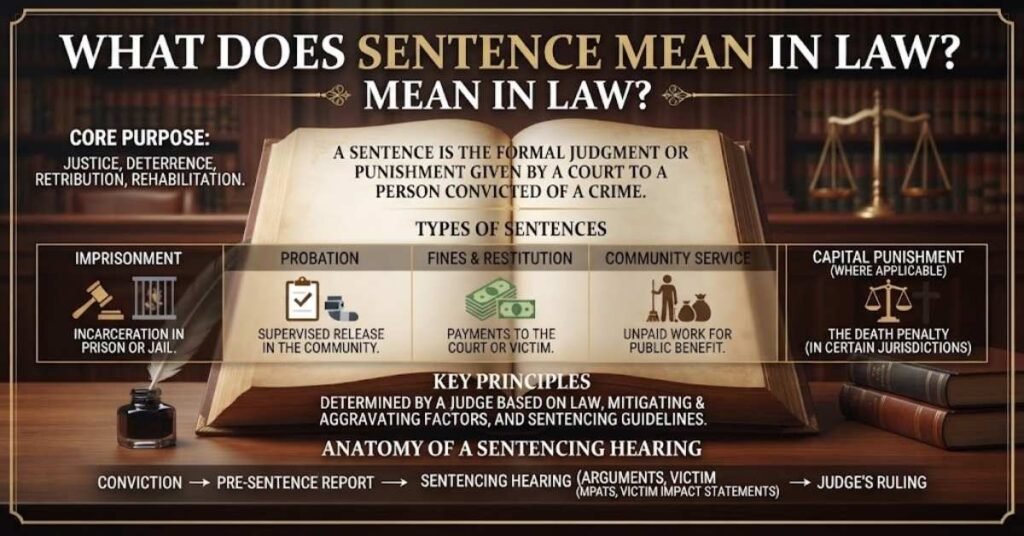
In a legal context, a sentence is court-ordered punishment.
A judge announces it after a defendant is found guilty of an offense.
A five-year sentence means a prison term of up to five years.
How much time someone actually serves depends on local rules, so the number on paper isn’t always the final answer.
The sentencing hearing is where the decision gets made.
Prosecutors and the defense attorney each speak before the judge rules.
Not every penalty means locked doors.
A judge might order community service or a suspended sentence instead.
Sentence As A Verb
Yes, sentence works as a verb too.
To sentence someone means to impose a penalty on them.
Here’s an example: “The judge sentenced him to community service.”
The base form is sentence, and the third-person singular is sentences.
The past tense and past participle are both sentenced.
The present participle is sentencing, which you’ll hear in courtroom news all the time.
Is Sentance Ever Correct?
No, it isn’t.
It’s not a regional variant, and no major dictionary lists it.
Older English texts do spell plenty of words in ways that look strange today.
That’s because spelling wasn’t fixed until dictionaries and printing caught up, and old habits don’t make a form valid now.
Modern standard English settled on sentence.
That’s the version editors, teachers, and judges all expect.
Is It -ence Or -ance? Words That Trip Everyone Up
English has no clean rule for picking between these two endings.
You mostly have to learn each word one by one.
Words that end in -ence:
- Presence
- Absence
- Difference
- Experience
- Evidence
- Independence
Words that end in -ance:
- Importance
- Distance
- Assistance
- Performance
- Attendance
- Acceptance
Notice how sentence sits with the first group.
Once you file it there, the a version feels less tempting.
Tone, Context, And Formality
Spelling standards shift a little with the audience.
This one doesn’t shift at all, but the stakes do.
In School And Academic Writing
Teachers circle every spelling mistake in an essay.
In academic writing, one slip can weaken an otherwise strong argument.
In Professional Writing
Business writing runs on trust.
A typo in a proposal tells a client you skimmed, and that’s a rough first impression.
In Legal Writing And News
Legal documents demand precision.
Reporters use sentenced constantly, so a wrong spelling stands out fast.
In Everyday Conversation
Nobody hears a spelling out loud.
In informal writing like texts, people forgive typos, but why risk it when the fix is so easy?
Which One Should You Use?
Use sentence.
That’s the only answer, and it covers formal writing and informal writing alike.
Run this quick check before you hit send:
- Count the e’s, and you should find three.
- Look for an a, and you shouldn’t find one.
- Read it aloud with the stress on the first syllable.
When Sentance Looks Wrong
Some spots make the error jump off the page.
Let’s walk through four of them.
In A School Assignment
Picture a student writing “every paragraph needs a strong topic sentance.”
One wrong letter, and the teacher’s red pen comes out.
In A Professional Document
A report with “sentance” in the summary looks rushed.
Run the spell-checker, then read the page once yourself.
In Legal Writing
A ruling that says “the sentance was reduced” loses credibility on the spot.
Only sentence belongs in a legal document.
As A Verb
“The court sentanced her” is wrong in two ways.
The correct line is “The court sentenced her.”
Common Mistakes And Quick Fixes
People misspell this word in six main ways.
Each one has a simple fix.
Mistake: Sentance
The a in the second half is the culprit.
Replace it with an e.
Mistake: Sentense
The ending is -ence, not -ense.
Keep the c, and add the e.
Mistake: Sentince
The middle i doesn’t belong.
Use an e, so it reads sen-tence.
Mistake: Sentancing
You’ve got the a problem again.
The right form is sentencing.
Mistake: Sentenceing
This one keeps the silent e when it shouldn’t.
Drop the final e before -ing, and you get sentencing.
Mistake: Sentanced
Same a issue, just in the past tense.
Write sentenced instead.
Sentence vs Phrase
A phrase is a group of words without a subject and verb pair.
“Under the old bridge” is a phrase.
Add a subject and a verb, and you get a sentence: “The kids played under the old bridge.”
That’s the jump that matters.
Sentence vs Clause
A clause has a subject and a verb.
An independent clause can stand alone, so it’s already a sentence.
A dependent clause can’t stand alone.
“Because the power went out” leaves you hanging, so it needs a partner.
Sentence vs Fragment
A sentence fragment looks like a sentence but misses a complete thought.
“Running down the street” is a classic case.
Fix it by adding what’s missing: “She was running down the street.”
Now the reader isn’t left guessing.
The Four Main Types Of Sentences
Every sentence has a job.
Four types cover nearly everything you’ll write.
Declarative Sentence
A declarative sentence makes a statement and ends with a period.
“The bus arrives at nine.”
Interrogative Sentence
An interrogative sentence asks a question and ends with a question mark.
“Did the bus arrive yet?”
Imperative Sentence
An imperative sentence gives a command or makes a request.
“Close the door, please.”
Exclamatory Sentence
An exclamatory sentence shows strong feeling and ends with an exclamation point.
“What a game that was!”
Sentence Structures And Paragraph Roles
Beyond types, sentences also come in structures.
A simple sentence has one clause, a compound sentence joins two independent clauses, and a complex sentence adds a dependent clause.
Each paragraph also leans on a few key sentences.
The opening sentence or topic sentence sets the point, and the concluding sentence wraps it up.
How To Spell Related Forms
Word forms follow a spelling pattern once you spot it.
Here they are in one place:
- Sentences: the plural of the singular noun
- Sentenced: past tense and past participle
- Sentencing: the -ing form, with the silent e dropped
- Sentential: a rare related adjective that means “of a sentence”
Pronunciation Of Sentence
Say it as SEN-tuhns.
It has two syllables, and the stress lands on the first one.
The second syllable holds a weak vowel.
In natural speech, it’s a quick “uh,” which explains why so many people reach for an a.
Lookalike Words To Watch
Some real words sit close to sentence, and a spell-checker won’t flag them.
That’s what makes them sneaky.
- Sentiment: a feeling or opinion, as in “public sentiment”
- Sentience: the ability to feel or perceive
- Sentient: able to feel, as in “sentient beings”
- Sentinel: a guard who keeps watch
Each one is spelled correctly, but each one means something else.
If your sentence suddenly talks about feelings or guards, check what you meant to type.
Everyday Examples
Seeing the word in action helps it stick.
Here are examples from both worlds.
Grammar And Writing Examples
- “A complete sentence needs a subject and a verb.”
- “Her opening sentence grabbed my attention.”
- “Read each sentence example twice.”
Legal Examples
- “The judge gave him a life sentence.”
- “She received a suspended sentence.”
- “Her lawyer asked the court to reduce a sentence.”
Dictionary-Style Word Details
Dictionaries break a word into parts.
Let’s do the same here.
Verb
To sentence means to declare a punishment.
Forms: sentence, sentences, sentenced, sentencing.
Noun
As a noun, it means a group of words with a complete idea.
It also means a legal punishment handed down by a court.
Synonyms
For grammar, try statement, utterance, expression, or line.
For law, try penalty, punishment, judgment, or prison term.
As a verb, you can swap in condemn or punish, depending on the tone.
Example Sentences
- “Write one clear sentence, then stop.”
- “The court will sentence him on Friday.”
Word History
The etymology traces back to the Latin word sententia, which meant opinion or feeling.
It reached English through French, and the meaning grew to cover both grammar and judgment.
Phrases Containing
Common ones include serve a sentence, impose a sentence, maximum sentence, and minimum sentence.
You’ll also see death sentence and jail sentence in news stories.
How To Remember The Correct Spelling
Try this memory trick: write it as sEntEncE.
Those three e’s are the whole spelling rule.
Here’s another angle.
Say “Every sentence ends when the thought ends,” and notice how many e’s you just used.
Repeat the trick a few times, and word recognition kicks in.
Soon your fingers just know it.
Quick Self-Test
Ready to check yourself?
Pick the right spelling in each line.
- The judge will (sentence / sentance) him tomorrow.
- She got a five-year (sentence / sentance) for the offense.
- The court is (sentencing / sentenceing) two people today.
Answers: sentence, sentence, sentencing.
Got all three? You’ve got this word handled.
Conclusion
Sentence is the only correct spelling, whether you mean grammar or a court ruling.
Sentance is a common slip, but it’s still a slip.
Which spelling trips you up most?
Drop a comment, and share this with a friend who keeps second-guessing their spelling.
FAQs
Is it sentence or sentance?
It’s sentence. Sentance is always a misspelling.
Why do people spell sentence as sentance?
The unstressed ending sounds like “uhns.” Words like importance nudge people toward an a.
How do you spell sentence in American English?
Exactly the same: s-e-n-t-e-n-c-e. American English doesn’t change it.
What are the two main meanings of sentence?
One is a complete thought in grammar. The other is a court punishment in law.
Can sentence be a verb?
Yes, it can. “The judge will sentence him tomorrow.”
Is sentance an alternative British spelling?
No. British English uses sentence too.
Does every sentence need a subject and verb?
Almost always, yes. Commands like “Stop!” imply the subject “you.”

Arthur Whitmore is a passionate grammar enthusiast and language writer at Hexobrust.com. He creates clear, helpful content on grammar, spelling, and everyday English to make learning simple and enjoyable.
