

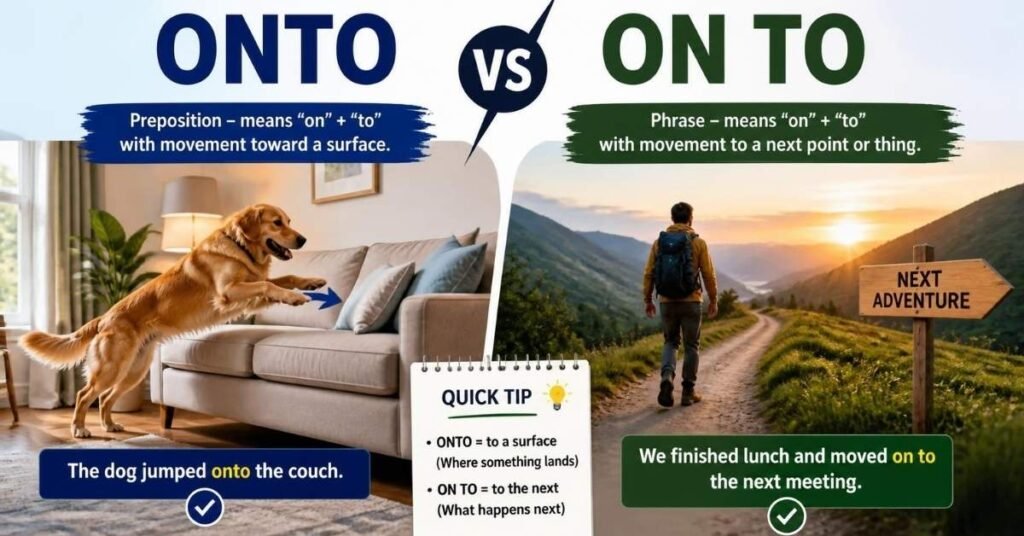
Ever typed a sentence, stared at it, and thought “wait, is that one word or two?” You’re not alone. Onto vs on to is one of those tiny grammar puzzles that trips up even careful writers, and it shows up everywhere from emails to school essays.
The good news? Once you get the trick behind it, you’ll never second guess yourself again.
Quick Answer
Here’s the short version. Onto is one word, and it’s a preposition that shows movement toward a surface or position, like “she climbed onto the roof.” On to is two separate words, where “on” pairs with a verb (think “move on”) and “to” simply points to what comes next, like “she moved on to her next job.”
If you’re in a rush, that’s really all you need. But grammar rarely stays that simple in real writing, so let’s dig into why this mix up happens in the first place.
Why People Confuse Them

Honestly? These two look almost identical on the page. Both contain the same three letters, “o,” “n,” and “t,” just arranged a bit differently, and both often describe some kind of motion or connection.
Add in the fact that spoken English doesn’t pause between “on” and “to,” and you get a recipe for confusion. When you say “log on to your account” out loud, it sounds exactly like “log onto your account.” Your ears can’t tell the difference, only your eyes can.
This is also a classic case of spelling rules bending under pressure from everyday speech. People write the way they talk, and that habit sneaks into texts, emails, and even formal reports.
Key Differences At A Glance
Let’s make this dead simple with a quick table you can bookmark.
| Feature | Onto | On To |
| Word count | One word | Two words |
| Part of speech | Preposition | Adverb “on” + preposition “to” |
| Shows | Movement to a surface | Continuation of an action |
| Example | He jumped onto the stage | He moved on to the next slide |
| Common in | Physical actions | Verb phrases like “log on to” |
Notice something? Onto almost always answers “where,” while on to usually answers “what’s next.” Keep that question test in your back pocket, it’ll save you more times than you think.
Meaning And Usage Difference

Here’s where things get interesting. Onto works as a single preposition, and it points to physical movement toward a surface or a new position. Picture someone stepping onto a bus, or a cat jumping onto the counter.
On to, on the other hand, is a phrase built from two separate pieces. “On” often belongs to a phrasal verb like “move on,” “hold on,” or “carry on,” and “to” just introduces whatever the object of that action happens to be.
There’s also a figurative side to onto. When someone says “I’m onto you,” they mean they’re aware of something, maybe a scam, a lie, or a suspicious plan. That sense of being informed about or suspicious of something has nothing to do with physical surfaces, and it only works with the one word version.
Tone, Context, And Formality
Does formality change which one you pick? Not really, since both are grammatically correct in their own situations. But context does shape which one shows up more often in different types of writing.
In academic writing and technical writing, you’ll often see verb phrases like “proceed to” or “move on to” because these fields lean on precise, step by step language. In business writing, phrases like “log on to the portal” or “pass on to the next department” pop up constantly.
Meanwhile, onto feels right at home in news writing, storytelling, and everyday descriptions involving physical movement. Whether you’re writing something formal or informal, the real test isn’t tone, it’s meaning.
Which One Should You Use?
Ask yourself one question: is something moving to a surface, or is an action simply continuing? If it’s the surface, go with onto. If it’s the action continuing, use on to.
Try this little trick too. Remove “to” from the sentence and see if “on” still makes sense on its own. “She held on” works fine, so you need on to in “she held on to the railing.” But “he jumped on the roof” changes meaning slightly, so onto fits better as “he jumped onto the roof.”
This isn’t just a classroom trick either. Writers, editors, teachers, and even business professionals use this same grammar test daily without even realizing they’re doing it.
When One Choice Sounds Wrong
Sometimes your ear can actually help more than any rulebook. Read your sentence out loud, and if it sounds clunky or off, that’s usually a sign you picked the wrong version.
For example, “he logged onto the system to check his email” sounds smooth because it’s describing entry into something, almost like stepping into a room. But “she carried on to explain her plan” might feel slightly stiff to some readers, depending on regional habits, since “carried on to” leans more formal.
In standard American English, both forms are accepted, but usage does shift depending on the verb involved. When in doubt, picture the action. Are you entering a space, or simply continuing one?
Common Mistakes (And Quick Fixes)
Let’s talk about the slip ups everyone makes, because honestly, even skilled writers mix these up under deadline pressure.
- Mistake: “I need to move onto the next chapter.” Fix: “I need to move on to the next chapter,” since this describes continuing an action, not landing on a surface.
- Mistake: “Please log in on to your account.” Fix: “Please log on to your account” or “log onto your account,” both work depending on your preferred style guide.
- Mistake: “She climbed on to the ladder.” Fix: “She climbed onto the ladder,” because this is clearly physical movement toward a surface.
- Mistake: “He held onto to his opinion.” Fix: Drop the extra “to.” It should read “He held on to his opinion.”
A quick habit that helps? Read the sentence backward. If “on” alone still makes sense without “to,” you probably need the two word version.
Everyday Examples
Nothing beats real examples to lock this in, so here’s a mix pulled from everyday situations you’ve probably lived through yourself.
- The kids jumped onto the school bus before it pulled away.
- He copied the files onto the hard drive just in case something crashed.
- After finishing the budget report, she moved on to the staffing issues.
- The nurse walked onto the platform to receive her award.
- We went on to discuss the next topic once the first question got answered.
- He poured the sauce onto the plate, careful not to spill it.
- The detective was clearly onto something, judging by that look on her face.
- After the meeting, they carried on to the next agenda item without missing a beat.
See the pattern? Every “onto” example involves a surface or position, and every “on to” example involves an action that keeps rolling forward.
Dictionary-Style Word Details
Let’s break this down the way a proper dictionary would, piece by piece, so you walk away with the full picture instead of just half the story.
Verb
Neither onto nor “on to” functions as a verb by itself. Instead, “on” frequently pairs with a verb to create a phrasal verb, such as “log on,” “move on,” “carry on,” or “hold on.” The word “to” then introduces the object that follows.
Noun
There’s no noun form here either, since both are strictly used as prepositions or parts of a verb phrase. Don’t expect to see “onto” functioning as a subject or object in a sentence.
Synonyms
For onto, useful synonyms include “on,” “upon,” and “to a position on.” For the continuation sense behind “on to,” you can often swap in “continue to,” “proceed to,” or “turn to,” depending on the sentence.
Example Sentences
- The plane taxied onto the runway right on schedule.
- She uploaded the photos onto the shared drive before the deadline.
- Let’s move on to discussing next quarter’s results.
- He went on to become a well respected lawyer.
Word History
The word history behind onto traces back to a natural merging of “on” and “to” in English, a process linguists call univerbation, where two frequently paired words fuse into one over time. This kind of blending isn’t unique to English either, but onto became widely accepted as a standalone preposition by the twentieth century.
Phrases Containing
Common phrases containing these words include “hold onto,” “move onto” (technically “move on to” in careful writing), “log onto,” “step onto,” and “climb onto.” On the two word side, you’ll spot “carry on to,” “get on to,” and “pass on to” fairly often in workplace writing.
The Simple Grammar Test You Can Use Anywhere
Want one trick that covers almost every situation? Ask if you can insert the word “up” before “on.” If “climbed up onto the roof” still makes sense, you’re dealing with onto.
This little test works because onto always implies upward or forward movement toward something physical. It won’t work with on to, since that phrase has nothing to do with surfaces at all.
Teachers use this trick constantly in grammar lesson plans for English learners, and honestly, it’s one of the fastest ways to build confidence with tricky word choice decisions like this one.
Onto And On To In Different Types Of Writing
School writing tends to favor whichever form matches the literal meaning, since teachers grade closely for punctuation and sentence structure accuracy. In contrast, casual texting and social captions often blur the line completely, and honestly, nobody’s checking your grammar in a group chat.
Technical writing, like instruction manuals or software guides, leans heavily on phrases like “log on to the system” or “upload the file onto the server,” since precision really matters when someone’s following steps. A tiny grammar slip in a manual can genuinely confuse a reader trying to complete a task.
Meanwhile, creative and news writing often favor onto for its punchy, visual quality. “She leapt onto the stage” simply reads better than a wordier alternative, and pacing matters a lot in storytelling.
Conclusion
At the end of the day, onto vs on to comes down to one simple question: movement to a surface, or an action that continues forward? Once that clicks, you’ll stop second guessing every sentence you write.
Keep the quick test handy, read your sentences out loud, and don’t stress over the occasional slip. Even professional editors double check this one sometimes, so you’re in good company.Got a tricky sentence you’re still unsure about? Drop it in the comments below, and let’s figure it out together.
FAQs
Is onto one word or two words?
Onto is always one word when it’s used as a preposition describing movement toward a surface or position.
Is on to ever correct?
Yes, absolutely. On to is correct whenever “on” belongs to a phrasal verb, like “move on,” “hold on,” or “carry on,” and “to” introduces what follows next.
Is it move onto or move on to?
It’s almost always “move on to” in careful writing, since this describes continuing an action rather than landing somewhere physical.
Is it log onto or log on to?
Both appear frequently, and honestly, usage varies by publication. Many standard American English style guides now accept “log onto” as informal but standard, while “log on to” remains the more traditional, careful choice.
How do I remember onto vs on to?
Picture a surface. If your sentence involves something physically landing on, jumping on, or climbing on that surface, use onto. If you’re simply continuing an action or topic, split it into on to.

Arthur Whitmore is a passionate grammar enthusiast and language writer at Hexobrust.com. He creates clear, helpful content on grammar, spelling, and everyday English to make learning simple and enjoyable.
