

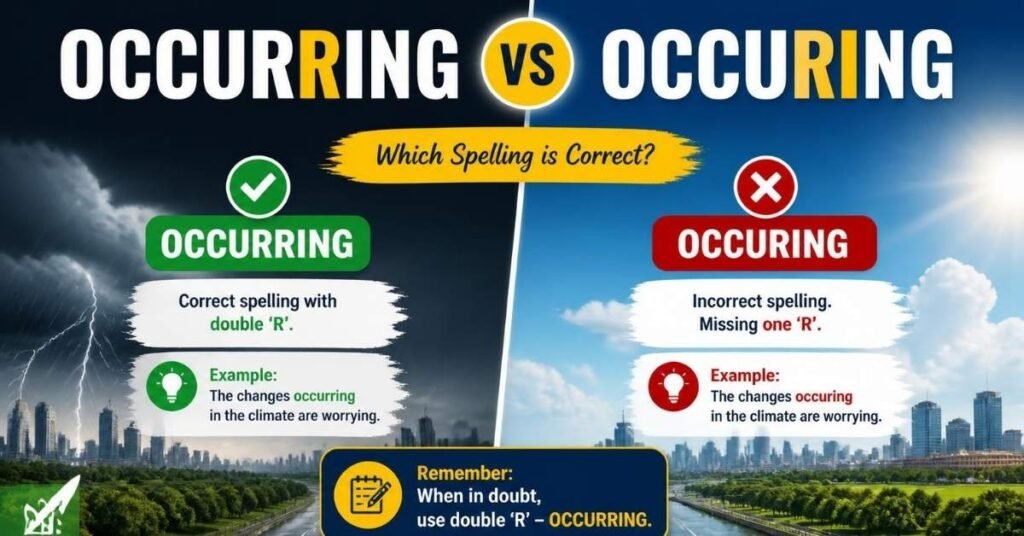
Wondering whether it’s occurring or occuring. The correct spelling is occurring, with two r’s, and occuring is simply a common typo.Maybe you typed it quickly in an email and paused, wondering if autocorrect missed something. Or maybe you’ve seen both versions online and now you’re not sure which one is actually right.You’re not alone.
This mix-up trips up even experienced writers, mostly because the -ing form doesn’t always follow the rule you’d expect.In this guide, you’ll learn exactly why occurring takes two r’s, when people get it wrong, and a simple trick to remember it for good. By the end, you won’t have to second guess this spelling again.
Quick Answer
Occurring is the correct spelling. It’s the standard present participle of the verb occur, and it always carries two r’s.
Occuring is a common misspelling. You won’t find it in any major dictionary, so if you’re writing something formal, always go with occurring.
Why People Confuse Them
Most people mix these up because English spelling rules aren’t always intuitive. The word occur ends in a single consonant, so it feels natural to just add -ing without doubling anything.
But that instinct works against you here. The consonant-doubling rule kicks in for certain verbs, and occur happens to be one of them, which is why so many writers stumble.
Add fast typing and autocorrect into the mix, and occuring slips through more often than you’d think. It’s an easy typo to make and an even easier one to miss.
Key Differences at a Glance
Quick Comparison
Here’s a simple breakdown so you never have to second guess it again.
| Word | Status | Notes |
| Occurring | Correct spelling | Standard English, used everywhere from academic writing to text messages |
| Occuring | Incorrect spelling | Common misspelling, not found in standard dictionaries |
The takeaway is simple. Occurring is the only version accepted in standard English, whether you’re writing in American English or British English.
Meaning and Usage Difference

Occurring
Occurring describes something that’s happening, taking place, or going on right now or in general. You’ll see it used for anything from a scientific process to a weather event.
It also works for things that exist naturally, which is where the phrase naturally occurring comes from. Think of naturally occurring minerals, gases, or compounds found in nature without human interference.
Occuring
There’s really no meaning to cover here because occuring isn’t a recognized word. It’s simply a spelling mistake, a dropped letter that changes the word form into something dictionaries don’t accept.
If you spot it in a document, treat it the same way you’d treat any typo. Fix it to occurring and move on.
Pronunciation
Here’s something that trips people up even more. Occurring and occuring sound exactly the same when spoken out loud.
That’s because pronunciation doesn’t change based on how many r’s you type. In spoken English, nobody can tell the difference, which is exactly why this mistake sneaks into written English so easily.
Relying on your ear alone won’t catch this one. You have to actually think about the spelling rules behind it.
Parts of Speech
Occurring
Occurring functions as the present participle form of the base verb occur. It can also work as an adjective, describing something that is currently happening, like an “occurring event” or an “occurring pattern.”
Grammatically, it fits right after helping verbs too. For example, “The delays are occurring” uses it as part of a continuous verb tense.
Occuring
Since occuring isn’t a real word, it doesn’t have an official verb form, noun, or adjective form. Any grammatical role you try to give it collapses the moment a dictionary or spell check tool flags it.
Basically, don’t try to build sentences around it. Just swap in occurring every single time.
Tone, Context, and Formality
Occurring in Formal Writing
In formal writing like reports, business writing, or academic writing, spelling accuracy matters a lot. Using occurring correctly signals attention to detail and keeps your writing polished.
Whether it’s a research paper or a professional writing sample for work, the correct spelling is non-negotiable. Readers, editors, and hiring managers notice these small details more than you’d expect.
Occurring in Everyday Writing
Even in casual settings like emails, blog posts, or quick notes, using occurring still matters. It just reads better and avoids that “did they not proofread this” feeling.
Everyday writing doesn’t need to be stiff, but it should still be accurate. A misspelled word can distract readers from your actual message.
Why “Occuring” Looks Convincing
Part of the confusion comes from how our brains process short, common suffixes. The -ing form feels automatic, so people apply the “just add -ing” rule without thinking about consonant doubling.
It also doesn’t help that occuring looks perfectly reasonable at a glance. Your eyes skim right past it unless you’re actively looking for the mistake.
Which One Should You Use?
Always choose occurring. There’s no context, formal or informal, academic or casual, where occuring is the accepted correct form.
A Simple Memory Tip
Here’s an easy trick that sticks. Picture two identical letters standing side by side, just like the event you’re describing keeps repeating or continuing.
You can also remember it this way:
- Occur has one syllable ending in a stressed vowel plus consonant
- That pattern almost always triggers double consonant spelling before -ing
- So occur becomes occurring, not occuring
Once that clicks, you’ll never second guess it again.
When One Choice Looks Wrong
Sometimes writers second guess themselves and think occurring looks “too doubled up” to be right. That hesitation is normal, especially if English isn’t your first language or if you’re switching between different spelling patterns.
But trust the rule here. Verbs like occur, refer, and prefer all double their final consonant before adding -ing, so occurring fits right into that same family.
Common Mistakes (and Quick Fixes)
Mistake 1: Removing One “R”
This is the most frequent error by far. Writers drop a letter without noticing, turning occurring into occuring in a matter of seconds.
Mistake 2: Assuming Every Verb Simply Adds “-ing”
Not every verb follows the same suffix pattern. Some verbs double their final consonant, and occur is a textbook example of that consonant-doubling rule.
Mistake 3: Misspelling the Adjective
People sometimes forget that occurring works as an adjective too. Whether you’re describing an “occurring issue” or an “occurring theme,” the spelling stays exactly the same.
Mistake 4: Relying Only on Pronunciation
Since both spellings sound identical, your ears simply can’t help you here. You need to rely on visual memory or a quick spell check instead.
Mistake 5: Typing Too Quickly
Fast typing is a major culprit behind this typing error. Slowing down for just a second when typing longer words can save you from an easy spelling mistake.
Everyday Examples
School
Teachers might describe a historical event as “an occurring pattern throughout the decade.” Students often see this word in essays discussing cause and effect.
Work
In business writing, you’ll spot phrases like “delays occurring due to supply chain issues.” It’s common in status updates, reports, and meeting notes.
Home
At home, you might say “the leak keeps occurring near the same pipe.” It’s a natural fit for describing repeated household issues.
Science
Scientific writing uses this word constantly, especially for naturally occurring elements or reactions. Researchers describe “naturally occurring bacteria” or “a chemical reaction occurring under specific conditions.”
News
Newspapers frequently report on events “occurring” in real time. Think of headlines like “flooding occurring across the region” or “protests occurring downtown.”
Side-by-Side Comparison
- Correct: “The meeting is occurring at 3 PM.”
- Incorrect: “The meeting is occuring at 3 PM.”
- Correct: “Changes are occurring rapidly.”
- Incorrect: “Changes are occuring rapidly.”
Dictionary-Style Word Details
Verb
Occur means to happen, exist, or come to mind. Its present participle form is occurring, its past tense is occurred, and its past participle form is also occurred.
Noun
While occurring itself isn’t typically used as a noun, the related word occurrence is. An occurrence refers to something that happens or takes place.
Synonyms
Common synonyms include happening, taking place, unfolding, developing, and arising. Depending on context, you might also use existing or appearing.
Example Sentences
Occurring
- “Strong winds are occurring across the coast this week.”
- “A rare phenomenon is occurring in the northern sky tonight.”
Occuring
There are no correct example sentences for this spelling since it isn’t a valid word. Any sentence using it should be corrected to occurring.
Word History
Occur traces back to Latin roots meaning “to run into” or “to meet.” Over centuries, English absorbed it into its own spelling conventions, eventually standardizing the doubled r in its -ing form.
Phrases Containing
You’ll often run into set phrases like naturally occurring, frequently occurring, commonly occurring, and rarely occurring. Each one describes how often something happens, whether that’s a condition, process, or phenomenon.
How Spell Checkers Handle This Mistake
Modern spell-check tools usually catch occuring right away and flag it in red. Still, some quick typing apps or older writing software might miss it, especially in autocorrect-heavy environments.
That’s why proofreading manually still matters. Don’t rely on writing programs alone to catch every single writing mistake.
Occurring Across Different Fields
Beyond school, work, and science, this word pops up in law, medicine, and technology too. You might read about “symptoms occurring after treatment” or “errors occurring during a software update.”
Its flexibility is part of why it shows up so often. Almost any industry or organization can use it to describe events, changes, or conditions unfolding over time.
Final Tips for Getting It Right Every Time
Here are a few quick habits that make this an easy fix going forward:
- Always double check verbs ending in a single stressed vowel and consonant
- Read your sentence out loud, even though pronunciation won’t reveal the typo, slowing down helps you catch it visually
- Keep a mental list of similar words like referring, preferring, and occurring
- Let your spell check tool do a final pass before publishing
Conclusion
At the end of the day, occurring is the only correct spelling, and occuring is simply a misspelling that slips in when we type too fast or forget the consonant-doubling rule. Once you understand why the double r exists, you’ll never second guess it again.
Small spelling details like this one add up. They shape how polished and trustworthy your writing feels, whether it’s a quick text or a formal report.Got a spelling mix-up that drives you crazy? Drop it in the comments below and share this guide with anyone who could use the reminder.
FAQs
Which spelling is correct: occurring or occuring?
Occurring is correct. Occuring is a common misspelling with no dictionary backing.
Why does occurring have two “r”s?
Because occur follows the consonant-doubling rule, where a single stressed final consonant doubles before adding -ing.
Is occuring a real word?
No, it isn’t recognized by any standard dictionary. It’s simply a typo of occurring.
How do I remember the correct spelling?
Picture the doubled letters representing something that keeps happening or repeating. That small mental image makes the double r easier to recall.
Is occurring a verb or an adjective?
It can function as both. It’s the present participle of occur, and it also works as a descriptive adjective.
Is occurring used in American and British English?
Yes, occurring is standard in both American English and British English with no regional spelling differences.
What is the past tense of occur?
The past tense is occurred, which also doubles the r for the same reason as occurring.
Can spell check miss “occuring”?
It’s rare, but some lightweight tools or fast-typing apps can occasionally miss it. That’s why a manual proofread is always worth the extra minute.

Arthur Whitmore is a passionate grammar enthusiast and language writer at Hexobrust.com. He creates clear, helpful content on grammar, spelling, and everyday English to make learning simple and enjoyable.
