

Ever typed a sentence, paused, and thought “wait, is it noisy or noisey?” You’re not alone.This tiny spelling mix-up trips up more people than you’d expect, from students writing essays to professionals drafting emails.
The good news? The answer is simple, and once you know the spelling rule behind it, you’ll never second-guess yourself again.
Quick Answer: Noisy or Noisey?
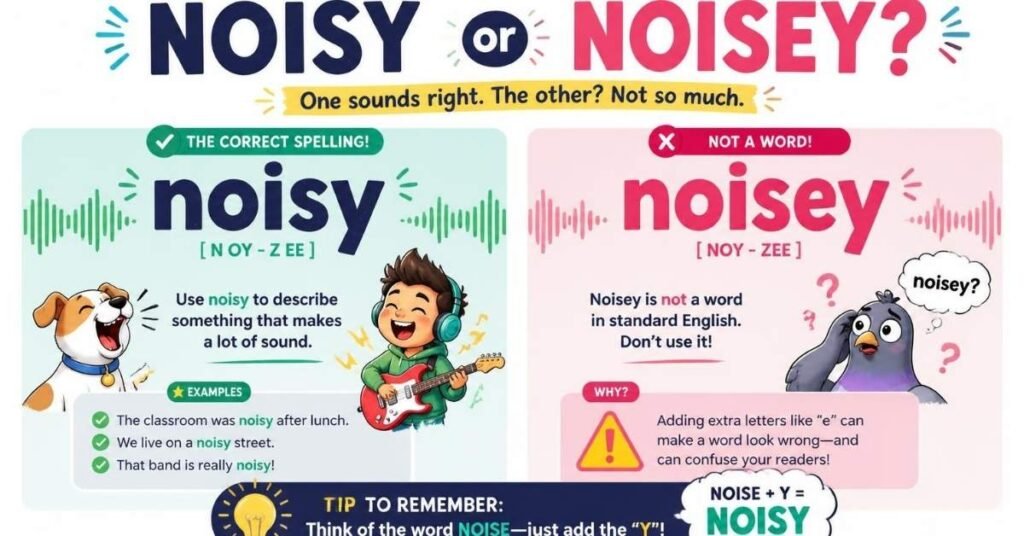
Noisy is the correct spelling. It’s the only form accepted in standard English spelling, whether you’re writing for school, work, or casual chats.
Noisey is a common misspelling. It shows up a lot online, especially in texts and social posts, but it has no place in formal writing or professional writing.
So if you remember one thing from this article, remember this: drop the extra “e” and go with noisy every single time.
Why People Confuse Noisy And Noisey
The confusion mostly comes down to word formation habits. Many English adjectives keep their final “e” when you add a suffix, like “brave” becoming “braver.”
That pattern makes people assume the same rule applies here, so they tack an “e” onto noise before adding “y.” It feels intuitive, but it’s simply not how this word works.
Autocorrect and casual online writing haven’t helped either. Since noisey shows up so often in comments and texts, some readers start to believe it’s an alternative spelling, when it’s really just an incorrect form.
What Does Noisy Mean?
Noisy is an adjective that describes something full of sound, usually more sound than you’d like. Think of a noisy environment where you can barely hear yourself think.
It covers everything from a noisy classroom full of chatty kids to a noisy street packed with traffic. The word captures both the loudness and the sense of disturbance that comes with it.
You’ll also see it used for people, not just places. A noisy neighbor who blasts music at midnight fits the definition just as well as a noisy machine grinding away in a factory.
What Does Noisey Mean?
Here’s the short version: noisey doesn’t mean anything, at least not officially. It’s not listed in any major dictionary as a dictionary definition, and it carries no separate meaning from noisy.
Some people assume it might be a British spelling or a rare alternative spelling, but that’s not the case in American English or British English. It’s simply a spelling error.
If you ever see it used, it almost always means the writer meant noisy and slipped up on the final letter rule.
Meaning And Usage Difference
There isn’t really a meaning difference between the two, because only one of them is a real word. Noisy carries the actual definition; noisey just borrows it by mistake.
Where you will notice a difference is in how each one reads. Noisy feels clean and correct, while noisey immediately signals a grammar mistake to anyone who notices it.
That matters more than people think, especially in professional documents where small errors chip away at credibility.
Tone, Context, And Formality
Formality level plays a bigger role here than most writers realize. In formal writing, like a report or a cover letter, noisey will stick out immediately and hurt reader perception.
In casual writing, like a group chat with friends, the stakes are lower. Nobody’s grading your texts. Still, using the correct word builds a habit that carries over into your other writing.
Context also shapes tone. Describing a noisy workplace in a formal email calls for precision, while venting about a noisy neighbor to a friend allows more relaxed language, but the spelling itself should stay the same either way.
Which One Should You Use?
Always use noisy. There’s no scenario, formal or casual, where noisey is the better or even acceptable choice.
Think of it like autocorrect for your brain: noise + y = noisy, no extra letters needed. That little formula covers every situation you’ll run into.
Whether you’re writing school writing assignments, business emails, or a quick caption for a photo, stick with the standard accepted spelling. It keeps your writing looking polished without extra effort.
When One Choice Sounds Wrong
Noisey will almost always sound wrong to a careful reader, even if they can’t explain why right away. It creates a tiny stumble, the kind that pulls attention away from your actual message.
That stumble matters most in professional writing, where readers are already scanning for red flags. A single misspelling can make people question the accuracy of everything else you wrote.
In casual settings, it’s less damaging, but it still reads as sloppy rather than intentional. There’s no upside to using it anywhere.
Common Mistakes And Quick Fixes
Most errors with this word follow a predictable pattern. Once you spot the pattern, fixing it becomes second nature.
Here’s a quick breakdown of what usually goes wrong and how to fix it fast.
Mistake 1: Keeping The Final E
Writers often keep the “e” from noise out of habit, since that’s how many other words behave. But with this suffix -y ending, the final e removal is required.
Quick fix: say the word out loud and picture the word roots. Noise loses its “e” the moment you add “y,” giving you noisy, not noisey.
Mistake 2: Using Noisey In Professional Writing
This mistake shows up more in professional documents than you’d expect, especially in fast typed emails. It slips past spell check at times because it still resembles a real word.
Quick fix: double check any sentence describing sound or volume before hitting send. If you typed noisey, swap it for noisy immediately.
Mistake 3: Confusing Noise And Noisy
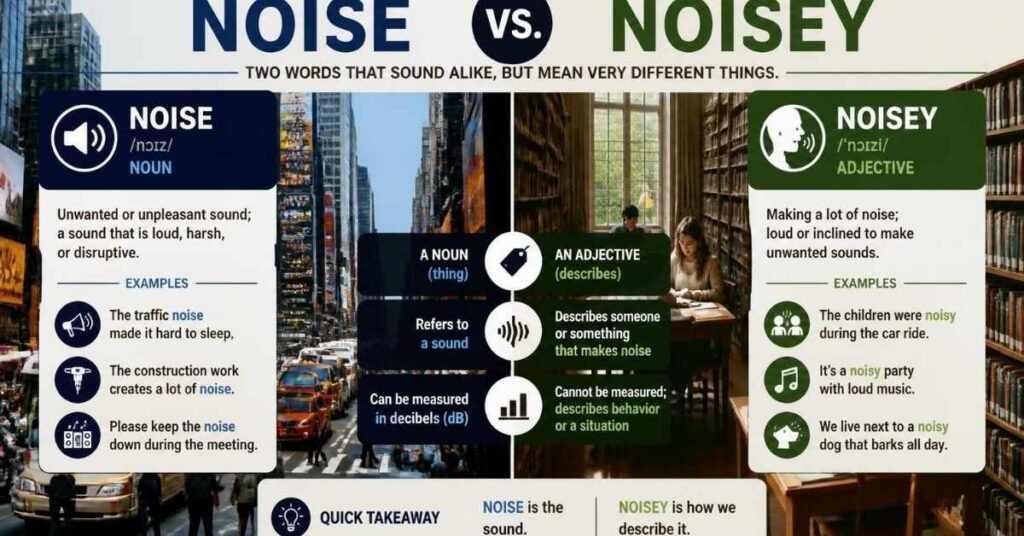
Some writers accidentally use “noise” where “noisy” belongs, treating a noun-to-adjective formation as interchangeable. “The room was noise” reads awkwardly compared to “the room was noisy.”
Quick fix: remember that noise is the noun, while noisy is the adjective. If you’re describing a quality, you need the “y” ending.
Everyday Examples
Seeing the word in real situations makes the correct usage stick far better than memorizing a rule.
Home Examples
Picture a noisy washing machine running through its final spin cycle late at night. Or a noisy baby who refuses to settle down during dinner.
Even something as small as a noisy clock ticking in a quiet room counts. Home life is full of these everyday moments.
Work Examples
Open floor plans often create a genuinely noisy office environment, with phones ringing and conversations overlapping. A noisy equipment room near your desk doesn’t help focus either.
During rush hour, commuting to a noisy workplace can feel exhausting before the workday even starts.
Travel Examples
Anyone who has sat near a gate at a noisy airport knows the feeling of announcements blending into chatter. A noisy train car during peak hours isn’t much better.
Even a noisy construction area near your hotel can turn a relaxing trip into a restless one. Travel has a way of highlighting sound in ways daily routines don’t.
Dictionary-Style Word Details
Beyond the basic definition, it helps to understand how this word behaves grammatically and where it fits in everyday English vocabulary.
Verb
Noisy does not function as a verb in modern English. There’s no version like “to noisy something.” If you need a verb form, you’d reach for “to make noise” instead.
Noun
The related noun is simply “noise,” referring to any sound production or sound disturbance. Noisy describes the quality; noise names the thing itself.
Synonyms
Knowing a few alternatives helps you avoid repeating the same word across a paragraph.
Noisy
Common synonyms include loud, boisterous, rowdy, and clamorous. Each carries a slightly different shade of meaning, from playful chaos to harsh disruption.
Noisey
Since it’s not a real word, it has no synonyms of its own. Any list you find online is really just listing synonyms for noisy by association.
Example Sentences
Seeing correct and incorrect usage side by side clears up any lingering doubt fast.
Noisy
“The noisy crowd outside the stadium made it hard to hear the announcer.” “Their new apartment sits above a noisy street, so they invested in thicker curtains.”
Noisey
There genuinely aren’t correct example sentences for this spelling, since it’s an incorrect usage in every context. Any sentence using it should simply be corrected to noisy.
Word History
The word noisy comes directly from the noun “noise,” which traces back through Old French and Latin roots tied to disturbance and quarrel. Adding the adjective-forming ending “y” turned the noun into a descriptive word.
This kind of word formation is common across English adjectives, think “rain” becoming “rainy” or “luck” becoming “lucky.” The same spelling pattern applies here, which is part of why understanding this one word can clarify several others.
Over time, noisy became the fixed, standard form, while variations like noisey never gained any real recognition in language usage.
Phrases Containing
Certain phrases pair naturally with this word and show up constantly in everyday English language learning materials.
Noisy
You’ll frequently hear “noisy neighbor,” “noisy environment,” “noisy crowd,” and “noisy street” in daily conversation and writing alike. These combinations feel natural because they describe common, relatable situations.
Noisey
No established phrases exist using this spelling, since it isn’t part of accepted spelling in any dictionary. Any phrase using it should be treated as a typo needing correction.
Conclusion
At the end of the day, this comes down to one clear rule: noisy is correct, noisey is not. Once that sticks in your memory, you’ll spell it right without even thinking twice.Small details like this shape how readers perceive your writing, whether it’s a school assignment, a work email, or a quick text to a friend.
Getting it right costs nothing and adds a little more polish to everything you write.Got a spelling mix-up that always trips you up? Drop it in the comments, chances are someone else deals with the exact same one.
FAQs
Is noisy or noisey correct?
Noisy is correct. Noisey is a misspelling with no accepted use in standard English spelling.
Why is noisy spelled without an e?
Because the suffix -y rule requires final e removal when attaching to certain base words like noise, turning it into noisy through standard word formation.
Is noisey a real word?
No, it’s not recognized in any dictionary. It’s simply an incorrect form of noisy that spread through casual typing and autocorrect slips.
What is the plural of noisy?
Noisy is an adjective, and adjectives in English don’t take a plural form. You’d instead pluralize the noun it describes, like “noisy rooms” or “noisy crowds.”
What is another word for noisy?
Common alternatives include loud, boisterous, rowdy, and clamorous, each fitting slightly different tones depending on the sentence.

Arthur Whitmore is a passionate grammar enthusiast and language writer at Hexobrust.com. He creates clear, helpful content on grammar, spelling, and everyday English to make learning simple and enjoyable.
