


You typed a sentence, paused, and stared at the screen.Is it “midday” or “mid day“? Should there be a space in there or not?You’re not overthinking it.
This is one of those small spelling questions that trips up even careful writers, and it shows up everywhere from business emails to school assignments.Let’s settle it for good.
Quick Answer: Midday or Mid Day?
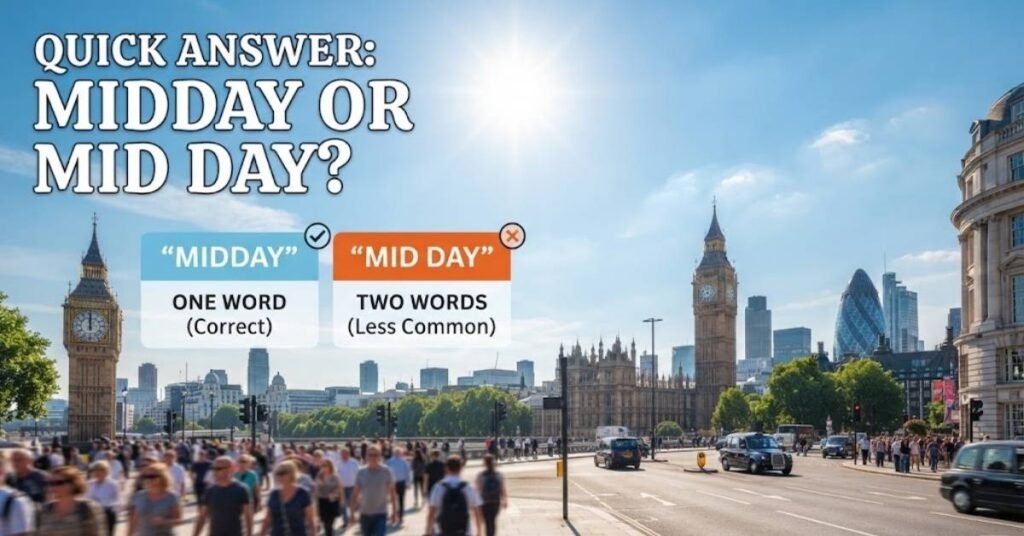
Midday is the correct spelling. One word, no space, no hyphen.
It’s the standard spelling in American English, and you’ll find it that way in every major dictionary. If you’re writing a report, a website page, or even a quick text to a friend, “midday” is the safe, accepted choice.
“Mid day” as two separate words is technically a nonstandard spelling. It’s not “wrong” in the sense of being nonsense, people understand what you mean, but it doesn’t match standard written English. Think of it like writing “to day” instead of “today.” You’d get the point across, but it would look off to anyone reading closely.
Why People Confuse Midday And Mid Day
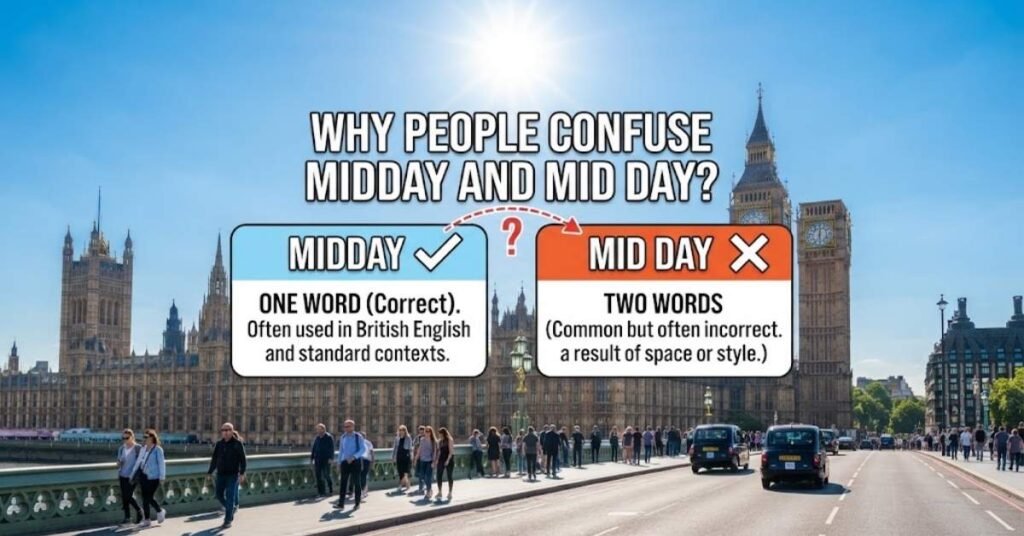
Here’s the honest reason this mix up happens so often: our brains process “mid” and “day” as two separate ideas.
“Mid” means the middle part of the day, and “day” is, well, the day. Since we think of them as two concepts, it feels natural to type them as two words too.
Add autocorrect into the mix. Some phone keyboards and typing apps don’t flag “mid day” as an error, so writers assume it must be fine. That small gap in feedback lets the incorrect spacing slide by unnoticed for years.
There’s also a pattern effect at play. English has plenty of compound phrases that do use a space, like “half day” or “full day.” Your brain borrows that pattern and applies it here, even though midday followed a different path when it became a compound word.
What Does Midday Mean?
Midday refers to the middle of the day, usually pointing to the hour around 12:00 p.m. It’s the moment when the sun sits at its highest point and the morning has fully given way to the day proper.
In casual conversation, people use it loosely to describe the general period around noon, not always the exact minute. If someone says “let’s meet at midday,” they usually mean somewhere close to noon, not a strict, timed appointment.
That flexibility is actually useful. Midday works as a general period when you don’t need to pin down an exact time, which makes it a handy word for planning, scheduling, or just describing your day to someone else.
How To Use Midday Correctly
Using midday the right way comes down to knowing its role in a sentence. It can act as a noun or as a describing word, and each use has its own small rules worth knowing.
Midday As A Noun
As a noun, midday names a point in time, just like “morning” or “evening” do.
You’d write something like, “We took a break at midday” or “Midday arrived, and the office went quiet for lunch.” In both cases, midday stands on its own as the subject or object of the sentence.
This noun form is probably the most common way people use the word day to day, especially in casual conversations and personal messages.
Midday As A Describing Word
Midday also works as a describing word, sitting in front of another noun to add detail.
Think of phrases like midday sun, midday heat, or midday meal. Here, “midday” isn’t the main subject, it’s modifying something else, telling you when that sun, heat, or meal happens.
This pattern shows up a lot in weather reports and travel writing, where writers want to be specific about timing without adding a whole extra clause.
Is Mid Day Ever Correct?
Almost never, at least not in standard written English.
There’s one narrow exception. If “mid” is being used to modify a completely separate word in an unusual construction, like a hyphenated compound someone invents on the spot, you might technically split it. But this is rare, and honestly, most style guides would still steer you back to midday.
For business writing, academic writing, or anything meant for a wide audience, stick with one word. It’s the preferred form, and using it consistently protects your credibility as a writer.
Meaning And Usage Difference
The meaning difference between midday and mid day is basically zero, since “mid day” isn’t a separate word with its own definition. The real difference is usage, not meaning.
Midday carries the weight of an established, dictionary-approved term. “Mid day” carries the weight of a typing mistake or a spelling mistake that slipped past a quick proofread.
If context matters to you, and it should if you’re writing anything professional, this usage difference is worth remembering. One version signals polish. The other signals a rushed first draft.
Midday vs. Noon: What Is The Difference?
Here’s where things get interesting, because midday and noon aren’t exactly twins.
Noon refers to the exact time: 12:00 p.m., no wiggle room. It’s a precise marker on the clock, the kind you’d use for a scheduled meeting or a train departure.
Midday, on the other hand, describes a broader stretch of time. It covers the general period surrounding noon, sometimes stretching into what people would call early afternoon or the tail end of the morning.
So if your boss says “send that report by noon,” they mean 12:00 sharp. If a friend says “let’s grab lunch around midday,” you’ve got some breathing room. That small distinction matters more than people realize in professional communication.
Which One Should You Use?
Use midday in almost every situation. It’s clear, it’s correct, and it reads naturally whether you’re writing reports, articles, or a quick message to a coworker.
Save “noon” for moments when precision counts, like appointments, contracts, or anything time sensitive. And avoid “mid day” altogether unless you’re deliberately breaking style for creative reasons.
When in doubt, picture a dictionary entry. Midday is there, spelled as one word. “Mid day” isn’t. That’s really all the guidance you need.
Common Mistakes And Quick Fixes
Even confident writers slip up here sometimes. Let’s look at the three most common spelling mistake patterns and how to fix them fast.
Writing Mid Day As Two Words
This is the big one. Writers add a space out of habit, often because they’re typing quickly or drafting on a phone.
The fix is simple: whenever you type “mid,” pause for half a second and finish it as “midday,” no space. Reading your sentence out loud before hitting send catches this almost every time.
Using Mid Day In Compound Phrases
Some writers make the mistake worse by building a whole compound phrase around the wrong spelling, like “mid day sun” or “mid day meeting.”
Since midday is already a compound word on its own, adding another word after it, like “meeting” or “sun,” doesn’t need a second space. Keep “midday” tight, then attach your next word normally.
Confusing Midday With Afternoon
Afternoon technically starts right after noon and stretches toward evening. Midday overlaps with the very start of that window but isn’t identical to it.
If you mean anytime from 1 p.m. onward, “afternoon” fits better. If you mean the stretch right around 12:00, midday is your word. Mixing the two up won’t confuse most readers, but precise writers keep the distinction clean.
Everyday Examples Of Midday
Seeing midday used in real situations makes the rule stick faster than any dry explanation. Here’s how it shows up across different parts of daily life.
Workplace Examples
Offices run on rhythm, and midday often marks a shift in that rhythm. People say things like “let’s push the midday meeting to 1 p.m.” or “the office empties out around midday for lunch.”
Emails often reference it too, especially when scheduling calls across time zones. “I’m free at midday your time” is a common, natural phrase in business emails.
Travel Examples
Travelers deal with midday constantly, especially around flights and check ins. “Our flight lands at midday” or “check in isn’t until midday” are phrases you’ll hear at airports and hotels worldwide.
Tour guides also lean on the word to plan itineraries, since midday gives tourists a flexible window without locking them into an exact minute.
Weather Examples
Forecasters love this word because weather doesn’t follow the clock precisely. You’ll hear things like “expect the midday heat to peak near 95 degrees” or “showers will clear by midday.”
The midday sun especially gets mentioned often, since that’s typically when temperatures and UV exposure hit their highest point of the day.
Daily Life Examples
Beyond work and travel, midday slips into casual, personal conversations too. “I usually eat my midday meal around 1″ or “I take a short midday break to clear my head” are everyday examples most people can relate to.
Even midday traffic is a phrase drivers use constantly, describing that stretch of congestion that hits right before or after the lunch rush.
Dictionary-Style Word Details
Let’s break midday down the way a dictionary would, piece by piece, so you have the full picture in one place.
Verb
Midday isn’t used as a verb. There’s no version like “to midday” in standard usage, so you won’t need to worry about conjugating it.
Noun
As a noun, it means the middle of the day, generally understood as the time around 12:00 p.m.
Synonyms
Common synonyms include noon, the noon hour, and the middle of the day. None of these are perfect matches, since each carries slightly different shades of precision, but they’re close enough for everyday swaps.
Example Sentences
“We’ll pause the meeting at midday for lunch.” “The midday sun felt brutal by the time we reached the trailhead.” “She prefers to schedule calls before midday, when her energy’s highest.”
Word History
Midday has roots stretching back to Old English, where “mid” already meant middle and combined naturally with “day” over time. This kind of compound-word formation was common in older English, and many similar words followed the same path toward becoming one solid term.
Phrases Containing
Beyond the examples already mentioned, you’ll spot midday in phrases like midday schedule, midday picnic, and midday temperature, all following the same describing word pattern covered earlier.
How Style Guides And Dictionaries Treat Midday
Most major dictionaries, along with style guides used in professional communication, list midday as the only accepted spelling. There’s no ongoing debate here the way there sometimes is with words like “email” versus “e mail.”
This consistency matters if you’re writing for a wider audience. Editors, teachers, and hiring managers all recognize “midday” as the standard, and using the correct form quietly signals attention to detail. It’s a small thing, but small things add up in written English.
Midday In Formal Versus Casual Writing
You might wonder if the rule shifts depending on the setting. It doesn’t, not really.
Whether you’re drafting formal writing for a client or sending a casual text, midday stays spelled the same way. The tone of your sentence can shift, get playful, get direct, whatever fits, but the spelling itself remains fixed.
That’s actually good news. You don’t need to remember two different rules for two different contexts. Learn it once, and it applies everywhere from school assignments to polished website content.
Conclusion
Midday is the word you want, spelled as one, with no gap in the middle.It’s flexible enough to describe a general stretch of time, precise enough to be useful in planning, and accepted everywhere from dictionaries to daily conversation.
“Mid day” might slip out when you’re typing fast, but now you’ve got the fix locked in.Next time you catch yourself pausing over this word, you’ll already know the answer.
FAQs
Is mid day wrong?
Yes, in standard written English, “mid day” is considered a nonstandard spelling. Midday, written as one word, is the correct spelling you should use.
Is midday the same as noon?
Not exactly. Noon means the exact time of 12:00 p.m., while midday describes the broader period around noon, sometimes stretching a bit before or after.
Should midday be capitalized?
No, midday stays lowercase in regular sentences, just like “morning” or “evening.” You’d only capitalize it if it starts a sentence or appears in a title.
Can midday be used before another noun?
Yes, that’s actually one of its most common uses. Phrases like midday sun, midday break, and midday traffic all use “midday” as a describing word in front of another noun.
Why do people write mid day?
Mostly habit and autocorrect gaps. Since “mid” and “day” feel like separate ideas, writers instinctively add a space, even though modern usage treats them as one solid compound word.

Arthur Whitmore is a passionate grammar enthusiast and language writer at Hexobrust.com. He creates clear, helpful content on grammar, spelling, and everyday English to make learning simple and enjoyable.
