


Quick Answer
Guidance is the correct spelling. Guidence is a common spelling mistake, not an alternate form of the word.
If you’re typing an email, a school paper, or a work report, stick with guidance. There’s no situation in standard English where guidence is the right choice.
Guidance Vs Guidence At A Glance
Here’s the short version before we dig deeper.
| Guidance | Guidence | |
| Correct spelling | Yes | No |
| Recognized word | Yes | No |
| Used in dictionaries | Yes | Never |
| Safe for formal writing | Yes | No |
You’ll see guidance used everywhere, from school hallways to boardrooms. Guidence shows up only as a typo, usually made by someone typing fast or trusting their ear over the actual spelling rule.
What Does Guidance Mean?
At its core, guidance means help, advice, or direction given to someone trying to make a decision or complete a task. Think of a teacher pointing a student toward the right answer, or a manager walking a new hire through their first project.
The word carries a sense of support without taking over. Someone offering guidance is steering you, not doing the work for you. That’s what separates it from a strict order or command.
You’ll hear it paired with instruction, counsel, and leadership in everyday conversation. All of these point toward the same idea: someone with a bit more experience helping you move in the right direction.
Is Guidence A Word?
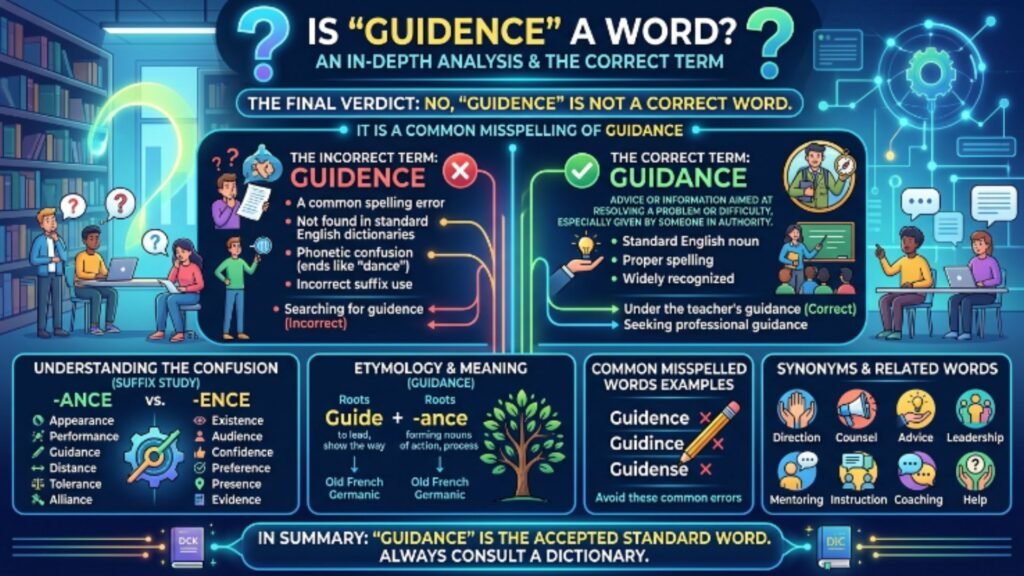
No. Guidence is not an accepted English word. You won’t find it in Merriam Webster, Oxford, or Cambridge dictionaries.
It’s a misspelling that happens because the -ence ending sounds almost identical to -ance when spoken out loud. Words like confidence and evidence use -ence, and that pattern bleeds into how people spell guidance.
If guidence ever shows up in your writing, it’s an error to fix, not a stylistic choice. Spell checkers usually catch it, but it still slips through in emails and quick messages.
Why Do People Confuse Guidance And Guidence?
The confusion comes down to sound and spelling not matching up cleanly. English has plenty of words ending in -ence, and plenty ending in -ance, and the pronunciation of both is nearly the same.
Say guidance and confidence out loud back to back. The final syllable sounds almost identical, even though the spelling is different. That’s where the spelling confusion starts for a lot of writers.
Add in autocorrect that doesn’t always catch it, and fast typing where people trust their ear, and you get a spelling error that keeps repeating across emails, essays, and social posts.
How To Remember The Correct Spelling
Here’s a simple trick. Guide gives guidance. If you can spell guide, you can spell the word correctly, since it’s just guide plus -ance.
- Start with the base word: guide
- Drop the silent e
- Add -ance, not -ence
- You get guidance
This spelling memory trick works because the connection between guide and guidance is obvious once you see it written out. Keep that link in mind and the mistake becomes much harder to make.
Pronunciation Of Guidance
Guidance is pronounced GUY-duns. Two syllables, with the stress landing hard on the first one.
The second syllable is soft, almost swallowed in natural speech. That soft -ance pronunciation is exactly why people guess at the spelling and land on -ence instead.
Practice saying it slowly a few times: guide, then guidance. Hearing the connection between the two words helps lock in both the sound and the correct spelling at once.
Guidance As A Noun
Guidance functions as a noun in every sentence you’ll find it in. It’s not a verb, and it never changes form to describe an action someone is doing.
As a noun form, it names a thing, in this case, a type of help or direction. You give guidance, receive guidance, or ask for guidance, but you never “guidance” someone the way you might “guide” them.
This matters for English grammar because writers sometimes try to force it into a verb slot. That’s where usage mistakes creep in, which we’ll cover a bit further down.
Guidance In School And Education
In schools, guidance shows up constantly. A guidance counselor helps students figure out class selection, college applications, and even tricky academic decisions that feel bigger than they are at seventeen.
Parents lean on this kind of academic guidance too. When a kid is stuck choosing a major or figuring out study habits, a good counselor’s advice can save months of second guessing.
I remember sitting across from my own guidance counselor, totally unsure about career planning, and one honest conversation changed my entire course list. That’s the real value of solid student development support.
Guidance In The Workplace
Workplace guidance looks different but works the same way. A manager or supervisor gives new employees direction on company policy, project expectations, and how things actually get done day to day.
Good leadership isn’t about barking instructions. It’s professional guidance delivered clearly, so employees understand the why behind a task, not just the what.
Even remote workers need this. Without a hallway conversation to lean on, clear written workplace training and steady team leader check ins become the main source of direction for the whole team.
Guidance In Personal Life
Outside of school and work, guidance still matters. Parents give children direction on everyday choices. Friends offer honest guidance during a rough patch, the kind that doesn’t sugarcoat things.
A trusted mentor can reshape a career change decision with one blunt conversation over coffee. That’s the power of personal decisions made with someone else’s perspective in the mix.
Some people also seek spiritual guidance or moral guidance during a difficult time. Whatever form it takes, the goal stays the same: clearer thinking through someone else’s supportive guidance.
Guidance In Legal, Financial, And Professional Contexts
Legal guidance comes from a lawyer, someone with the training to walk you through a contract before you’re signing an agreement. This isn’t the moment to guess. Professional advice here protects you.
Financial guidance works the same way. An advisor helping with major financial decisions or a company issuing financial guidance to investors for next quarter is offering informed, professional direction, not a casual opinion.
Both cases share one thing: the guidance comes from a qualified source with real knowledge and responsibility behind their words. That’s what separates professional guidance from a random tip.
Guidance Vs Advice
Guidance and advice overlap, but they’re not identical twins. Advice tends to be a specific recommendation for one moment, like “take the highway, not the back roads.”
Guidance is broader and often ongoing. A mentor’s counsel over months, or a teacher’s instruction across a whole semester, that’s guidance. It’s support with staying power, not a single tip.
Think of advice as a suggestion dropped in passing. Guidance is closer to someone walking alongside you while you figure things out.
Guidance Vs Guide
A guide can be a person or a resource, like a travel guide or a person who leads a hike. Guidance is the actual help that person or resource provides.
So a guide helps or leads. Guidance is what results from that help. One’s the source, the other’s the outcome.
If someone guides you through a process, the direction they give along the way is the guidance itself. Simple as that.
Guidance Vs Guidelines
Guidelines are specific, often written rules or recommended procedures. Think safety guidelines or company guidelines posted on a wall somewhere.
Guidance is more general direction, without necessarily being a formal list. A manager might give you guidance on how to approach a project without handing you a written rulebook.
So guidelines are the specific instructions. Guidance is the broader steer that might include, but isn’t limited to, those instructions.
Common Phrases With Guidance
Certain phrases show up again and again with this word. Knowing them helps you use guidance naturally instead of forcing it into odd sentences.
- Provide guidance
- Seek guidance
- Under someone’s guidance
- Follow expert guidance
- Thank you for your guidance
These collocations aren’t random. Native speakers reach for them automatically, which is why learning the common pairings speeds up sounding natural in both formal writing and casual conversation.
Common Mistakes With Guidance
Even confident writers slip up here occasionally. Let’s break down the four mistakes that show up most often.
Mistake 1: Writing Guidence Instead Of Guidance
This is the big one. It’s a straightforward spelling error, almost always caused by trusting how the word sounds rather than how it’s actually built from guide.
Mistake 2: Using Guidance As A Verb
You can’t “guidance” someone. The word stays a noun. If you need a verb form, use guide instead, as in “she guided the new hire through onboarding.”
Mistake 3: Making Guidance Plural
Guidance is typically an uncountable noun, so “guidances” isn’t standard usage. Instead, say “some guidance” or “a piece of guidance” when you need to talk about individual instances.
Mistake 4: Using Guidence In Formal Writing
A misspelling in a text message is forgivable. In a job application, a report, or business writing, it signals carelessness. Always double check before hitting send on anything formal.
Is Guidance Countable Or Uncountable?
Mostly uncountable. You wouldn’t say “three guidances.” Instead, you’d talk about the amount or quality of it, like “a lot of guidance” or “clear guidance.”
When you need to reference a specific instance, use a workaround phrase. “A piece of guidance” or “some guidance” both work well and sound natural in real conversation.
This isn’t unusual. Plenty of English nouns, like advice and information, follow the same uncountable noun pattern, which is worth remembering if this trips you up.
Correct And Incorrect Examples
Seeing the word in action, both right and wrong, makes the rule stick faster than any explanation alone.
Correct Examples
- “I really appreciate your guidance on this project.”
- “The guidance counselor helped her pick classes for next year.”
- “We’re waiting on financial guidance before we finalize the budget.”
Incorrect Examples
- “I really appreciate your guidence on this project.”
- “She guidanced me through the whole process.”
- “We received three separate guidances from the team.”
Synonyms For Guidance
Need a fresh word for variety in your writing? Try one of these depending on the tone you’re after.
- Advice
- Direction
- Instruction
- Counsel
- Mentoring
- Coaching
- Support
Each carries a slightly different flavor. Counsel feels more formal, while coaching leans casual and hands on. Pick based on the context you’re writing in.
Antonyms And Opposite Ideas
On the flip side, you’ve got words like confusion, misdirection, and neglect. These describe exactly what happens in the absence of good direction.
Lack of guidance often leads to uncertainty and confused decision-making. Without someone steering, people tend to freeze up or make choices they regret later.
Poor leadership, or simply no support at all, sits at the opposite end of the spectrum from everything we’ve talked about so far in this piece.
Word History In Simple Terms
Guidance traces back to the verb guide, which came into English through Old French and, further back, likely Germanic roots tied to showing or watching.
Once guide existed as a root word, English speakers added the -ance noun ending to turn the action into a concept, the same pattern you see in words like assistance from assist.
That’s really the whole story. Word formation in English often works this way, base word plus ending, which is exactly why the guide memory trick from earlier holds up so well.
Everyday Example Sentences
- “My coach gave me solid guidance before the big match.”
- “Can you offer some guidance on how to fill out this form?”
- “Her parents’ guidance shaped how she handled the whole situation.”
- “The company issued fresh guidance for the upcoming quarter.”
- “I still think about the guidance my old professor gave me.”
Notice how naturally the word slides into completely different settings, sports, paperwork, family, and business, without ever changing its spelling or form.
Mini Practice
Try filling in the blanks before checking your answers.
- “Thank you for your ______ (guidance/guidence).”
- “She ______ (guided/guidanced) the team through the merger.”
- “We need ______ (some guidance/three guidances) on this.”
Answers: guidance, guided, some guidance. If you got all three, the spelling rule has officially clicked.
FAQ
Is guidance or guidence correct?
Guidance is correct. Guidence is a misspelling and isn’t recognized in any standard dictionary.
Is guidence ever acceptable?
No. There’s no context, formal or informal, where guidence is the accepted spelling.
Why do people write guidence?
Because the pronunciation of guidance sounds close to words ending in -ence, like confidence, so writers guess wrong based on sound alone.
What does guidance mean?
It means help, advice, or direction offered to someone making a decision or working through a task.
Is guidance a noun?
Yes, always. Guidance never functions as a verb in standard English.
What is the verb form of guidance?
There isn’t one. Use guide instead, as in “he guided her through the paperwork.”
Can guidance be plural?
Not typically. It’s an uncountable noun, so use “some guidance” or “a piece of guidance” rather than “guidances.”
Is guidance formal or informal?
Both. It works comfortably in a casual text and a formal legal document alike.
What is another word for guidance?
Advice, direction, counsel, and support all work as synonyms for guidance depending on tone.
How do you spell guidance in American English?
The same way as everywhere else: g u i d a n c e. There’s no regional variation for this one.
Conclusion
Guidance is the only correct spelling, and guidence is simply a spelling mistake worth catching before you hit send. Remember the trick: guide plus -ance equals guidance, and you’ll never second guess it again.
Whether you’re writing a school essay, a work email, or asking a mentor for career guidance, getting the spelling right builds trust in your writing. Small details like this add up fast in how readers judge your credibility.
Keep the guide connection in your back pocket, and this word will stop tripping you up for good.

Arthur Whitmore is a passionate grammar enthusiast and language writer at Hexobrust.com. He creates clear, helpful content on grammar, spelling, and everyday English to make learning simple and enjoyable.
