


Both spellings are correct. Cozy is the standard American English spelling, while cosy is the standard British English spelling. Neither one is a typo. You’re just looking at two sides of the same coin, split by the ocean between the US and the UK.
If you’ve ever typed one version and had a red squiggly line pop up under it, you’re not alone. That little glitch trips up writers, students, and even native speakers all the time. So let’s clear it up for good.
Quick Answer
Use cozy if you’re writing for a US audience, and use cosy if you’re writing for British, Australian, or most other English speaking readers outside America. Both words mean the same thing: warm, comfortable, and inviting.
There’s no grammar rule that makes one version “more correct” than the other. It all comes down to regional spelling and who’s going to read your words.
Cozy vs Cosy At A Glance
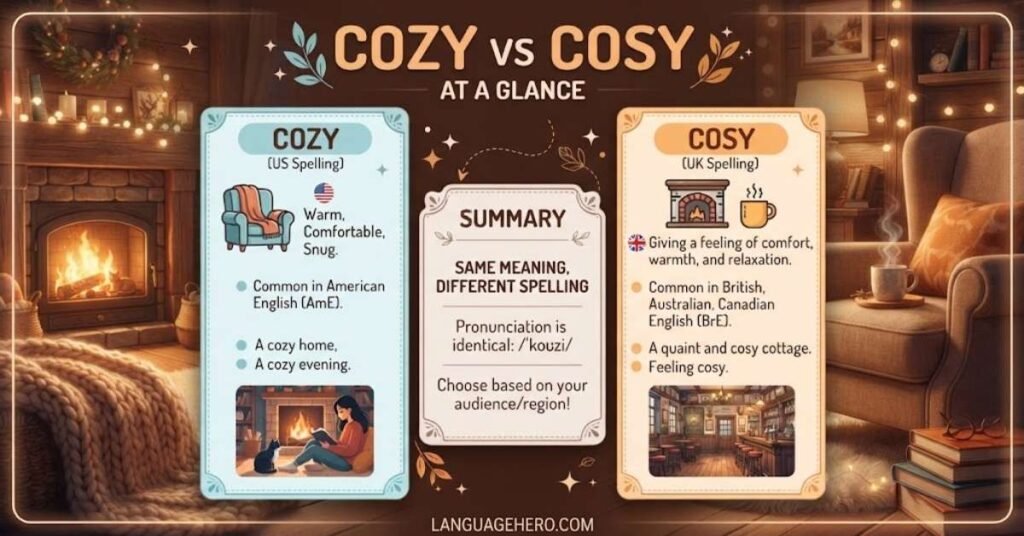
Here’s a quick snapshot before we go deeper.
| Feature | Cozy | Cosy |
| Region | American English, Canadian English | British English, Australian English |
| Meaning | Warm and comfortable | Warm and comfortable |
| Pronunciation | KOH-zee | KOH-zee |
| Noun form | Cozy (as in tea cozy, less common) | Cosy (tea cosy, more common) |
Same sound, same meaning, different spelling habits. That’s really the whole story in one table.
Why Are There Two Spellings?

This split isn’t random. It traces back to language reforms in the early 1800s, when American lexicographer Noah Webster wanted to simplify English spelling for US readers. He trimmed extra letters from a bunch of words, and that same pattern shows up in color vs colour and center vs centre.
British English kept its older forms, while American English leaned toward shorter, more phonetic spellings. Cozy picked up the “z” because it matched how Americans wanted their words to look and sound. Cosy stuck with the softer “s” that British writers were already used to.
Neither choice is better. It’s just history doing what history does, nudging language in different directions depending on where you stand.
What Does Cozy Mean?
Cozy describes something that feels warm, snug, and comfortable. Picture a cozy blanket on a cold night or a cozy corner with a good book and a cup of tea. That’s the feeling this word is built to capture.
It also stretches to describe a mood or a relationship. You might read about a cozy dinner for two, or a business deal that seems a little too cozy with industry leaders. Context shifts the tone from wholesome to suspicious pretty fast.
American writers, bloggers, and brands lean on this spelling constantly, especially around home decor, fall content, and lifestyle pieces. If your audience is mostly in the US, this is your go to spelling.
What Does Cosy Mean?
Cosy means exactly the same thing as its American twin: warm, snug, and comfortable. A cosy cabin, a cosy evening, or a cosy café all paint the same mental picture as their American counterparts.
British readers also use cosy for that intimate, small setting feeling, whether it’s a cosy bedroom or a cosy reading corner by the window. The word carries the exact same warmth, just spelled the British way.
You’ll spot cosy all over UK lifestyle blogs, cosy crime novels, and even product descriptions for a tea cosy or an egg cosy. It’s the default in British, Australian, and most Commonwealth English.
Which Spelling Should You Use?
The honest answer is: it depends on your audience. Think about who’s reading before you think about which spelling looks nicer.
For American English
Stick with cozy. This is the accepted US spelling, and using cosy in American content can look like a mistake to your readers, even though it isn’t technically wrong.
For British English
Go with cosy. It’s the standard UK spelling, and it matches the conventions your British audience already expects from British English spelling.
For Canadian English
Canadian English tends to favor the American cozy, though you’ll occasionally spot cosy creeping in from British influence. When in doubt, cozy is the safer bet for a Canadian audience.
For International Content
If you’re writing for a global audience, pick one spelling and stay consistent throughout the piece. Mixing both versions in the same article looks sloppy and can confuse readers who notice the inconsistency.
Cozy And Cosy As Adjectives
Both words work as adjectives, describing comfort in a few different flavors. Let’s break down the three main ways people use them.
Physical Comfort
This is the most literal use. A cozy sweater, a cozy blanket, or cozy socks all describe something that physically warms you up and feels good against your skin.
A Pleasant Atmosphere
Sometimes it’s not about touch, it’s about vibe. A cozy atmosphere in a coffee shop, with soft lighting and candles, creates a feeling of comfort without anyone touching anything warm at all.
A Small, Intimate Setting
A cozy corner, a cozy cabin, or a cozy kitchen often just means small and welcoming. Size and warmth get tangled together here, and that’s exactly the point.
Comparative And Superlative Forms
Things get a little tricky once you start comparing. In American English, the comparative and superlative forms are cozier and coziest. British English swaps in cosier and cosiest.
Notice the pattern holds steady: swap the “z” for an “s” and you’ve converted from American to British spelling every single time. The adverb forms follow suit too, with cozily on the American side and cosily on the British side, along with coziness versus cosiness.
Keep this consistency in mind when you’re writing longer pieces. Switching spelling mid article, even just on the comparative form, breaks the flow and looks like an oversight.
Cozy Up Or Cosy Up?
Cozy up means to snuggle in and get comfortable, like when you cozy up on the couch with a blanket. It also gets used to describe getting friendly with someone, sometimes with a hint of suspicion, like a politician who seems to cozy up to a particular industry.
British writers use cosy up the exact same way, whether that’s cosied up by the fire or cosying up to a new business partner. The meaning never changes, only the letters do.
Watch your spelling here especially, since verb forms like cozied and cozying need that consistent regional spelling all the way through, not just in the base word.
Cozy As A Noun
Here’s where it gets interesting. As a noun, cozy refers to a cover, usually one that keeps something warm, like a tea cozy placed over a teapot or an egg cozy for a soft boiled egg.
In American English, this noun use is fairly rare these days, since Americans don’t talk about tea cozies nearly as often as the British do. It still shows up occasionally in a coffee-pot cozy or similar product names.
British English uses cosy as this noun far more often, and you’ll spot tea cosy and egg cosy regularly in UK homeware shops and cookbooks. This is one spot where the British version genuinely gets more everyday use.
Cozy Mystery Or Cosy Mystery?
If you love a good whodunit without the gore, you’ve probably run into this genre. A cozy mystery is a lighthearted crime novel, usually featuring an amateur investigator, a small community, and very limited graphic violence.
American publishers and readers call it a cozy mystery, while British publishing often labels the same genre a cosy mystery or cosy crime. Same books, same charm, different spelling on the cover depending on which side of the Atlantic prints it.
If you’re writing book reviews or recommendations, match your spelling to your target market. A US book blog should say cozy mystery, while a UK site should stick with cosy crime.
Common Phrases With Cozy And Cosy
Certain phrases pop up constantly with these words, and knowing them helps your writing sound natural rather than stiff.
American English
Americans commonly say cozy home, cozy room, cozy bedroom, and cozy evening. You’ll also hear cozy relationship used with a slightly wary tone when someone’s getting too close to a person or group they shouldn’t be.
British English
British speakers favor cosy home, cosy room, cosy chair, and cosy evening. The phrase cosy with shows up too, often carrying that same suspicious undertone about improper closeness in a professional or political setting.
Tone, Context, And Formality
Both words fit casual and semi formal writing beautifully, but they rarely show up in strictly formal documents. You won’t find cozy or cosy in a legal contract or a scientific paper, and that’s fine, because these words were built for warmth, not stiffness.
Casual writing, blogs, product descriptions, and lifestyle content are where these words shine brightest. Match your spelling to your audience’s region, and you’ll sound like you actually know who you’re talking to.
If you’re ever unsure which tone fits, lean casual. Nobody’s going to complain that a piece about a cozy cabin sounds too relaxed.
Common Mistakes And Quick Fixes
Let’s walk through the slip ups people make most often, and how to fix each one fast.
Using Cosy In American Content
If your target readers are American, swap cosy for cozy every time. It’s a small fix, but it matters for spelling consistency and keeps your content looking polished to a US audience.
Using Cozy In British Content
The reverse applies here too. British readers expect cosy, so keep your UK style consistent from headline to footer.
Mixing Related Forms
Watch out for switching mid word family, like writing cozy in one paragraph and cosiness in the next. Pick your region and carry it through every related word, including comparatives and adverbs.
Spelling Cozier With A Double Z
Some writers accidentally double the z, spelling it “cozzier.” That’s simply wrong in both American and British English. The correct forms are always cozier or cosier, never with a doubled letter.
Using Cozy To Mean Cramped
Be careful with tone here. Cozy should suggest pleasant comfort, not tight, uncomfortable cramped quarters. If a space genuinely feels crowded rather than charming, choose a different word so you don’t send mixed signals to your reader.
Examples Of Cozy In American English
Seeing the word in action helps everything click. Here are a few natural, everyday sentences.
- We spent a cozy evening by the fireplace with hot cocoa.
- Her apartment felt small but cozy, with warm lighting and thick blankets everywhere.
- The bookstore had a cozy reading area tucked behind the front counter.
- He wrapped himself in a cozy sweater before heading out into the cold.
Examples Of Cosy In British English
Now here’s the same warmth, dressed in British spelling.
- The cottage had a cosy atmosphere, complete with a crackling fire and soft pillows.
- She curled up in a cosy chair near the window with her tea.
- Their new flat felt cosy rather than cramped, thanks to clever furniture choices.
- We booked a cosy hotel room for the weekend getaway.
How To Remember The Difference
Here’s a trick that sticks. Think of the “z” in cozy as standing for the good old USA, since American English loves its zesty z’s in words like organize and realize. British English trims that z away, leaving the softer cosy.
Another quick memory hook is the acronym trick: Cozy has a Z like USA, while Cosy keeps things simple like the UK. Whichever trick sticks in your head, use it, because consistency matters more than the specific memory device you pick.
Additional Tips For Choosing The Right Spelling
A few extra pointers can save you from second guessing yourself later.
If you’re writing for a global blog with readers from everywhere, check your site’s style guide first. Many international publications pick one spelling standard and apply it across every article, regardless of the topic.
Browser spell checkers often default to American English, so don’t automatically trust a red squiggly line under cosy. It might just mean your settings are tuned to the wrong region, not that you’ve made an actual mistake.
Conclusion
Both cozy and cosy describe that warm, snug, wonderful feeling we all chase on a cold evening. The only real difference is geography: cozy belongs to American and Canadian English, while cosy belongs to British and Australian English.
Pick the spelling that matches your audience, stay consistent through every comparative, adverb, and related phrase, and you’ll never trip over this one again. Now go enjoy something cozy, or cosy, whichever side of the pond you’re writing from.
FAQs
Which is correct, cozy or cosy?
Both are correct. Cozy is standard in American English, and cosy is standard in British English.
Is cozy the American spelling?
Yes, cozy is the accepted spelling in the United States and generally in Canada as well.
Is cosy used in British English?
Yes, cosy is the standard spelling across the UK, Australia, and most Commonwealth countries.
Do cozy and cosy have different meanings?
No, they mean exactly the same thing: warm, comfortable, and inviting. Only the spelling changes by region.
Is it cozy room or cosy room?
Use cozy room for American readers and cosy room for British readers. Both describe the same warm, comfortable space.
Is it cozier or cosier?
Cozier is the American comparative form, while cosier is the British comparative form. Both mean “more cozy” or “more cosy.”

Arthur Whitmore is a passionate grammar enthusiast and language writer at Hexobrust.com. He creates clear, helpful content on grammar, spelling, and everyday English to make learning simple and enjoyable.
