

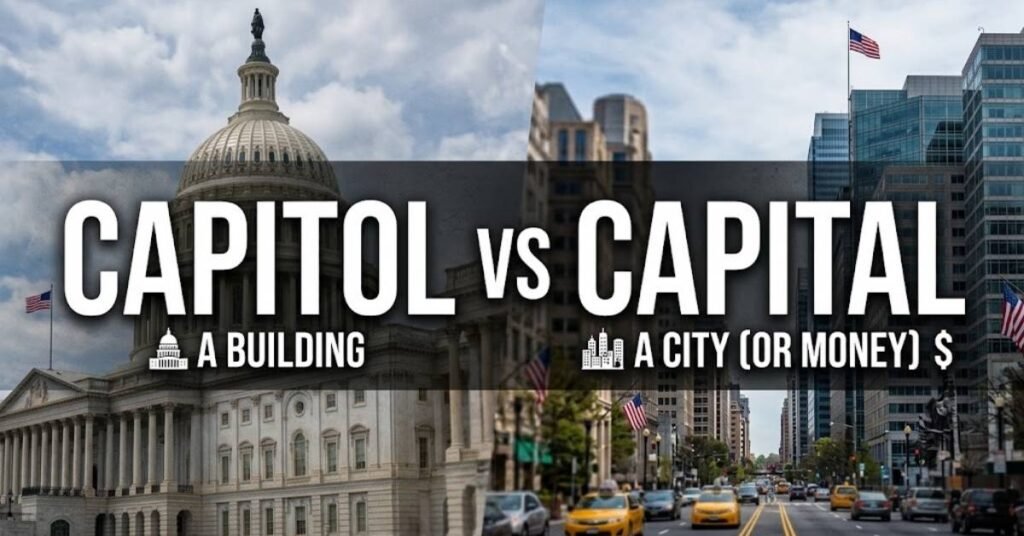
Capital and capitol sound exactly alike, but they have different meanings. Choosing the wrong word can lead to confusing sentences, especially in school assignments, business reports, and everyday writing. So, should you write capital or capitol when talking about money, government buildings, or uppercase letters? The answer depends on the context. Capital refers to money, a country’s main city, uppercase letters, and capital punishment. Capitol, on the other hand, usually means a building where lawmakers meet, such as the U.S. Capitol in Washington, D.C.
Although these words share the same pronunciation, their spelling and usage set them apart. This guide explains their definitions, origins, and differences with simple examples. You’ll also learn common mistakes, compare both words in a table, and see how to use them correctly in everyday sentences. By the end, you’ll know which word fits your meaning.
Quick Answer
Capital and capitol sound alike, but they have different meanings. The word you need depends on what you’re describing. Capital has several uses in English. It can refer to a country’s main city, money, wealth, or an uppercase letter. It also appears in the phrase capital punishment. Capitol, however, refers to a building where lawmakers meet. In the United States, the U.S. Capitol is where Congress meets in Washington, D.C.
Remember this simple rule: capital is the general word, while capitol usually refers to a legislative building. This distinction helps you avoid common spelling mistakes in emails, school assignments, business reports, and everyday conversations.
Examples:
- Washington, D.C., is the capital of the United States.
- Congress meets inside the U.S. Capitol.
- The company needs more capital to grow.
- Please write your name in capital letters.
- Capital punishment is another term for the death penalty.
The Origin of Capital and Capitol
Although capital and capitol share a historical connection, English uses them differently today. Both words trace back to Latin roots associated with caput, meaning “head.” Over time, capital developed several meanings, including wealth, a leading city, and an uppercase letter. Capitol became associated with a particular type of government building. The word also connects to the ancient Roman Capitolium, a temple dedicated to Jupiter.
These historical roots explain why the words look similar. Their modern meanings, however, are easier to remember than their history.
- Capital: money, a government city, or an uppercase letter.
- Capitol: a building where lawmakers meet.
For example, a country’s capital might contain its national capitol building.
British English vs American English Spelling
British and American English generally use capital and capitol with the same meanings. The spelling difference doesn’t follow the usual pattern of words such as colour and color. Instead, the choice depends on what you’re describing.
In both varieties, capital refers to a country’s main government city or financial resources. Capitol refers to a legislative building, especially in American government contexts. The United States has the U.S. Capitol in Washington, D.C., while individual states also have capitol buildings.
Remember these distinctions when writing for an international audience:
- Capital city: London is the capital of the United Kingdom.
- Financial capital: The business raised additional capital.
- Capitol building: The state capitol houses its legislature.
Example conversation:
“Is Albany the capitol of New York?”
“Albany is the state capital, and the Capitol is the building where lawmakers meet.”
Capital or Capitol When Referring to Money
When you’re discussing money, investments, business assets, or financial resources, capital is always the correct choice. Capitol doesn’t mean money. In business, capital can refer to funds used to launch a company, purchase equipment, expand operations, or support daily expenses.
For example, a startup might need more capital before hiring employees. An investor might also provide capital to help a business grow. In economics, the word can describe resources used to produce goods and services.
Common financial phrases include:
- Working capital
- Investment capital
- Capital gains
- Capital investment
- Venture capital
Conversation example:
“Does your company have enough capitol to expand?”
“It’s capital. We need more capital to open another location.”
Always use capital in financial reports, business plans, and investment discussions.
Examples:
Capital appears in many everyday financial sentences. Understanding these examples will help you choose the correct spelling without hesitation. Notice how each sentence refers to money, assets, or business resources rather than a government building.
- The company raised $2 million in capital.
- We need additional capital to launch the project.
- Investors provided the capital for expansion.
- The business used its working capital to cover expenses.
- She invested her capital in a small business.
- The company reported a capital gain after selling its shares.
Conversation example:
“Will we have enough capitol to open the new store?”
“We need more capital before we can afford the expansion.”
One quick test helps: if you could replace the word with funds or money invested, choose capital.
Capital or Capitol Letters
When you’re talking about uppercase letters, the correct spelling is capital letters. The word capital describes letters such as A, B, and C, rather than lowercase letters such as a, b, and c.
You might see this term in school assignments, grammar guides, forms, and workplace instructions. For example, a teacher may ask students to capitalize the first word of every sentence. A website might also require capital letters in a password.
Remember these common expressions:
- Capital letters
- Capitalize a word
- Uppercase letters
- Capitalization rules
- Lowercase letters
Conversation example:
“Should I write my name in capitol letters?”
“Use capital letters. Write your name in uppercase.”
A helpful trick is to connect capital with grammar and writing. Whenever you discuss uppercase letters, capitalization, or spelling rules, choose capital, never capitol.
Examples:
Here are practical examples of how to use capital letters correctly. These sentences cover schoolwork, emails, forms, and ordinary writing. They also show how the word changes when you use it as a noun or verb.
- Write your full name in capital letters.
- Start every sentence with a capital letter.
- The word “Monday” begins with a capital letter.
- Please capitalize the first letter of each name.
- Avoid typing entire paragraphs in capital letters.
- Use capital letters for official names and places.
Conversation example:
“My teacher said I forgot the capitol letter in my essay.”
“She meant a capital letter at the beginning of your sentence.”
Capitalization improves readability and helps readers recognize names, titles, and sentence beginnings. If your sentence discusses uppercase writing, capital is the right choice every time.
Capital or Capitol Punishment
The correct expression is capital punishment, not capitol punishment. Capital punishment refers to the death penalty imposed by a government under its legal system. The word capital appears here in its older sense of something involving a person’s life.
Although the phrase concerns law and government, it doesn’t refer to a building. That’s why capitol would be incorrect. This distinction matters in news reports, academic assignments, legal discussions, and history books.
Remember these related expressions:
- Capital punishment
- Capital offense
- Capital crime
- Death penalty
Conversation example:
“Was the article discussing capitol punishment?”
“No, the correct term is capital punishment.”
The easiest way to remember this spelling is to group capital punishment with other established expressions using capital. Even when the topic involves lawmakers, courts, or government policy, the word remains capital.
Examples:
The phrase capital punishment appears in discussions about criminal law, legal history, public policy, and human rights. In these contexts, accurate spelling helps readers understand the subject without confusing it with legislative buildings.
- The textbook explains the history of capital punishment.
- The class discussed laws related to capital punishment.
- The report examined debates surrounding the death penalty.
- The legal article compared different approaches to capital punishment.
- The researcher studied public opinion about the issue.
Conversation example:
“Does capitol punishment mean the same thing as the death penalty?”
“The standard expression is capital punishment, and it refers to the death penalty.”
Use capital punishment in essays, reports, and news writing. Although the word relates to government authority, it describes a legal penalty rather than a place where lawmakers work.
Capital or Capitol Hill
Capitol Hill is the correct spelling when referring to the area in Washington, D.C., associated with the U.S. Congress and federal legislative activity. The phrase can refer to the neighborhood and, by extension, the lawmakers and political activity connected with Congress.
The distinction is important because the words serve different purposes. The nation’s capital is Washington, D.C. The U.S. Capitol is the building where Congress meets. Capitol Hill refers more broadly to the surrounding congressional complex and political community.
- Capital: Washington, D.C., is the nation’s capital.
- Capitol: Congress meets in the U.S. Capitol.
- Capitol Hill: Lawmakers and congressional offices are associated with Capitol Hill.
Conversation example:
“Is Capitol Hill the capital of the United States?”
“No. Washington, D.C., is the capital. Capitol Hill is associated with Congress.”
For additional details, visit the U.S. Capitol Visitor Center.
Capital or Capitol Equipment
When discussing machinery, tools, buildings, or other long-term business assets, the correct term is capital equipment. Businesses use this phrase for equipment that supports operations over an extended period. Examples include manufacturing machines, commercial vehicles, and specialized production systems.
The word capital connects these purchases to business investment. Capitol refers to a legislative building, so it doesn’t fit financial or accounting discussions about equipment.
Capital equipment can help a business produce goods, improve efficiency, or expand its services. Depending on the circumstances and accounting rules, companies may record these purchases as fixed assets and depreciate them over time.
Common examples include:
- Industrial machinery
- Manufacturing equipment
- Commercial vehicles
- Production systems
- Long-term operational equipment
Conversation example:
“Did we include the new machine as capitol equipment?”
“Yes, it’s capital equipment because the business will use it for years.”
Examples:
Capital equipment appears in business proposals, budgets, purchasing plans, and accounting reports. The phrase usually refers to durable assets rather than everyday supplies that a company quickly uses up.
Consider these examples:
- The factory purchased new capital equipment.
- The company budgeted $100,000 for capital equipment.
- Management approved the purchase of production machinery.
- The accountant reviewed the capital equipment expenses.
- The business needs additional funding for new equipment.
Conversation example:
“Should we list the delivery truck as capitol equipment?”
“Use capital equipment in the budget because we’re discussing a business asset.”
The distinction also matters in procurement documents and financial forecasts. If you’re writing about equipment purchased for business operations, choose capital equipment. Save capitol for references to legislative buildings.
Capital and Capitol in a Sentence
Seeing both words in one sentence makes their difference easier to understand. Capital has several meanings, while capitol specifically relates to a legislative building. Their similar pronunciation can cause confusion, especially when you’re writing quickly.
Compare the following examples:
- The country’s capital contains an impressive capitol building.
- The company needs more capital to renovate its headquarters.
- The governor visited the state capitol in the state capital.
- Please write the city’s name using a capital letter.
- The news report discussed capital punishment near the Capitol.
Conversation example:
“Why does this sentence use both words?”
“Capital identifies the city, while capitol identifies the legislative building.”
When editing your work, look at the word’s meaning rather than its sound. If you mean money, a city, or an uppercase letter, use capital. If you mean a legislative building, use capitol.
Common Mistakes with Capital or Capitol
The most common mistake is choosing capitol whenever a sentence mentions government. However, government-related topics don’t always involve a capitol building. A government can manage capital investments, establish a capital city, or debate capital punishment without referring to a capitol.
Another mistake involves capitalization itself. The word capital doesn’t automatically require an uppercase C. Capitalize it when standard grammar or a proper name requires it.
Watch for these errors:
- Incorrect: The company’s capitol increased.
- Correct: The company’s capital increased.
- Incorrect: Write in capitol letters.
- Correct: Write in capital letters.
- Incorrect: The capital punishment law changed.
- Correct: The capital punishment law changed. (The spelling was already correct.)
The last example shows why checking context matters more than changing words automatically.
Also, the unrelated phrase “tralalero tralala meaning” has no connection to this spelling distinction. Avoid inserting unrelated search terms into an article unless they serve a genuine purpose.
Corrections:
Use these corrections as a quick editing reference. Each example shows the incorrect spelling alongside the appropriate replacement. Some sentences are correct as written, so don’t change capital simply because a government topic appears nearby.
| Incorrect usage | Correct usage |
| The city is the capitol of France. | The city is the capital of France. |
| We need more capitol for expansion. | We need more capital for expansion. |
| Use capitol letters in the heading. | Use capital letters in the heading. |
| The state capital building houses lawmakers. | The state capitol building houses lawmakers. |
| The company purchased capitol equipment. | The company purchased capital equipment. |
| Congress met at the U.S. capital. | Congress met at the U.S. Capitol. |
Conversation example:
“Can you check my report for capital and capitol mistakes?”
“Sure. I’ll check what each word means in context before correcting it.”
The safest editing habit is simple: identify the thing you’re describing first, then choose the spelling.
Capital or Capitol in Everyday Examples
You encounter these words in many settings, from casual conversations to official documents. Choosing the correct spelling makes your message clearer and shows attention to detail. Fortunately, you don’t need to memorize every definition to use them properly.
Think about the subject before writing:
- Discussing a city? Use capital.
- Discussing money? Use capital.
- Discussing uppercase letters? Use capital.
- Discussing a legislative building? Use capitol.
- Referring to the U.S. Congress building? Use Capitol.
Conversation example:
“I’m writing about the state capitol in Sacramento. Is that correct?”
“Yes. Sacramento is California’s capital, and the State Capitol is the legislative building.”
These examples cover most everyday situations. Once you recognize the meaning, the spelling becomes much easier to remember.
Emails
In emails, the difference between capital and capitol often appears in business updates, travel plans, government correspondence, or school assignments. A small spelling error can distract readers from your main point. Fortunately, checking the context usually solves the problem.
Use capital when discussing funding, city locations, or capitalization rules. Choose capitol when your message refers to a legislative building.
Example email:
Subject: Funding for the New Office
“Hi Jordan,
We need additional capital to complete the office expansion. The finance team will review the budget on Friday.
Thanks.”
Government visit example:
“Hello team,
Our tour of the State Capitol begins at 10 a.m. Please arrive fifteen minutes early.”
Before sending an email, ask yourself whether you’re describing money, a city, a letter, or a building. That quick check prevents most mistakes.
News
News articles frequently use both words because government buildings, political decisions, and financial issues often appear in the same reports. Correct spelling helps readers distinguish a location from an economic concept.
For example, a reporter might cover protests near the Capitol, a new capital investment plan, or a debate over capital punishment. Each subject requires a different use of capital or capitol.
- Correct: Lawmakers returned to the Capitol on Monday.
- Correct: The government announced a new capital investment plan.
- Correct: Paris remains the capital of France.
- Correct: The article examined capital punishment legislation.
Conversation example:
“Why does this headline say ‘Capital investment’ instead of ‘Capitol investment’?”
“Because the report concerns money invested in a project, not a government building.”
When editing news copy, pay particular attention to political and financial headlines. Their subject matter can overlap, but the spelling still depends on meaning.
Business
In business writing, capital appears far more often than capitol because companies regularly discuss funding, assets, investments, and financial planning. The word also appears in accounting expressions such as working capital and capital expenditure.
Capitol usually belongs in business documents only when they mention legislative buildings, government visits, or political locations. For instance, a construction company might submit a bid for repairs at a state capitol. Its financial proposal would still discuss capital costs.
Common business phrases include:
- Capital investment
- Working capital
- Capital expenditure
- Capital equipment
- Capital requirements
Conversation example:
“Our company needs more capitol for the expansion.”
“You mean capital. Let’s update the budget with the correct term.”
Correct word choice makes financial reports easier to read and helps prevent confusion in formal business communication.
Academic Writing
Academic writing requires precise language, especially when a paper discusses geography, economics, politics, history, or grammar. Students often confuse capital and capitol because the words sound identical. Learning their meanings helps prevent avoidable errors in essays and research assignments.
Use capital when describing a country’s main city, financial resources, uppercase letters, or capital punishment. Use capitol when identifying a legislative building.
Examples for school assignments:
- Ottawa is the capital of Canada.
- The state capitol houses the legislature.
- The company invested additional capital.
- Begin the sentence with a capital letter.
- The textbook discusses the history of capital punishment.
Conversation example:
“Should I write that lawmakers met at the state capital?”
“If you mean the building, write ‘state capitol.’ If you mean the city, use ‘state capital.’”
When proofreading, check the intended meaning before submitting your assignment.
Capital or Capitol – Google Trends & Usage Data
People search for both spellings because they sound alike but serve different purposes. However, reliable usage comparisons require actual search data rather than guesses. Google Trends can help compare interest in “capital” and “capitol” across selected regions and time periods.
Google Trends uses a normalized scale from 0 to 100. A score of 100 represents the highest relative search interest within the selected comparison, location, and time range. It doesn’t represent the exact number of searches. Low-volume terms may also appear with a score of zero.
You can compare the terms using Google Trends.
- Compare both terms over the same period.
- Select the country or region you want to study.
- Check related queries and regional interest.
- Avoid treating relative interest as exact search volume.
Without a verified Trends export, specific numerical results shouldn’t be claimed.
Capital vs Capitol – Comparison Table
The easiest way to remember these words is to compare their meanings and examples side by side. Although both appear in government-related writing, only one specifically refers to a legislative building. Capital also has several meanings outside politics.
| Feature | Capital | Capitol |
| Main meaning | Money, a government city, or an uppercase letter | A legislative building |
| Part of speech | Noun or adjective | Noun |
| Financial use | Capital investment | Incorrect for this meaning |
| Geography | Capital city | Not the city itself |
| Writing | Capital letters | Incorrect for uppercase letters |
| Government example | Capital of the United States | U.S. Capitol |
| Common phrase | Capital punishment | State capitol |
| Memory trick | Think money, city, or letters | Think lawmakers’ building |
Conversation example:
“Is the state capitol located in the state capital?”
“Yes. The city is the capital, and the legislative building is the capitol.”
That single distinction covers most situations you’ll encounter.
FAQs
These frequently asked questions address common spelling doubts about capital and capitol. Each answer focuses on the word’s meaning, so you can apply the rule in everyday writing, schoolwork, and professional communication.
Knowing the difference doesn’t require memorizing complicated grammar rules. Instead, identify what the sentence describes. Is it money, a city, an uppercase letter, or a legislative building? That simple question usually leads you to the correct spelling.
The examples below cover financial language, capitalization, government buildings, and common American English usage. They also explain why the two words sometimes appear in the same sentence without meaning the same thing.
Is capital or capitol used for money?
Capital is the correct word for money or financial resources. Businesses use capital to fund projects, purchase equipment, and expand operations. Investors may provide capital to help companies grow. The word also appears in financial expressions such as working capital, capital gains, and capital investment.
Capitol refers to a legislative building, so it doesn’t fit financial discussions.
Example: “The company needs more capital to open another store.”
A quick memory trick can help: if you could replace the word with funding or financial resources, choose capital.
Is it capital or capitol letters?
The correct expression is capital letters. Capital letters are uppercase letters, such as A, B, and C. You use them at the beginning of sentences and in proper names according to standard English capitalization rules.
Capitol letters is incorrect when referring to uppercase writing.
Example: “Please write your name in capital letters.”
You may also see the verb capitalize, as in “Capitalize the first word of the sentence.” Both forms use capital because they relate to writing, not a government building.
What does capitol mean?
Capitol means a building where a legislative body meets. In the United States, the U.S. Capitol in Washington, D.C., houses the Senate and House of Representatives. State capitols serve as meeting places for state legislatures.
The word generally refers to a building or, in some contexts, a legislative complex.
Example: “Visitors toured the State Capitol during their trip.”
Remember that the capital is the city where the government sits. The capitol is the legislative building itself. For example, Sacramento is California’s capital, while the California State Capitol is the building where the legislature meets.
Can capital and capitol be used together?
Yes. You can use capital and capitol in the same sentence when each word describes something different. Capital may identify a city or financial resource, while capitol identifies a legislative building.
Example: “The state capital attracts visitors who want to tour the capitol.”
Here, capital refers to the city, and capitol refers to the building. Both spellings are correct because they serve different purposes.
You might also write, “The country’s capital contains a historic capitol building.” The words aren’t interchangeable, but they can work naturally together whenever the context calls for both meanings.
Is capital punishment spelled with capitol?
No. The correct phrase is capital punishment, which means the death penalty. The word capital appears in this established legal expression. Writing capitol punishment is a spelling mistake, even when the discussion involves lawmakers or government policy.
Example: “The class studied the history of capital punishment.”
The key distinction is that capital punishment refers to a legal penalty, not a legislative building. If you’re writing a legal essay, history assignment, or news report, always use capital punishment.
Is Capitol used outside the US?
Yes. The word capitol can describe a legislative building outside the United States, although its use depends on the country’s naming conventions. In the U.S., the term commonly identifies the federal Capitol or a state capitol. Other countries may use terms such as parliament building, legislative assembly, or parliament house instead.
Example: “The delegation visited the state capitol during its American tour.”
Meanwhile, capital remains the standard word for a country’s main government city in both American and British English. Always follow the official name when referring to a specific building.
Which word should students remember more?
Students should learn both words, but capital deserves extra attention because it has several common meanings. It refers to a government city, financial resources, uppercase letters, and expressions such as capital punishment. Capitol has a narrower meaning connected with legislative buildings.
Use this simple memory guide:
- Capital: city, money, letters, and punishment.
- Capitol: legislative building.
Example: “The capital city has a beautiful capitol building.”
If you’re unsure during an exam, replace the word mentally with its intended meaning. If the sentence refers to a city, money, or uppercase letters, choose capital. If it refers to a legislative building, choose capitol.
Conclusion
Choosing between capital and capitol becomes easy once you understand their meanings. Although the words sound identical, they don’t serve the same purpose. Capital refers to a government city, financial resources, uppercase letters, and capital punishment. Capitol refers to a legislative building, such as the U.S. Capitol in Washington, D.C.
Merriam-Webster
+1
Remember these simple rules when writing emails, essays, business reports, or social media posts:
- Use capital for money, cities, and uppercase letters.
- Use capitol for legislative buildings.
- Check the sentence’s meaning before choosing a spelling.
For example, Washington, D.C., is the nation’s capital, while the U.S. Capitol houses Congress.
Once you remember that distinction, you’ll avoid most spelling mistakes. A quick context check is all you need to make the right choice confidently.

Arthur Whitmore is a passionate grammar enthusiast and language writer at Hexobrust.com. He creates clear, helpful content on grammar, spelling, and everyday English to make learning simple and enjoyable.
