

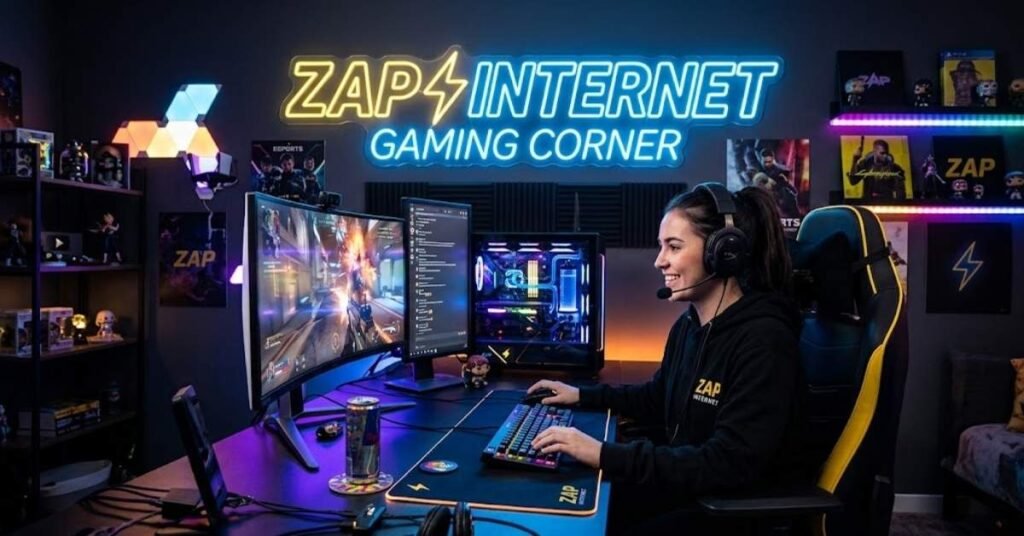
You built the desk, bought the headset, and picked the perfect chair. Then your game freezes right before the final round. Sound familiar?Gaming corner zap-internet is a search term for a gaming space built around a fast, stable internet connection, not just good-looking gear.
In short, it means pairing a comfortable gaming setup with a network that keeps ping, jitter, and packet loss low. This guide explains what the term means, what speeds you really need, and how to fix lag step by step.
What Is Gaming Corner Zap-Internet?
Gaming corner zap-internet is best understood as a gaming setup plus internet optimization. The “gaming corner” is the physical space with your PC, console, monitor, and gaming peripherals. The “zap-internet” part points to the quick, reliable connection that powers it.
Most pages that rank for this phrase describe it as a concept, not a product. That is how we use it here too. It is a practical way to think about low latency gaming: comfort, hardware, and network quality working as one system.
A quick note on trust: a few pages present Zap-Internet as a branded internet provider with fixed plans and guaranteed ping numbers. We could not verify an official provider website, pricing page, or coverage map for that claim. So treat any plan details you see online with caution, and confirm directly with your local internet service provider (ISP) before paying for anything.
What Can You Find in the ZAP-Internet Gaming Corner?
A well-planned gaming corner covers three areas: knowledge, equipment, and community. Each one helps you play better and avoid wasted money.
Gaming Tips and Guides
Good guides save you from trial and error. In a gaming corner zap-internet style setup, you would look for practical help like:
- How to run a speed test and read ping results
- Router and QoS (Quality of Service) settings
- Game settings that reduce input lag
- Fixes for lag spikes and disconnects
The best guides explain the “why” in plain words. If a tip does not say why it works, be careful with it.
Gaming Hardware and Accessories
Hardware is the visible part of your corner. The essentials are:
- A gaming PC or console that matches your games
- A monitor with a good refresh rate
- A gaming router or a solid Wi-Fi 6 router
- Ethernet cable (Cat6 or better) and a network switch if you have several devices
- A gaming headset, mechanical keyboard, and gaming mouse
- A surge protector or UPS for power protection
Spend on the network before the extras. A cheap cable can beat an expensive RGB light strip for real performance.
Gaming Spaces and Community Hubs
Gaming is social. Many people want a place to play with friends, join LAN parties, or run a small esports night. That could be a corner at home, a gaming café, or a local community hub.
These spaces work only when the network infrastructure is solid. Fun fades fast when five players share one weak connection.
How Internet Quality Affects Gaming Performance
Most people blame “slow internet” for lag. In reality, four separate things shape online gaming performance. Knowing them helps you find the real problem.
1. Ping and Latency
Latency is the time data takes to travel from your device to the game server and back. Ping is how we measure it, in milliseconds (ms). Lower is better.
As a general guide, under 20 ms feels excellent, 20 to 50 ms is good, 50 to 100 ms is playable, and over 100 ms is noticeable in fast games. Shooters and fighting games punish high ping the most.
2. Jitter
Jitter is the change in ping from one moment to the next. Your ping might sit at 30 ms, then jump to 90 ms, then drop again. That uneven rhythm hurts timing more than a steady, slightly higher ping.
Wi-Fi interference, busy networks, and network congestion are common causes. Keeping jitter low (ideally under 10 to 30 ms) is key for smooth play.
3. Packet Loss
Packet loss happens when data never reaches its destination. You see it as freezing, rubber-banding, or players teleporting. Ideally, packet loss stays at 0%.
Even 1 to 2% can be felt in competitive games. A weak Wi-Fi signal or a damaged cable is a common culprit.
4. Download and Upload Speed
Download speed and upload speed (measured in Mbps) matter for game downloads, updates, streaming, and cloud gaming. For regular online play, the game itself uses very little bandwidth.
That is why a 1 Gbps plan can still lag. Speed is only one part of the picture. Stability and low latency decide how the game feels.
Quick Targets: What Numbers Should You Aim For?
Use these as practical benchmarks, not strict rules. Different games and servers vary.
- Ping: under 50 ms for most games, under 30 ms for competitive shooters
- Jitter: under 30 ms, lower is better
- Packet loss: 0%, and never consistently above 1%
- Speed for online play: 25 to 50 Mbps is often enough for one player
- Speed for cloud gaming or big households: 100 Mbps or more is safer
- Upload speed: at least 5 to 10 Mbps, more if you stream
Test at different times of day. Evening peak hours often show the real picture.
How to Build a Gaming Corner With Better Internet
You do not need a huge budget. You need a smart order of steps. Follow these five in order.
Step 1: Choose the Right Location
Place your gaming corner as close to your router as you can. Distance and thick walls weaken Wi-Fi fast. A spot near the router also makes a short Ethernet run possible.
Pick a spot with airflow and power outlets too. Heat shortens hardware life, and tangled cords cause accidents.
Step 2: Connect Through Ethernet When Possible
A wired connection is usually the single biggest upgrade. Ethernet gives steadier ping, lower jitter, and fewer drops than Wi-Fi. Use a Cat6 cable for a simple, reliable link.
If you cannot run a long cable, try powerline adapters or a mesh Wi-Fi system with a wired backhaul. Test them first, because results vary by home wiring.
Step 3: Optimize Your Wi-Fi
Sometimes Wi-Fi is your only choice. Make it work better with these steps:
- Use the 5 GHz band, or 6 GHz if your router supports Wi-Fi 6E
- Move the router to an open, central, raised spot
- Pick a less crowded Wi-Fi channel
- Update the router firmware
- Keep the router away from microwaves and cordless phones
These small changes can cut jitter without spending a cent.
Step 4: Reduce Network Congestion
Your connection is shared. A 4K stream, a cloud backup, or a big game update can eat bandwidth while you play.
Try these fixes:
- Pause large downloads during matches
- Turn on QoS or “game mode” in your router to prioritize gaming traffic
- Limit background apps on your PC or console
- Schedule updates for off-peak hours
This is the most underrated part of gaming corner zap-internet planning, because the problem often sits inside your own home.
Step 5: Choose a Nearby Game Server
Distance adds delay. Data travels fast, but a server on another continent will always add ping. Pick the closest server region in the game’s settings.
If the game offers a server browser, choose the lowest ping option, not the most popular one. A VPN can sometimes help with poor routing, but it often adds delay, so test before you commit.
What Equipment Do You Need for a Gaming Corner?
Start with the basics and grow slowly. Here is a simple priority list:
- Reliable router (Wi-Fi 6 or better, with QoS controls)
- Ethernet cable (Cat6 or Cat6a)
- Gaming device (PC, console, or handheld)
- Ergonomic chair and desk for long sessions
- Monitor with a suitable refresh rate (60, 120, or 144 Hz)
- Headset with a clear mic for team chat
- Cable management tools and a surge protector
If you play on mobile, add a stable Wi-Fi spot and a phone stand. A small corner can work well. You do not need a whole room, only a smart layout.
Gaming Corner Zap-Internet for Gaming Cafés and Community Hubs
Running a shared space is different from setting up one desk. Many players share the same line, so small mistakes multiply fast. Here is how to plan it right.
Plan the Space Carefully
Count your stations first, then leave room to walk, sit, and breathe. Check the electrical load and ventilation before adding more machines. Good lighting and comfortable seating keep people coming back.
Also think about noise. A tournament corner needs a different layout from a casual console lounge.
Standardize Equipment
Use the same model of monitor, mouse, and keyboard where you can. It makes repairs faster and gameplay fairer. Identical PC specs also make it easier to spot which machine has a problem.
Keep a few spare cables and peripherals on hand. Downtime costs customers.
Build a Reliable Network
For a café, wired connections at every station are the safest choice. Use a quality managed switch, a business-grade router, and clear VLAN or QoS rules so gaming traffic stays first.
Ask your ISP about a business plan with higher upload and support for many devices. Test the network during busy hours, not just when the room is empty.
Organize Events and Community Activities
Events build loyalty. You could run weekly tournaments, beginner nights, or LAN party weekends. Keep rules simple and prizes small and fair.
Collect feedback after each event. Players will tell you quickly if lag ruined the night, and that is useful data.
How to Troubleshoot Common Gaming Internet Problems
Before you call your ISP, run a simple test. Check the problem on Ethernet, then on Wi-Fi, and note your ping, jitter, and packet loss. This tells you whether the fault is local or on the provider’s side.
Problem 1: High Ping
Likely causes: distance to the server, Wi-Fi interference, or a crowded network.
Fixes:
- Switch to Ethernet
- Choose a closer server
- Close bandwidth-heavy apps
- Restart your router and modem
Problem 2: Sudden Lag Spikes
Likely causes: background downloads, interference, or an overloaded router.
Fixes:
- Pause cloud backups and streaming
- Change your Wi-Fi channel
- Turn on QoS
- Check for overheating on the router
Problem 3: Frequent Disconnections
Likely causes: a loose or damaged cable, weak signal, or outdated firmware.
Fixes:
- Reseat or replace the Ethernet cable
- Move closer to the router or go wired
- Update the router firmware
- Contact your ISP if the modem drops the line often
Problem 4: Slow Downloads During Gaming
Likely causes: the plan’s speed limit, peak-hour congestion, or other devices using the line.
Fixes:
- Run a speed test and compare it to your plan
- Download large files off-peak
- Use a wired connection
- Consider a faster plan only if tests show you are maxing out your speed
Is Gaming Corner Zap-Internet a Specific Internet Service?
Based on our research, the answer is not clear. Most top pages treat gaming corner zap-internet as a concept: a gaming space plus an optimized connection. A few describe it as a branded service with named plans, but we found no official provider page to confirm that.
The safe approach is simple. Use the idea, not the hype. Choose a trusted local ISP, ask about latency and fiber or cable availability, and read recent customer reviews. Never pay for a service based only on a blog post, including this one.
Conclusion
Gaming corner zap-internet comes down to one idea: great gear needs a great connection. Focus on ping, jitter, and packet loss before you chase bigger Mbps numbers.Start with the basics. Go wired, place your corner near the router, cut background traffic, and pick a nearby server.
Those four moves fix most lag problems without a new plan.Have a trick that cut your ping? Share it in the comments, and send this guide to a friend who keeps blaming their router.
FAQs
1. What is gaming corner zap-internet?
It is a gaming setup built around fast, stable internet, combining comfortable hardware with low ping and steady connectivity. Most sources treat it as a concept, not a single product.
2. Is Gaming Corner Zap-Internet a gaming platform?
Not clearly. Most pages describe it as a setup idea, and we found no official platform or app to confirm otherwise.
3. Does ZAP-Internet offer a dedicated gaming internet plan?
Some sites claim so, but we could not verify an official provider. Check directly with your local ISP before buying any plan.
4. What internet speed is best for online gaming?
For one player, 25 to 50 Mbps is usually enough. Choose 100 Mbps or more for cloud gaming, streaming, or a busy household.
5. Is Ethernet better than Wi-Fi for gaming?
Yes, in most cases. Ethernet gives lower jitter, steadier ping, and fewer dropped packets than Wi-Fi.
6. How can I reduce ping in online games?
Use Ethernet, pick a nearby server, and close background downloads. Turning on router QoS can help too.
7. What equipment do I need for a gaming corner?
You need a reliable router, an Ethernet cable, a gaming device, a monitor, a headset, and a comfortable desk and chair. Add a surge protector for safety.
8. Can I create a gaming corner in a small room?
Yes. A compact desk near the router, good cable management, and a wired connection are enough.
9. Is Gaming Corner Zap-Internet useful for gaming cafés?
Yes, the idea applies well. Wired stations, matching equipment, and a managed network keep play smooth for many users.
10. Does faster internet always mean less lag?
No. Lag depends on ping, jitter, and packet loss more than raw speed, so a stable connection often beats a faster one.

Arthur Whitmore is a passionate grammar enthusiast and language writer at Hexobrust.com. He creates clear, helpful content on grammar, spelling, and everyday English to make learning simple and enjoyable.
