

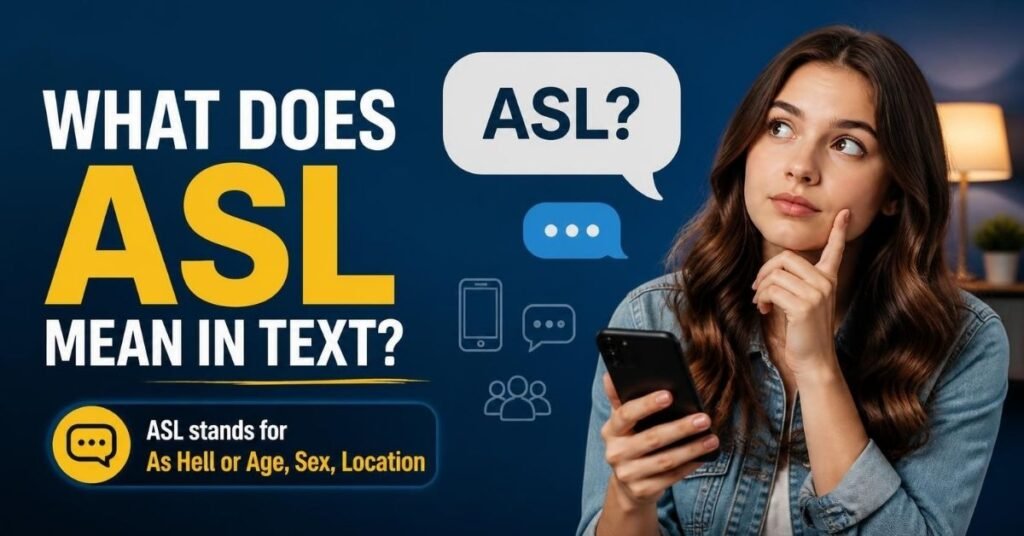
Someone sends you “asl” and you pause. Is it a stranger fishing for personal details, or a friend joking about being tired?
The short answer is that ASL meaning in text depends on context.
It can mean “age, sex, location,” “as hell,” or American Sign Language.
Quick Answer
Most of the time, a lone “ASL?” asks for your age, sex, location.
It shows up when someone wants to size up a new contact.
Lowercase asl at the end of a description means as hell.
“I’m tired asl” simply says you’re extremely tired.
When people talk about signing or accessibility, ASL means American Sign Language.
That one is a full language, not slang.
ASL Meaning at a Glance
| Meaning | How it looks | Example |
| Age, Sex, Location | Standalone, usually with a question mark | “ASL?” |
| As hell | Lowercase, after an adjective | “That movie was boring asl” |
| American Sign Language | Uppercase, in a language discussion | “She is learning ASL.” |
Keep this table handy when an ASL abbreviation shows up out of nowhere.
Three meanings share one acronym, so you’ll need to check the message around it.
1. ASL Means “Age, Sex, Location”
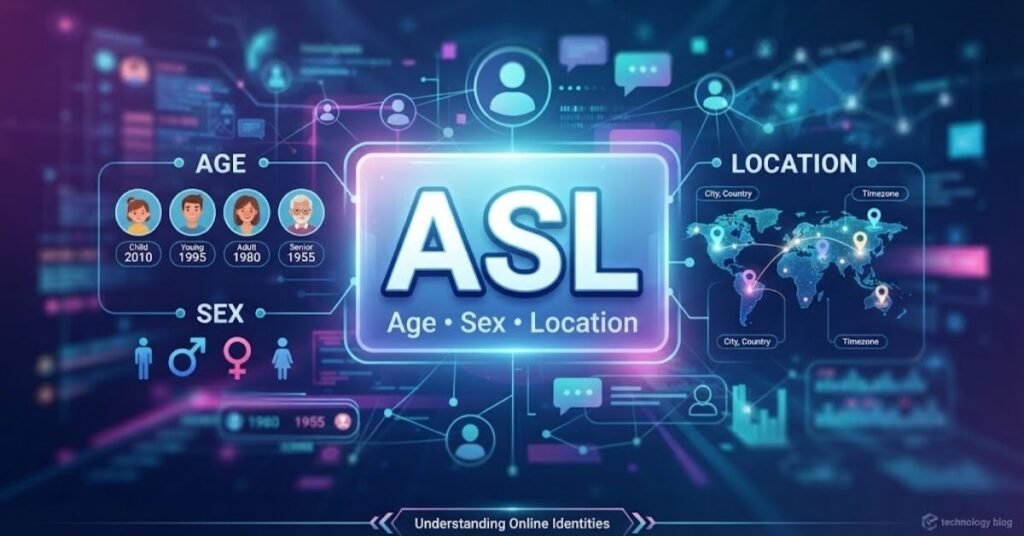
This is the oldest meaning.
People often write it A/S/L, and it took off in online chat rooms and instant messaging back in the 1990s.
Back then, you’d join a room full of strangers.
Typing “a/s/l?” was the fastest way to learn who you were talking to.
Today you’ll still see it in a private message or direct message from an unfamiliar person.
Younger users often think of it as an old internet habit, but it hasn’t disappeared.
Here’s a quick example.
Your cousin’s friend joins a game lobby, and a random player writes “asl?” in the chat.
That’s someone asking for age, gender, and location before they’ve said hello.
Is It Safe to Answer “ASL?”
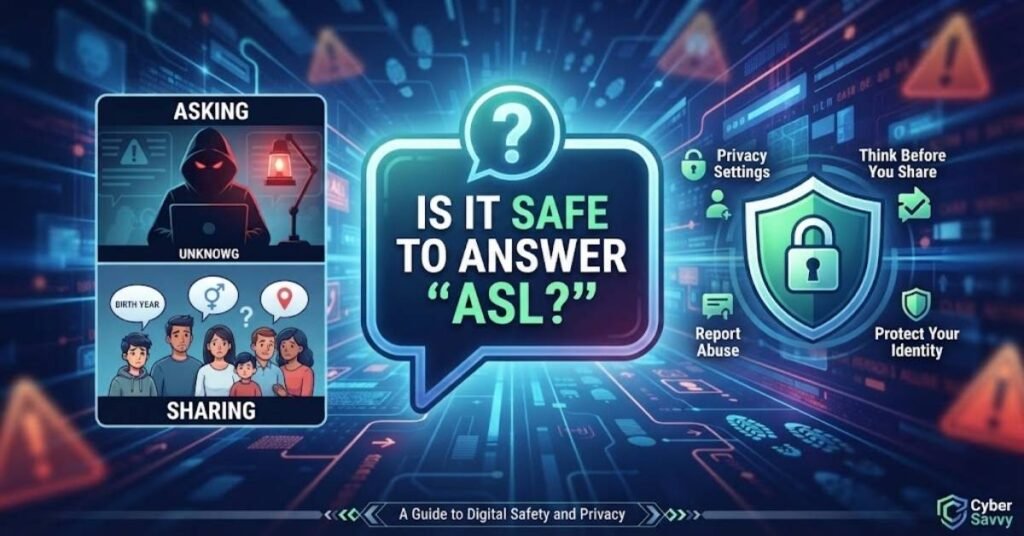
Usually, no.
Answering with real details hands a stranger the first pieces of your online identity.
Your age and location may look harmless alone.
Put together with a school name or a live location, they can reveal more than you’d like.
Good online safety habits start small.
Skip your home address, workplace, and daily schedule until you actually know the person.
If a message from an unfamiliar account feels off, you don’t owe it a reply.
Blocking is a perfectly fine response.
2. ASL Means “As Hell”
This is the meaning most people know today.
Here asl is an intensifier, a word that adds emphasis.
It works like “very,” “really,” or “extremely.”
People clip “as hell” down to compressed spelling because typing it out feels slow.
You’ll spot it after an adjective.
Think of “I’m tired asl,” “It’s cold asl,” or “That dog is cute asl.”
More examples show how flexible it is:
- This test was hard asl.
- That video was funny asl.
- Her outfit is stylish asl.
- This song is catchy asl.
- I’m busy asl.
- Those tickets are expensive asl.
Is “As Hell” ASL Rude?
It’s mildly profane.
Most people treat it as casual language, but “hell” is still a swear word to some.
Among friends it lands fine.
With grandparents, a boss, or a stranger, you might want a cleaner word.
Here’s a real scenario.
You text your manager “I’m hungry asl, let’s break for lunch.”
It might get a smile, or it might get a raised eyebrow, so know your audience.
3. ASL Means “American Sign Language”
Here the meaning has nothing to do with slang.
American Sign Language is a natural language used by the Deaf community across the United States and much of English speaking Canada.
It has its own grammar and linguistic structure.
It isn’t a hand version of English, and it isn’t the same as signed English.
Deaf culture shapes how people use it, from storytelling to humor.
Many Deaf creators now share ASL videos, which helps more people learn.
You’ll see this meaning in sentences like “Do you know ASL?” or “He communicates in English and ASL.”
People also use it when they talk about an ASL class, a beginner class, or an ASL interpreter.
How to Know Which ASL Meaning Is Intended
Reading context clues takes a second, and it saves you from awkward replies.
Look at the surrounding words, the capitalization, and who’s texting you.
ASL appears alone with a question mark
A message that says only “ASL?” almost always asks for age, sex, location.
There’s no adjective for it to describe.
It usually comes from a new contact.
That’s your cue to think about privacy before typing anything.
Lowercase asl follows a description
If lowercase asl trails a feeling or a thing, it means as hell.
“This coffee is strong asl” is a clear example.
The word works like a volume knob on the adjective before it.
Nobody’s asking you a question here.
The conversation mentions signing or accessibility
If the chat covers sign language, hard of hearing friends, or an interpreter, ASL means American Sign Language.
Uppercase spelling is another hint.
Topics like education or accessibility services point the same way.
The surrounding sentence usually settles it.
What Does ASL Mean on Social Media?
On social media, all three meanings float around.
Your best clue is where you see it.
On TikTok and Instagram, you’ll mostly see “as hell” in captions and comments.
Creators also post ASL lessons, so the language meaning appears too.
On Snapchat and X (Twitter), a direct message reading “asl?” tends to mean age, sex, location.
That’s especially true when the account is new or has no posts.
Memes add more twists.
Someone might caption a photo “me after Monday, tired asl,” and everyone gets it instantly.
How Should You Reply to ASL?
Your reply should match the meaning you think you’re seeing.
A wrong guess isn’t a disaster, but a careful one helps.
If it means “age, sex, location?”
Skip the details.
Try “Why do you ask?” or just ignore it.
If you know the person, say a friend from class, you can share what feels comfortable.
Keep it general, like your city instead of your street.
If it means “as hell”
It isn’t a question, so you don’t have to answer.
Respond to the feeling instead.
If a friend texts “I’m tired asl,” you could write “Same, let’s grab coffee.”
That keeps the online conversation natural.
If it means American Sign Language
Answer the actual question.
“Yes, I’m learning ASL” or “I’d love to take a sign language class” both work.
If you’re curious, ask what they’re studying.
People often love talking about Deaf culture and how they learned.
Common Mistakes
Interpreting abbreviations wrong happens to everyone.
These slipups come up most often.
Assuming ASL always has one meaning
Some people learn one ASL meaning and apply it everywhere.
That’s how “I’m cold asl” turns into someone answering with their location.
Always check the context.
One quick look at the message solves most confusion.
Calling American Sign Language slang
ASL the language is not internet slang.
It’s a natural language with rules, history, and a community behind it.
Calling it slang can sound dismissive.
Say “American Sign Language” or “ASL” when you mean the language.
Sharing too much information
Oversharing is the riskiest mistake.
One reply can hand over your school, age, and live location at once.
For children and teenagers, a trusted adult should know about strange messages.
Teaching stranger danger early helps kids spot trouble.
Using “asl” in professional writing
Slang doesn’t belong in professional writing, academic writing, or business communication.
A note to customers, teachers, or supervisors should sound clean.
Swap it for neutral language like “very,” “really,” or “extremely.”
For a bit more flair, try “incredibly” or “remarkably.”
Professional vs Casual Communication
Casual conversation gives you room to play.
Informal language like “asl” works with friends, in group chats, and in casual messages.
Workplace communication asks for a steadier voice.
If you doubt whether a phrase fits, leave it out.
A simple test helps.
Would you say it out loud to your boss?
If not, don’t text it.
How ASL Compares With ASF and Other Text Slang
ASF works like ASL “as hell,” but stronger.
It stands for “as f***,” so it’s more profane.
You’ll see it in text abbreviations like “I’m tired asf.”
Treat it as a harsher cousin of as hell, and skip it in mixed company.
Other internet abbreviations keep changing too.
Because texting abbreviations shift fast, checking context beats memorizing lists.
Quick Safety Tips for Parents and Teens
If you’re a parent, talk openly about internet safety.
Ask your kids what an “asl?” message would look like and how to respond.
If you’re a teen, keep your privacy settings tight.
Only share details with people you know offline, and tell a trusted adult if a message feels weird.
Simple rules help everyone practice safe sharing and digital safety.
Never post your live location, and avoid posting your daily schedule.
Conclusion
ASL in text carries three meanings, and each depends on context.
It can ask for age, sex, location, it can mean as hell, or it can name American Sign Language.Read the capitalization, the surrounding words, and the topic.
That habit builds better digital communication and keeps your personal privacy safe.Which meaning have you run into most often? Drop your story in the comments, and share this with a friend who’s still puzzled.
FAQs
What does ASL mean from a girl?
It depends on the message. A lone “ASL?” asks for age, sex, location, while “I’m tired asl” means as hell.
What does ASL mean from a guy?
The meaning works the same way. Gender doesn’t change it, so read the context clues.
What does asl mean on TikTok?
Mostly “as hell,” found in captions and comments. Occasionally it refers to American Sign Language in learning videos.
What does ASL mean on Snapchat?
In a private message from a new contact, it often means age, sex, location. Between friends, it usually means “as hell.”
Is ASL the same as ASF?
Not quite. ASF means “as f***,” which is a stronger version of as hell.
Does ASL always mean American Sign Language?
No. It also means age, sex, location or as hell, depending on the conversation.

Arthur Whitmore is a passionate grammar enthusiast and language writer at Hexobrust.com. He creates clear, helpful content on grammar, spelling, and everyday English to make learning simple and enjoyable.
