

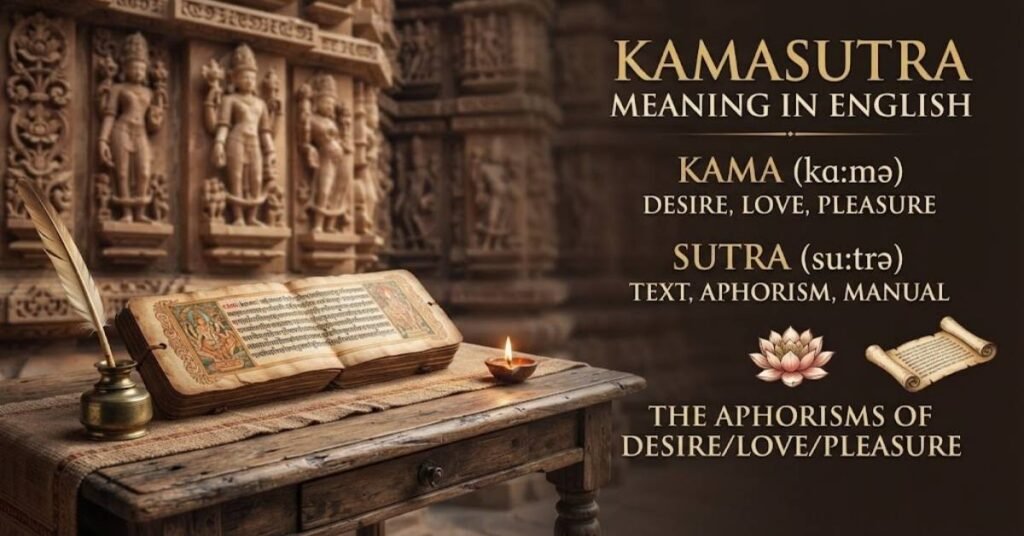
If you have ever typed “Kamasutra” into a search bar, you probably had one simple question in mind. What does this word actually mean? A lot of people carry a fuzzy idea about it from movies, memes, or half heard jokes, but the real answer is more interesting and a lot less scandalous than most expect.
In plain English, Kamasutra roughly translates to “principles of pleasure” or “teachings on desire.” It comes from two Sanskrit words, kama meaning desire or pleasure, and sutra meaning a thread or a short rule. Put together, the Kamasutra meaning in English points to a guide, not a rulebook of shame or a dirty secret.
Quick Answer
Here is the short version before we go deeper. Kamasutra is the English translation of an ancient Sanskrit work that offers teachings on desire, love, and human relationships. It is a classical work of classical Indian literature, written centuries ago, that covers far more ground than most people assume.
The word itself is not rude, and it is not a swear word or an insult. It is simply the title of a historical text, similar to how “Art of War” is the title of a book about military strategy. The English meaning is really a combination of two smaller ideas joined into one transliteration.
So if someone asks you directly, you can answer with confidence. The Kamasutra English meaning is essentially “a guide to pleasure” or “a guide to love and pleasure,” built from the literal meaning of its two Sanskrit roots.
What Does Kamasutra Literally Mean?
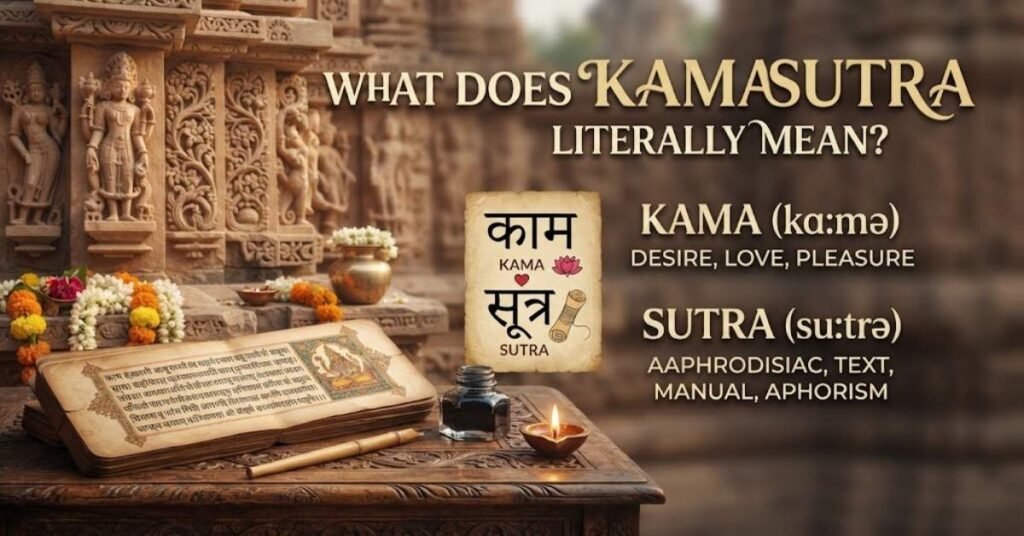
To understand the Kamasutra literal meaning, it helps to break the word into its two building blocks. Kama is a Sanskrit term for desire, love, or sensual enjoyment, while also touching on emotional enjoyment, beauty, and the pleasures of the senses.
Sutra literally means thread, but in Sanskrit literature it came to describe a short rule or teaching, almost like a compact life lesson strung together with others. Think of it as a single strand in a larger rope of guiding principles.
When you combine kama and sutra, the Kamasutra literal meaning becomes something like “aphorisms on desire” or “threads of pleasure.” It is less a single instruction and more a woven set of ideas about how people experience attraction, affection, and connection.
What Is the Kama Sutra?
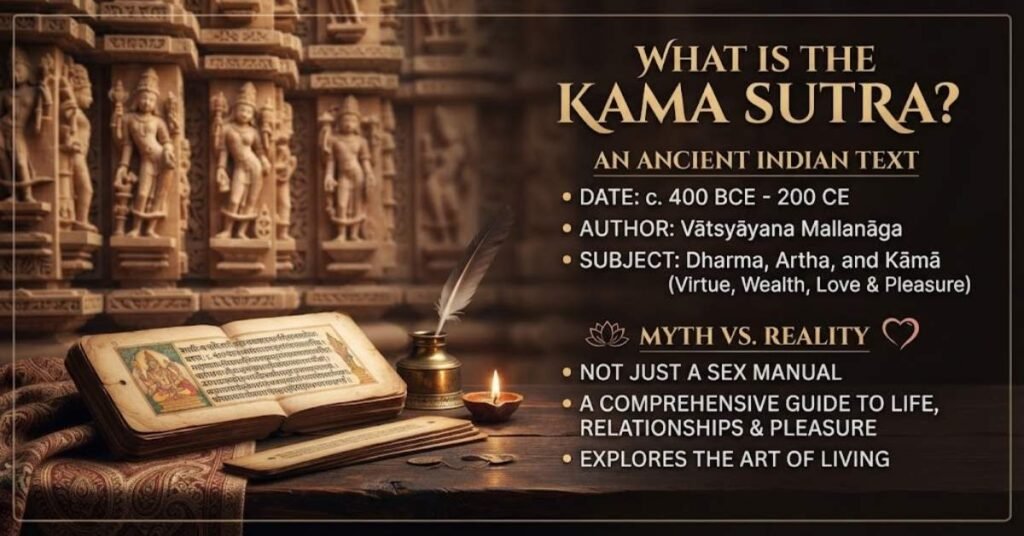
The Kama Sutra is an ancient Indian text believed to have been compiled by the ancient Indian scholar Vatsyayana, likely sometime during the early centuries of the Common Era. It stands as one of the most recognized pieces of Sanskrit literature in the world today.
Many people are surprised to learn that the book was never meant to be a shock piece. It was written as a broader historical work on human life, discussing everything from courtship and choosing a partner to household management and social behavior in ancient Indian society.
Scholars in cultural studies and Indian thought often point out that the text reflects the social customs and gender roles of its time. Reading it today means viewing it through a historical context, not expecting a modern instruction manual written for our era.
Is Kamasutra Only About Sexual Positions?
This is probably the biggest misconception out there, and honestly, it is an easy one to fall into thanks to pop culture. Sexual positions do appear in parts of the text, but they represent a small slice of a much larger conversation about relationships.
The wider book actually discusses love and attraction, marriage, married life, intimacy, and even personal grooming and refinement. There are sections on communication between partners, social life, and how to build emotional connection alongside physical closeness.
So no, treating it purely as a manual for sexual behavior misses most of the point. The original work was aiming for something closer to a complete life guide, one that includes physical intimacy as only one thread among many.
Is It Written Kamasutra or Kama Sutra?
Here is some good news if grammar rules stress you out. Both Kama Sutra spelling and Kamasutra spelling are widely accepted in modern usage, so you are not going to get this one “wrong.”
The two word spelling tends to show up more in academic and formal writing, since it mirrors the original Sanskrit structure more closely. The single word spelling has become common in everyday English, especially online, where it reads faster and feels more like a standard English title.
Whichever version you pick, just try to stay consistent within the same piece of writing. Consistency matters more to readers and to search engines than picking the “more correct” option, since both are considered an accepted spelling of this transliterated word.
How Is Kamasutra Used in Modern English?
The word shows up in more places than people realize, and the meaning shifts slightly depending on where you spot it.
Referring to the historical text
In academic settings, cultural studies, and serious discussions of classical Indian literature, “Kamasutra” refers directly to the original historical book attributed to Vatsyayana. This usage respects the work as a genuine piece of Indian thought rather than a punchline.
Referring to popular culture
In everyday conversation, the term often gets tossed around in jokes, movie references, and popular culture moments. It becomes shorthand for anything related to romance or intimacy, even when the reference has nothing to do with the actual text.
Describing a modern adaptation
You will also see “Kamasutra” attached to countless books inspired by the original work, along with a modern relationship guide or an illustrated manual sold in bookstores. These modern products borrow the name for recognition, even though the content is usually simplified and quite different from the source material.
Tone and Appropriateness
A common worry people have is whether saying “Kamasutra” out loud is inappropriate. The short answer is that the word itself carries no built in insult or vulgarity, so it is not comparable to actual swear words.
That said, tone still matters based on setting. Dropping it casually in a professional meeting or around children might raise eyebrows, simply because of its sexual associations, even if your intent was purely educational.
In contexts like adult health education, an academic setting, or a genuine literature discussion, the word fits naturally and carries no awkwardness. Reading the room is really the only skill you need here, since appropriate usage depends entirely on your audience.
Pronunciation of Kamasutra
If you have ever hesitated before saying this word out loud, you are definitely not alone. The American English pronunciation is generally rendered as kah muh SOO truh, with the main stress landing on the “SOO” syllable.
This differs slightly from the original Sanskrit pronunciation, which carries its own rhythm and emphasis based on classical Sanskrit phonetics. English speakers have naturally smoothed it into an easier, more familiar sound over time.
Whether you use the two word pronunciation or say it as one flowing word, native English speakers will understand you either way. The important part is getting close enough that the English pronunciation sounds natural in conversation.
Common Misunderstandings
Let’s clear up a few myths that keep circulating, since these misconceptions are honestly where most of the confusion around this word comes from.
It does not mean only sexual positions
As mentioned earlier, the sexual positions misconception is probably the most widespread myth out there. The actual text covers relationships, courtship, and daily life far more extensively than physical technique alone.
It is not a general Sanskrit word for sex
Some assume “Kamasutra” is just a general Sanskrit word for sex itself, but that is not accurate. It is a specific title, referring to one particular text, not a blanket term you would use to describe sexuality in general Sanskrit vocabulary.
It is not simply a modern illustrated manual
Many bookstore versions today are a modern illustrated manual, often visual and simplified for casual readers. These modern adaptations differ significantly from the original classical literature, which relied on Sanskrit literature conventions rather than glossy photography.
Ancient advice is not automatically modern advice
Finally, treating every line as directly applicable to modern relationships ignores the gap between ancient advice and modern values. Society, gender roles, and relationship expectations have shifted enormously since the text was written.
Kamasutra in Academic and Cultural Discussions
Beyond casual curiosity, the Kamasutra holds a respected place in academic writing and university level cultural studies programs. Historians and literature scholars study it as a window into ancient India, examining what it reveals about social customs and daily life centuries ago.
Comparative literature courses sometimes place it alongside other pieces of classical Indian literature, treating it as a serious contribution to global literary history rather than a novelty item. This academic angle gives the word a completely different weight than the one it carries in pop culture jokes.
Why the Word Still Feels Taboo Today
Even with all this historical context, the word still triggers a giggle or a raised eyebrow in casual conversation, and there is a reason for that. Western media has spent decades using “Kamasutra” as a punchline rather than explaining its actual historical context.
That repeated shorthand in movies, sitcoms, and advertising cemented an incomplete picture in the public imagination. Once a word gets flattened into a joke long enough, people stop questioning whether the joke is even accurate.
Conclusion
At its core, the Kamasutra meaning in English comes down to “teachings on desire” or “principles of pleasure,” built from the Sanskrit roots kama and sutra. The text itself is a genuine piece of ancient Sanskrit work, covering relationships, courtship, and social life far beyond the narrow reputation it has picked up over time.Both Kamasutra and Kama Sutra are accepted spellings, the word is not offensive on its own, and its pronunciation has settled into a comfortable English rhythm.
Understanding its real background gives you a much fuller picture than the version most people pick up from pop culture alone.If this cleared up a few things you were unsure about, share it with someone who has asked the same question, or drop your own thoughts below. Conversations like this are exactly how outdated misconceptions finally get corrected.
FAQs
What is the simple English meaning of Kamasutra?
The simple English meaning is “teachings on desire” or “principles of pleasure,” based on combining the Sanskrit words kama and sutra.
What does kama mean in English?
Kama translates to desire, love, or pleasure, and can also refer to beauty and the enjoyment of the senses.
What does sutra mean in English?
Sutra literally means thread, though in Sanskrit literature it refers to a short rule or teaching.
Who wrote the Kamasutra?
It is traditionally attributed to Vatsyayana, an ancient Indian scholar, believed to have compiled the text sometime during the early centuries of the Common Era.
Is the Kamasutra a religious book?
No, it is not considered a religious scripture. It is a classical work on relationships, pleasure, and social life rather than a sacred religious text.
Is Kamasutra an English word?
Not originally. It is a transliterated word borrowed from Sanskrit into English usage, now widely recognized as an English word in its own right.
Is it appropriate to say Kamasutra?
Generally yes, since the term itself is not a swear word or insult. Appropriate usage still depends on your setting, audience, and the tone of the conversation.

Arthur Whitmore is a passionate grammar enthusiast and language writer at Hexobrust.com. He creates clear, helpful content on grammar, spelling, and everyday English to make learning simple and enjoyable.
