

You’ve typed it both ways. Maybe you second guessed yourself mid sentence and just picked one. You’re not alone, and honestly, this mix up trips up a lot of sharp writers.
Here’s the short version before we dig in: aesthetic is the standard American English spelling for almost everything, while esthetic shows up mainly in beauty and skincare businesses. Keep reading, because the “almost” part matters more than you’d think.
Quick Answer
If you’re writing for a general US audience, go with aesthetic. It’s the dominant spelling, the one you’ll find in newspapers, blogs, textbooks, and casual conversation.
Esthetic isn’t wrong. It’s just a narrower spelling variant that survives mostly in the beauty industry, think spas, skincare clinics, and licensing boards. Outside of that world, it can look like a typo even when it isn’t.
So the quick rule: use aesthetic by default. Switch to esthetic only when you’re talking about esthetician services or a business that has officially branded itself that way.
Is It Spelled Esthetic or Aesthetic?
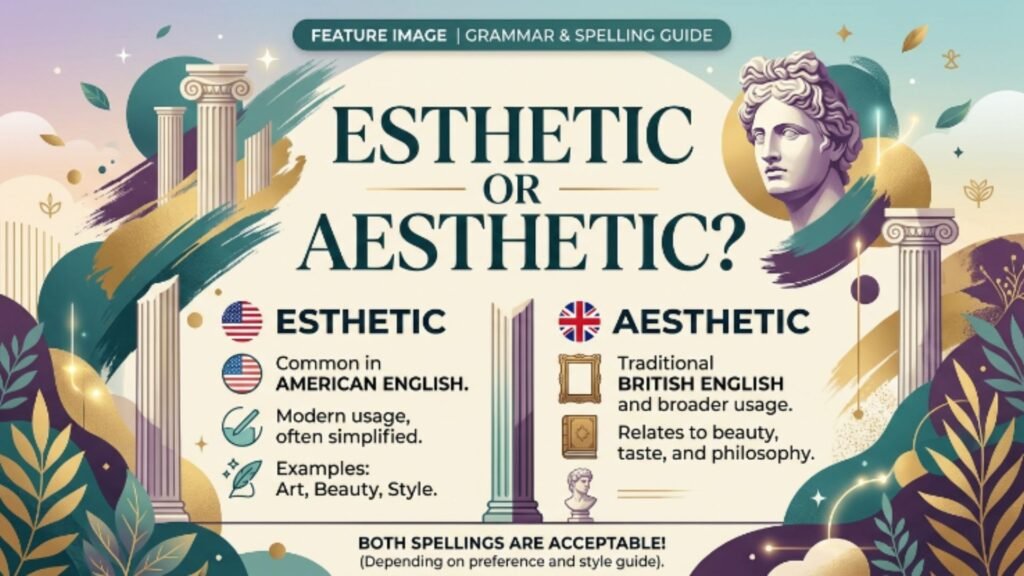
Both spellings are technically correct, but they’re not interchangeable in every context. Aesthetic wins in general writing, academic writing, art criticism, design talk, and everyday chat about visual style.
Esthetic tends to show up in cosmetic and appearance-related fields, especially skincare and beauty therapy. Think of it as a house style choice rather than a grammar rule. A spa might call itself an “esthetic center” on purpose, because that’s the industry terminology clients expect to see.
Here’s a simple gut check. If you’d say the word out loud in a sentence about art, philosophy, or how a room looks, spell it aesthetic. If you’re filling out paperwork for a skincare license or writing copy for a beauty clinic, esthetic might be the expected term.
Why Does Gen Z Say “Aesthetic”?

Scroll through any social media feed and you’ll see “aesthetic” used as its own little category. A “cottagecore aesthetic” bedroom. A “minimalist aesthetic” wardrobe. A “dark aesthetic” playlist cover.
This isn’t a spelling debate at all, it’s a shift in meaning. Gen Z turned the word into shorthand for a whole vibe, a carefully chosen appearance that signals personality and taste. Instead of describing beauty in the abstract, the word now points to a recognizable style you can screenshot and share.
That’s actually a natural extension of the original meaning. Aesthetics has always been about artistic taste and visual identity. Social media just gave the word a faster, punchier job to do.
What Is the Difference Between Aesthetic and Beautiful?
People swap these two around, but they’re not twins. Beautiful describes a quality, something either pleases the eye or it doesn’t. Aesthetic is broader. It covers the whole appreciation of beauty, including taste, style, and how something is designed or arranged.
A messy, chaotic bedroom can still have a strong personal aesthetic even if it’s not conventionally beautiful. A brutalist building might not strike you as beautiful, yet critics still study its aesthetic value because of the ideas behind its design.
So beautiful is about the reaction. Aesthetic is about the whole judgment process, the taste, the theory, and the visual choices that shape that reaction in the first place.
Is Botox Aesthetics or Esthetics?
This one confuses a lot of people, and honestly, the industry itself isn’t fully consistent. In clinical and medical settings, Botox treatments usually fall under aesthetic medicine or aesthetic procedures, performed by licensed physicians in an aesthetic clinic.
Esthetics, on the other hand, usually refers to non-medical skincare and beauty therapy, things like facials, waxing, and skin treatments performed by a licensed esthetician. Botox involves needles and prescription medication, which places it firmly in medical territory, not the esthetics side.
So if you’re writing about injectables, laser treatments, or anything requiring a physician, “aesthetic” is your word. If you’re writing about facials or spa skincare routines, “esthetic” fits better.
Why People Confuse Them
Blame your ears for this one. Both words are pronounced almost the same way, and that silent letter confusion makes the spelling feel arbitrary even when it isn’t.
There’s also the historical angle. Esthetic actually came first in American publishing as a simplified variant, dropping the initial “a” the way US English often trims extra letters from British spellings (think “color” versus “colour”). Over time, though, aesthetic pulled ahead and became the standard, leaving esthetic behind as a niche term mostly tied to the beauty profession.
Add in autocorrect, industry jargon, and inconsistent branding, and it’s no wonder even careful writers second guess themselves.
Key Differences At A Glance
| Feature | Aesthetic | Esthetic |
| Common use | General writing, art, design | Beauty and skincare industry |
| Frequency in US English | Dominant spelling | Rare, industry specific |
| Typical field | Art, philosophy, marketing, architecture | Spas, esthetician licensing, skincare |
| Formality | Works in formal and casual writing | Mostly professional/business context |
| Pronunciation | Same | Same |
Meaning And Usage Difference
Spelling aside, both words share the same core meaning: something tied to beauty, taste, and visual appeal. But where they get used tells a different story.
Relating To Beauty
At its root, aesthetic (and its cousin esthetic) describes anything connected to beauty and how we experience it. This is the broadest sense of the word, covering everything from a sunset to a well designed logo.
Relating To Art And Taste
In academic and critical writing, aesthetic leans toward philosophy of beauty, artistic judgment, and taste. You’ll see it in art history essays, design critiques, and discussions about what makes something “good” art versus just decoration.
A Particular Visual Style
This is the modern, everyday sense. A “modern aesthetic,” a “rustic aesthetic,” a “clean aesthetic,” these all point to a specific visual theme rather than beauty in the abstract. It’s the meaning most people use without even thinking about it.
Cosmetic And Appearance-Related Uses
Here’s where esthetic earns its keep. Aesthetic medicine, aesthetic dentistry, and cosmetic procedures often use aesthetic in clinical branding, while esthetic sticks closer to spa and skincare language. Both exist side by side in this space, which adds to the confusion.
Aesthetics And Esthetics
As nouns, aesthetics refers to the study of beauty and art, a genuine branch of philosophy. Esthetics, when spelled this way, usually points to the beauty industry itself, licensing exams, treatments, and professional services.
Pronunciation
Good news here, there’s no trap. Both words are pronounced the same way, roughly “es-THET-ik.” No extra syllable, no hidden twist. The spelling difference is purely visual.
Tone, Context, And Formality
Aesthetic works everywhere. Formal essays, casual texts, marketing copy, and academic papers all lean on it without raising eyebrows. It’s the safer, more flexible choice.
Esthetic carries a narrower professional context. Outside of beauty and skincare writing, it can read as an error, even to sharp editors. If you’re writing for a broad audience, stick with aesthetic and save esthetic for industry-specific pieces.
Which One Should You Use?
For almost everything you write, aesthetic is the answer. Blog posts, product descriptions, essays, social captions, all of it calls for the standard American spelling.
Reach for esthetic only in a specific case: you’re writing about esthetician services, licensing, or a business that has branded itself with that spelling on purpose. Outside that lane, aesthetic keeps you safe and consistent.
When One Choice Sounds Wrong
Swap them in the wrong sentence and it shows. “She has a great sense of esthetic” sounds off to most American readers, aesthetic is expected there. Flip it around, and “aesthetician” instead of “esthetician” can look like a spelling mistake on a beauty license or job title.
Aesthetic vs Esthetician
Here’s a quirky exception worth remembering. Even though aesthetic is the general spelling, the beauty profession itself almost always uses esthetician, not “aesthetician,” for the job title. Some states and licensing boards do use “aesthetician” though, so it genuinely depends on your relevant jurisdiction. When in doubt, check your state’s cosmetology board for the official spelling they use.
Common Mistakes (And Quick Fixes)
- Writing “asthetic” or “aestethic,” both are simple misspellings, not variants
- Using esthetic in formal or academic writing where aesthetic is expected
- Switching spellings mid-article, pick one and stay consistent
- Assuming Botox falls under esthetics when it’s actually aesthetic medicine
- Forgetting that job titles (esthetician) can differ from general usage (aesthetic)
Everyday Examples
Seeing the words in action makes the difference click faster than any rule ever could.
Examples With Aesthetic As An Adjective
- The café has a cozy, rustic aesthetic that pulls in regulars.
- Her apartment’s minimalist aesthetic makes the small space feel open.
- The brand redesigned its site for a more modern aesthetic appeal.
Examples With Aesthetic As A Noun
- Interior designers study aesthetics as part of their formal training.
- The film’s aesthetic leaned heavily on shadow and muted color.
- Good aesthetics matter, but function still comes first in product design.
Examples With Esthetic
- She’s licensed as an esthetician and specializes in facials.
- The spa’s esthetic services include skin consultations and peels.
- He signed up for an esthetic treatment before the wedding.
Dictionary-Style Word Details
Verb
Neither word functions as a verb on its own. You won’t “aesthetic” something, though “aestheticize” exists as a related term meaning to give something artistic qualities.
Noun
As a noun, aesthetics refers to the philosophical study of beauty and taste. Esthetics, in its industry sense, refers to the field of skincare and beauty treatments.
Synonyms
Artistic, visual, decorative, tasteful, stylish, and design-oriented all work as rough synonyms depending on context.
Example Sentences
“The museum’s new wing has a striking aesthetic.” “She built a career in esthetics after finishing her training.”
Word History
Aesthetic traces back to Greek roots tied to perception and sensation, filtered through European philosophical usage before landing in English. Esthetic emerged later as a simplified American spelling, though aesthetic eventually became the dominant form in most writing.
Phrases Containing
Aesthetic appeal, aesthetic value, aesthetic sense, aesthetic medicine, aesthetic surgery, and aesthetic preferences are all common aesthetic phrases you’ll run into regularly.
FAQs
Is aesthetic or esthetic correct?
Both are correct spellings, but aesthetic is the standard choice for general American writing.
Is esthetic an American spelling?
Yes, it’s an American simplification, though it’s now limited mostly to the beauty and skincare industry.
Do aesthetic and esthetic mean the same thing?
Yes, they share the same core meaning. The difference lies in context and industry, not definition.
Which spelling should I use in the US?
Use aesthetic by default. Switch to esthetic only for beauty industry or esthetician-related writing.
Is it aesthetic appeal or esthetic appeal?
“Aesthetic appeal” is the standard phrase used across marketing, design, and general writing.
Is it aesthetics or esthetics?
Aesthetics is the more common noun form, referring to the philosophy and study of beauty.
Are aesthetic and esthetic pronounced differently?
No, they sound identical when spoken. The difference exists only in writing.
Conclusion
Two spellings, one meaning, and a whole lot of confusion, but you’ve got it sorted now. Use aesthetic for pretty much everything you write, and save esthetic for beauty industry contexts where it’s the expected term.
Next time you catch yourself pausing over the spelling, just remember the quick answer from the top: when in doubt, add the “a.”

Arthur Whitmore is a passionate grammar enthusiast and language writer at Hexobrust.com. He creates clear, helpful content on grammar, spelling, and everyday English to make learning simple and enjoyable.
