


Have you ever typed a word and suddenly wondered, “Wait, is that really how you spell it?” Pieces is one of those words that can easily cause confusion. The letters i and e often get switched, turning the correct spelling into a common mistake. If you have ever written “peices,” don’t worry. This small error is easy to make, especially when you are typing quickly. The good news is that the correct form is simple to learn.
So, which spelling should you use? Pieces is the correct plural form of piece. You will see it when talking about puzzle parts, food portions, clothing, artwork, chess pieces, and parts of an object. The wrong spelling usually comes from reversing the i and e. Once you learn the simple piece → pieces pattern, you can avoid this mistake with confidence.
Is it Pieces or Peices?
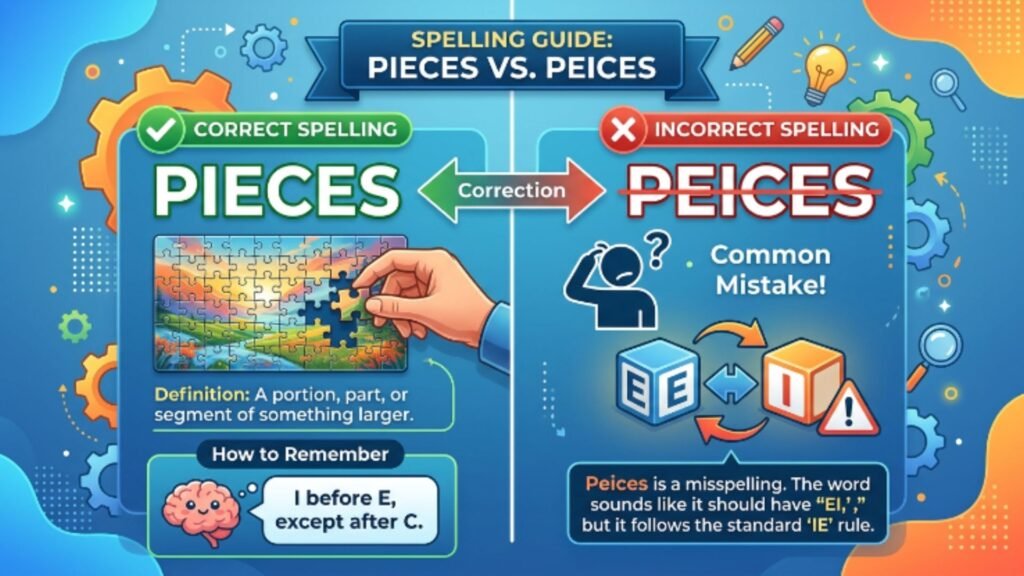
Pieces is the correct spelling in Standard English. Peices is a common spelling mistake caused by reversing the i and e.
If you’re writing in American English or British English, always choose pieces. The spelling doesn’t change between these varieties.
The word pieces is the plural form of piece. It can describe parts, portions, objects, or separate items.
- ✅ Pieces — correct spelling
- ❌ Peices — spelling error
- Piece — singular noun
- Pieces — plural noun
For example, you might say, “The puzzle has 500 pieces.”
Quick conversation:
Sam: “I found all the peices.”
Alex: “You mean pieces, right?”
Sam: “Yes, pieces. Thanks!”
The mistake looks small, but it can stand out in formal writing. Use pieces in school assignments, business emails, books, articles, and professional writing.
Why Do People Spell Pieces as Peices?
People often write peices because the letters i and e appear close together. When you type quickly, it’s easy to put them in the wrong order.
English spelling makes this confusion even trickier. Words such as believe, field, friend, receive, and ceiling use different IE / EI letter combinations.
That makes the correct pattern harder to remember.
- piece → correct
- pieces → correct
- peice → incorrect
- peices → incorrect
A simple typing mistake can create the wrong version without you noticing.
Conversation example:
Mia: “Did you send the report?”
Noah: “Almost. I noticed I wrote ‘peices.’”
Mia: “Just change it to ‘pieces.’”
Your spell checker or grammar checker will often flag peices. Still, proofreading helps catch mistakes before you submit important writing.
How Do You Spell Pieces Correctly?
The correct spelling is pieces. Start with the singular noun piece, then add -s.
The important letter order is i-e, not e-i.
Think of the word as a small building block:
piece → pieces
Once you remember the singular form, the plural becomes much easier.
- P + I + E + C + E = piece
- piece + s = pieces
- peice = incorrect
- peices = incorrect
This spelling works in both American English and British English.
Conversation example:
Teacher: “How do you spell the word?”
Student: “P-E-I-C-E-S?”
Teacher: “Almost. Remember the IE combination.”
Student: “Right. Pieces!”
If you’re unsure, write the singular form first. Then add the plural ending.
That quick trick can prevent a spelling error in school assignments, academic writing, text messages, and professional writing.
Why Do People Confuse Pieces and Peices?
The main problem comes from the IE / EI letter combination. English doesn’t always use one simple rule for these letter pairs.
For instance, you see ie in words like believe, field, and friend. However, receive and ceiling use ei.
That’s why relying on a broad spelling rule can cause trouble.
Pieces follows the ie pattern:
p + ie + ce + s
The incorrect peices reverses those middle letters.
You may also encounter other confusing spelling pairs, such as:
- Fulfil vs Fulfill
- Theater vs Theatre
- Phoenix vs Pheonix
Some involve regional differences. Others contain genuine spelling errors.
Conversation example:
Ben: “Why does ‘peices’ look almost right?”
Ella: “Because your brain recognizes the word but swaps two letters.”
Ben: “So I should remember ‘piece’ first?”
Ella: “Exactly.”
That approach works better than trying to memorize every spelling rule.
Pieces vs Peices: At a Glance
When you need a quick answer, the difference is straightforward. Pieces is the standard spelling, while peices is not a standard English word.
| Feature | Pieces | Peices |
| Correct spelling | ✅ Yes | ❌ No |
| Standard English | ✅ Yes | ❌ No |
| Singular form | Piece | — |
| Plural noun | Pieces | — |
| Dictionary entry | Yes | No |
| Formal writing | Correct | Incorrect |
| School assignments | Appropriate | Spelling error |
| Business emails | Appropriate | Incorrect |
You should use pieces whether you’re writing in American English or British English.
Conversation example:
A: “Which one should I use?”
B: “Always use pieces.”
A: “Even in text messages?”
B: “Yes. ‘Peices’ is still a spelling mistake.”
The only difference comes from the context in which you use the word, not its spelling.
What Does “Pieces” Mean?
Pieces is the plural form of the singular noun piece. Its meaning changes slightly depending on the context.
Most often, pieces means separate parts, portions, or individual items.
For example, broken glass has several pieces. A puzzle contains many puzzle pieces. A report might contain different sections.
Common meanings include:
- Parts of something
- Portions of food
- Individual items
- Fragments or chunks
- Separate components
- Works of art or writing
The word can also describe chess pieces, furniture pieces, and clothing pieces.
In a museum, you might see several valuable art pieces. A newspaper may publish opinion pieces. A quilt can contain many carefully joined sections.
Conversation example:
Lena: “What are those pieces on the table?”
Mark: “They’re parts of the old vase.”
The exact meaning depends on what you’re describing. However, the spelling remains pieces.
Examples
You can use pieces in many everyday sentences. The meaning becomes clear from the surrounding words.
Here are several natural examples:
- The puzzle has 500 pieces.
- The mirror broke into several pieces.
- She picked up the broken pieces of glass.
- We need all the chess pieces.
- The museum displayed beautiful art pieces.
- He ordered two pieces of cake.
- We shared several pieces of sushi.
- She bought new furniture pieces.
- The report contains several important pieces of information.
- The lawyer presented several pieces of evidence.
Conversation example:
Dad: “Where are the puzzle pieces?”
Ella: “They’re beside the vase.”
Whether you’re talking about food portions, objects, or fragments, pieces remains the correct spelling.
Is “Peices” Ever Correct?
No. Peices is not the correct spelling in Standard English.
It usually appears as a typing mistake, spelling error, or accidental letter reversal. Dictionaries don’t treat peices as the standard plural form of piece.
The correct forms are:
- piece — singular noun
- pieces — plural noun
- piece by piece — common phrase
You shouldn’t use peices in formal writing. That includes school assignments, academic writing, business emails, professional writing, books, and articles.
Conversation example:
Teacher: “Please correct this word.”
Student: “Is ‘peices’ okay?”
Teacher: “No. The correct spelling is ‘pieces.’”
Your spell checker may underline peices automatically. However, don’t depend entirely on software. Proofreading remains important.
Even casual writing deserves the correct spelling when clarity matters.
So, whenever you see peices, replace it with pieces.
How to Remember the Correct Spelling
The easiest way to remember pieces is to start with the singular word piece.
Don’t memorize the plural as a completely separate word. Instead, remember:
Piece → Pieces
The letter order stays the same. You simply add -s.
A useful memory method is to focus on IE.
- piece → IE
- pieces → IE
- peice → incorrect
- peices → incorrect
You can also say the word slowly while proofreading. Seeing the letters regularly makes the correct spelling feel more familiar.
Conversation example:
Ava: “I always write peices by accident.”
Leo: “Remember the singular form first.”
Ava: “Piece, then pieces?”
Leo: “Exactly.”
If you still hesitate, use a dictionary or spell checker. Those tools can confirm the spelling quickly.
Most importantly, don’t let one confusing letter pair trip you up. Remember piece, add -s, and you’re set.
Which Spelling Should You Use?
Use pieces. It’s the correct spelling in Standard English, including both American English and British English.
The incorrect form peices doesn’t become acceptable because you’re writing casually. A text message, social media post, school assignment, or business email can still use the correct spelling.
Choose pieces when referring to:
- Parts or sections
- Food portions
- Puzzle pieces
- Chess pieces
- Art pieces
- Broken pieces
- Pieces of advice
- Pieces of information
- Pieces of evidence
- Furniture pieces
- Clothing pieces
Conversation example:
Jordan: “Should I write ‘three peices of cake’?”
Taylor: “No. Write ‘three pieces of cake.’”
The same rule applies to formal writing and everyday communication.
If you ever forget, return to the singular noun:
piece → pieces
That’s the simplest way to avoid this common spelling mistake. Once the correct form becomes familiar, peices will look wrong almost immediately.
Quick Comparison
The correct spelling is pieces. The spelling peices is incorrect in Standard English.
Pieces is the plural form of piece. It can describe parts, portions, objects, or sections.
| Word | Correct? | Meaning |
| Pieces | ✅ Yes | More than one piece |
| Peices | ❌ No | Common spelling mistake |
| Piece | ✅ Yes | One part or item |
The main difference is the order of i and e.
- Piece → one
- Pieces → more than one
- Peices → incorrect spelling
Conversation example:
Sam: “How many puzzle peices are missing?”
Alex: “The correct spelling is pieces. Say it as piece-s.”
This quick comparison makes the rule easy to remember.
Common Uses of “Pieces”
The word pieces appears in everyday English. You can use it for physical objects, food, clothing, games, artwork, and writing.
It is the plural form of piece. Its meaning changes slightly depending on the context.
For example, you might talk about:
- Puzzle pieces
- Pieces of furniture
- Pieces of cake
- Pieces of clothing
- Chess pieces
- Art pieces
- Pieces of information
- Pieces of evidence
You can also use pieces in expressions such as piece by piece.
Conversation example:
Mia: “Did you pack all the pieces?”
Noah: “Yes, everything is in the box.”
Remember, peices is not the correct spelling in these situations.
Parts of an Object
Pieces can describe separate parts that make up something larger.
For example, a broken vase may fall into several pieces. A puzzle also contains many individual pieces.
You can use the word for both simple and complicated objects.
Common examples include:
- Pieces of glass
- Broken pieces of a mirror
- Puzzle pieces
- Pieces of furniture
- Pieces of luggage
- Pieces of a machine
- Pieces of a vase
The word usually refers to separate parts or components.
Conversation example:
Emma: “What happened to the mirror?”
Jack: “It fell and broke into several pieces.”
You could also say, “I found the missing pieces under the table.”
Be careful not to write peices when describing these parts.
Portions of Food
You can use pieces when talking about separate portions of food.
This usage is extremely common in everyday conversation. Restaurants and families use the word regularly.
For example, you might order:
- Two pieces of pizza
- Three pieces of cake
- Four pieces of sushi
- A few pieces of fried chicken
- Several pieces of cheesecake
The exact meaning depends on how the food is divided.
Conversation example:
Liam: “How many pieces of cake do you want?”
Sara: “Just one piece, please.”
You can also use piece for a single portion. The plural becomes pieces.
So, remember:
One piece → two pieces
Not:
One peice → two peices
Clothing
Pieces can also refer to individual items of clothing.
This usage often appears when discussing outfits, wardrobes, or fashion collections.
For example, someone might say they bought several new pieces for summer.
You could refer to:
- Clothing pieces
- Designer pieces
- Matching pieces
- Statement pieces
- Vintage pieces
- New wardrobe pieces
Here, pieces can mean separate clothing items.
Conversation example:
Ava: “How many pieces did you buy?”
Ella: “I bought a jacket, skirt, and two tops.”
In fashion writing, piece can also suggest something special or distinctive.
For example, “That jacket is a beautiful statement piece.”
Again, the correct spelling remains pieces, never peices.
Games
The word pieces commonly appears when talking about board games and puzzles.
Chess is a good example. Players move different chess pieces around the board.
Other games also contain individual pieces that players move, match, or arrange.
Common examples include:
- Chess pieces
- Puzzle pieces
- Game pieces
- Playing pieces
- Board-game pieces
- Missing pieces
Conversation example:
Ben: “Where is my chess piece?”
Tom: “Check beside the board. I saw several pieces there.”
You can also say, “This puzzle has 500 pieces.”
The singular form is piece. The plural form is pieces.
If you type peices, you have reversed the letters.
Art and Writing
Pieces can describe works of art, writing, music, or creative work.
For example, a museum may display several art pieces. A newspaper may publish opinion pieces.
Writers can also refer to different pieces of writing.
Examples include:
- Art pieces
- Writing pieces
- Opinion pieces
- Musical pieces
- Creative pieces
- Published pieces
- Short pieces
Conversation example:
Nina: “Which art pieces did you like?”
Leo: “I liked the landscape pieces the most.”
The word can also describe a specific work or creation.
For example, “She wrote several pieces for the school newspaper.”
In every case, pieces is the correct spelling. Peices remains a spelling error.
When “Peices” Looks Wrong
Peices often looks strange because it is not the standard spelling of any common English form of piece.
The letters i and e have been placed in the wrong order.
Compare these forms:
- Piece ✅
- Pieces ✅
- Peice ❌
- Peices ❌
The mistake becomes especially noticeable in formal writing.
You should always use pieces in:
- School assignments
- Business emails
- Academic writing
- Professional writing
- Reports
- Articles
- Social media posts
Conversation example:
Teacher: “Please check your spelling.”
Student: “I wrote peices instead of pieces.”
Teacher: “Switch the i and e after the p.”
A quick proofreading check can catch this small spelling error.
Common Mistakes (and Quick Fixes)
Many people know the word pieces but still misspell it occasionally.
The mistake usually happens because the letters i and e are easy to reverse.
You may also make the mistake while typing quickly.
Here are some common problems:
- Reversing i and e
- Typing too quickly
- Relying only on memory
- Ignoring spell-check warnings
The good news? Each mistake has a simple fix.
Conversation example:
Ryan: “I keep typing peices.”
Megan: “Think of the singular word first: piece.”
That small habit can make the correct spelling much easier.
Mistake 1: Reversing the Letters
The most common mistake is switching the i and e.
You may write peices when you mean pieces.
This happens because English has many words with confusing IE/EI combinations.
For example:
- Believe
- Field
- Friend
- Receive
- Ceiling
These words can make spelling patterns feel inconsistent.
However, piece has a simple spelling pattern you can memorize.
Correct: piece
Incorrect: peice
Then add s for the plural:
piece → pieces
Conversation example:
Ella: “I always write peice.”
Max: “Remember piece first. Then add s.”
The easiest fix is to memorize the complete word rather than guessing the letter order.
Mistake 2: Typing Too Quickly
Fast typing can create simple spelling mistakes.
Your fingers may move faster than your brain checks each word. That is especially common in text messages and casual online conversations.
You might type:
“I found all the peices.”
The sentence looks fine at first glance. However, peices is still incorrect.
A quick reread can catch it.
Try these habits:
- Slow down for important words.
- Reread before sending.
- Watch unfamiliar spelling patterns.
- Use spell check when available.
- Proofread formal writing carefully.
Conversation example:
Chris: “Sorry, I typed peices too fast.”
Dan: “No worries. Just change it to pieces.”
Fast typing is convenient. A two-second review can prevent many typing mistakes.
Mistake 3: Depending on Memory Alone
Sometimes your memory remembers the word but not its exact spelling.
You may know what pieces means. Yet you might hesitate over the letter order.
That uncertainty can lead to peices.
Instead of guessing, use a reliable memory trick.
Start with the singular form:
piece
Then add s:
piece → pieces
You can also write the word several times during practice.
Try this:
- Piece
- Pieces
- Piece
- Pieces
Conversation example:
Maya: “Is it peices or pieces?”
Owen: “Think piece first. Then add the plural s.”
Using a consistent spelling pattern is safer than relying on memory alone.
Mistake 4: Ignoring Spell Check
A spell checker can catch many obvious spelling errors.
If you type peices, your device may flag the word. However, spell check should support proofreading rather than replace it.
Some tools can miss errors or misunderstand unusual words.
For important writing, read the sentence yourself.
Use spell check for:
- School assignments
- Business emails
- Reports
- Articles
- Professional messages
- Academic writing
Conversation example:
Alex: “Why is peices underlined?”
Jamie: “Because the spelling is incorrect. Change it to pieces.”
Spell check is useful, but your own proofreading still matters.
Everyday Examples
You can see pieces in many ordinary sentences.
The word works in conversations about food, games, objects, art, and information.
Here are some natural examples:
- “I need two pieces of cake.”
- “The puzzle has 500 pieces.”
- “She picked up the broken pieces.”
- “We bought several furniture pieces.”
- “He lost three chess pieces.”
- “These pieces belong to the same set.”
- “I read several opinion pieces.”
- “Please put the pieces back in the box.”
Conversation example:
Mom: “Did you clean up the broken glass?”
Jake: “Yes, I collected all the pieces.”
Another example:
Sara: “How many pieces of pizza are left?”
Mike: “Only three pieces.”
Notice that pieces works naturally in both sentences.
Writing peices would create a spelling error.
Tips to Remember the Correct Spelling
The easiest way to remember pieces is to start with piece.
Once you know the singular spelling, simply add s.
Piece → Pieces
Avoid trying to memorize peices. It is the incorrect form.
Here are a few useful tricks:
- Remember piece before adding s.
- Keep ie together.
- Think: piece → pieces.
- Write the word several times.
- Check a dictionary when uncertain.
- Use a spell checker during proofreading.
- Look twice at the ie combination.
Conversation example:
Nora: “How can I stop writing peices?”
Ethan: “Memorize piece. Then make it plural: pieces.”
A simple word pattern usually works better than a complicated rule.
Dictionary-Style Word Details
Understanding a word’s basic dictionary details can make spelling easier.
Pieces is connected directly to the singular noun piece.
The word can describe physical objects, portions, sections, or individual items. Its exact meaning depends on the sentence.
You may encounter pieces in casual and formal writing.
It appears in:
- Everyday conversations
- School assignments
- Business writing
- News articles
- Academic writing
- Social media posts
Peices is not the standard spelling.
Conversation example:
Teacher: “What is the singular form?”
Student: “Piece.”
Teacher: “And the plural?”
Student: “Pieces.”
That basic connection helps you understand both grammar and spelling.
Noun
Pieces is most commonly used as a plural noun.
The singular noun is piece. It means one part, item, portion, or section.
When you have more than one, use pieces.
Examples include:
- One piece of cake
- Two pieces of cake
- One puzzle piece
- Several puzzle pieces
- One piece of information
- Several pieces of information
Conversation example:
Lily: “I need one piece.”
Mark: “There are five pieces on the table.”
The number changes the form.
One → piece
More than one → pieces
The spelling peices is incorrect in both singular and plural forms.
Verb
The word piece can also function as a verb in certain contexts.
For example, piece together means to assemble separate parts into a whole.
The verb can appear in phrases such as:
- Piece together the evidence.
- Piece together the puzzle.
- Piece together the story.
- Piece together the information.
Conversation example:
Detective: “Can we understand what happened?”
Partner: “We need to piece together the evidence first.”
The plural noun pieces is different from this verb use.
For example, “The pieces are missing” uses pieces as a noun.
Meanwhile, “We need to piece everything together” uses piece as a verb.
Synonyms
Pieces has several synonyms. The best choice depends on the context.
Common alternatives include:
- Parts
- Portions
- Sections
- Fragments
- Chunks
- Segments
- Items
- Components
For example, parts works well when discussing machine components.
Portions fits food.
Fragments often describes broken or incomplete material.
Conversation example:
A: “What are these pieces?”
B: “They are parts of the old machine.”
You cannot always replace pieces with every synonym.
Context matters.
For example, “pieces of cake” usually means portions. “Fragments of glass” suggests broken material.
Example Sentences
Seeing pieces in complete sentences makes its usage easier to understand.
The word can appear in many different contexts.
Try these examples:
- “I found the missing puzzle pieces.”
- “She cut the cake into small pieces.”
- “The vase broke into several pieces.”
- “He bought two new clothing pieces.”
- “The chess pieces are on the board.”
- “We collected the broken pieces.”
- “She displayed her favorite art pieces.”
- “I read several pieces of information.”
Conversation example:
Ben: “Where are the puzzle pieces?”
Anna: “They’re inside the blue box.”
Remember the spelling while reading each example.
The correct form is always pieces, not peices.
Word History
The word piece has a long history in English.
It came into English through Old French and ultimately traces back to Latin pecia, meaning a piece or portion.
Over time, piece developed several related meanings.
Today, it can refer to a part, portion, item, work of art, or section of something.
Its plural form is straightforward:
piece + s = pieces
The spelling has remained established in Standard English.
Conversation example:
Teacher: “Why does English have so many spelling patterns?”
Student: “Because many words developed from different languages.”
That history helps explain why English spelling sometimes feels unpredictable.
Still, you do not need to memorize the entire word history. Remembering piece → pieces is enough for everyday writing.
Phrases Containing
Pieces appears in many common English phrases.
Learning these expressions can help reinforce the correct spelling naturally.
Common phrases include:
- Piece by piece — one part at a time
- In pieces — broken into parts
- Pieces of advice — separate suggestions
- Pieces of information — separate facts
- Pieces of evidence — separate items supporting a claim
- Pieces of cake — individual portions
- Puzzle pieces — individual parts of a puzzle
- Chess pieces — individual game pieces
Conversation example:
Mom: “How did you finish the puzzle?”
Son: “I put it together piece by piece.”
Another example:
Manager: “Do we have enough information?”
Employee: “Yes, I collected several pieces of information.”
In every phrase, the correct spelling is pieces. Never replace it with peices.
Conclusion
Finding the right peices can make any collection more useful and meaningful. These peices help you understand the value and purpose of each item. Whether you need small peices or special peices, choosing carefully matters. Good peices can save time and add more beauty to your work or space. The right peices bring comfort and create a better experience for everyone.
Remember that quality peices are always important when making a choice. Simple steps can help you find the best peices for your needs. Take your time and compare different peices before deciding. Great peices are not only useful but also valuable in many ways. With the right approach, peices can give you lasting benefits and satisfaction. Keep looking for trusted peices that match your goals. The perfect peices can make a big difference and improve your overall experience today.
FAQs
Is pieces or peices correct?
Pieces is the correct spelling in English. Peices is a common spelling mistake people make.
Why do people spell pieces as peices?
People write peices because they confuse the letter order. This mistake happens often with similar English words.
Is peices a real English word?
No, peices is not a correct English word. The proper spelling is pieces in standard writing.
Can I use peices in formal writing?
No, avoid using peices in formal writing. Always use pieces for professional and academic content.
How do I remember the correct spelling?
Remember pieces has ie after p. This simple trick helps avoid writing peices incorrectly.
Does spell check recognize peices?
Most spell check tools mark peices as wrong. They usually suggest the correct word pieces instead.

Arthur Whitmore is a passionate grammar enthusiast and language writer at Hexobrust.com. He creates clear, helpful content on grammar, spelling, and everyday English to make learning simple and enjoyable.
